The Age of Vanceism Is Just Beginning
The next four years in American politics may be characterized as much by the vice president as by his boss.
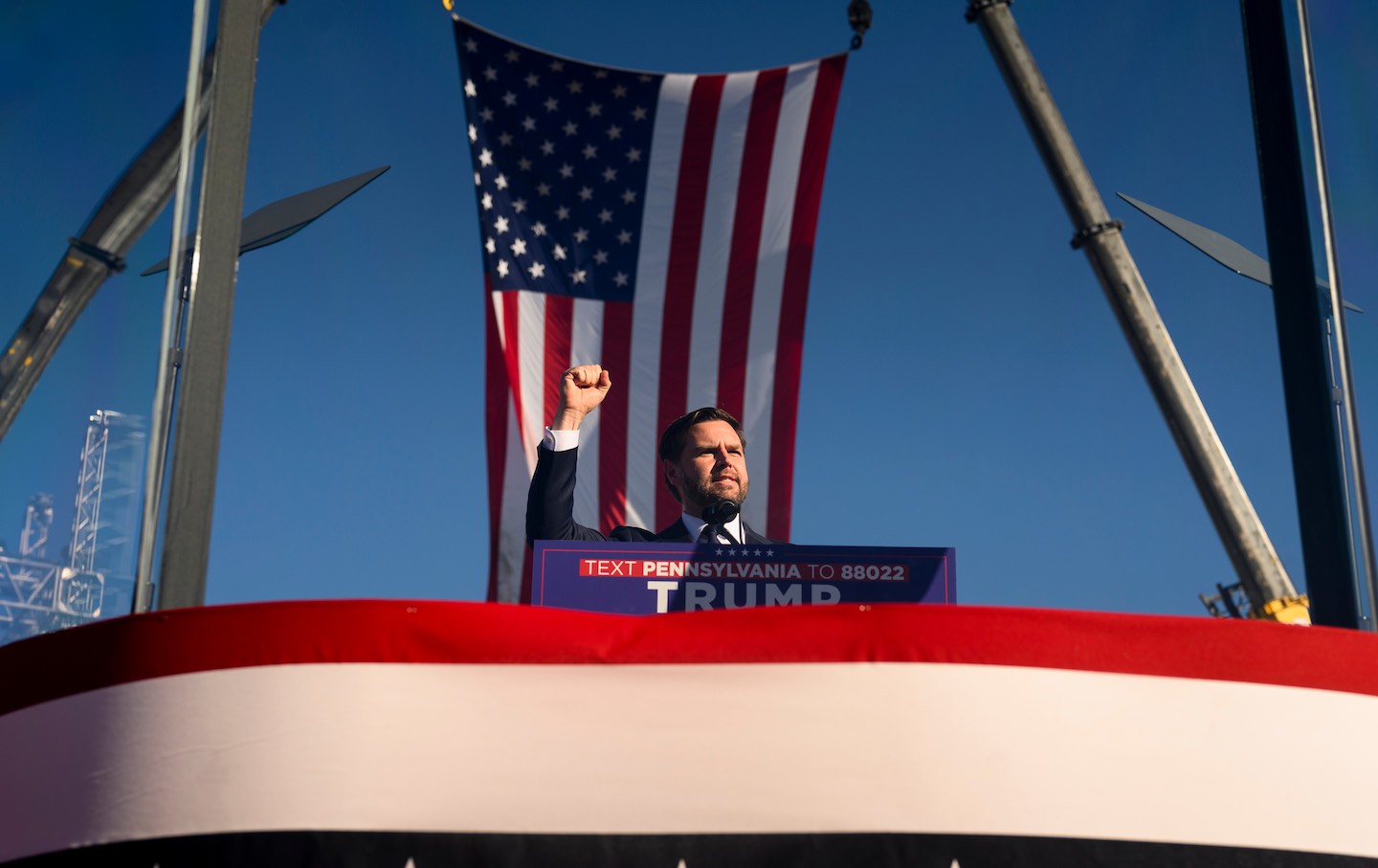
As the second Trump administration assumes power, most public attention remains focused on the president-elect’s cabinet selections—a grab-bag assortment of billionaires, Fox News personalities, conspiracy theorists, accused sexual assaulters, cronies, and toadies. Yet all through the eventful and unprecedented transition phase of Donald Trump’s restoration term, one key player has been notably quiet: Vice President–elect JD Vance. As speculation over the fate of various cabinet nominees waxed and waned, Vance was mostly confined to his pet hobby of social media posting—claiming, for instance, that Washington Post columnist Josh Rogin was overselling the collapse of the Assad regime in Syria, or hailing Daniel Penny’s exoneration for killing New York City subway passenger Jordan Neely with a choke hold.
Even though these kinds of talk-radio takes are an odd look for an incoming vice president, it would be a mistake to dismiss him as a troll without portfolio in the second Trump White House. Vance is poised to be the premier arbiter of policy and political discipline as his running mate seeks to avoid the missteps of his first term, and to wreak vengeance on his far-flung political, legal, and bureaucratic enemies. The selection of Vance was not a concession in the vein of Mike Pence or Joe Biden—a strategic ally chosen as a sop to a crucial wing in the governing coalition that helped secure the presidency. He is, rather, a Dick Cheney figure: a partner in government charged with defining and implementing much of the executive branch’s agenda and enforcing ideological conformity throughout the administration.
It’s true that, unlike Cheney, Vance isn’t a veteran Beltway insider—at 40, he’s the first millennial to serve on a presidential ticket, and he’s logged most of his adult working experience as a Silicon Valley venture capitalist rather than as a policy warrior in the burrows of the deep state. But his outsider standing is a credential he shares with many of the senior figures in this Trump White House, from Health and Human Services nominee Robert F. Kennedy Jr. to fellow Ohio finance bro Vivek Ramaswamy. What Vance brings to the job is a deep commitment to the ideological side of the MAGA movement and a nimble feel for effective popular messaging, shaped by both his Yale Law School training and his tour as a military journalist in the US Marines. No less an authority than Donald Trump Jr.—who aggressively lobbied his father to name Vance to the ticket—has tagged him as the MAGA movement’s heir apparent. “He’s a fighter,” the younger Trump announced at a Las Vegas rally toward the end of the campaign. “And, more importantly, what we have in JD is we now have an ‘America First’ bench—we have now people who can carry that torch, people unafraid to stand up to the tyranny of our government and fight.”
Vance himself gave a more accurate account of his intellectual disposition when he admitted in 2024 that he was “plugged into a lot of weird right-wing subcultures”—a gamut that runs from the “neoreactionary” former software engineer Curtis Yarvin to the excitable theocon Rod Dreher to the deep-state-baiting Claremont Institute, where Michael Anton—now nominated as Trump’s deputy secretary of state for policy—published the infamous “Flight 93” manifesto promoting Trump’s 2016 candidacy to true-believing right-wingers. The through line that connects this motley set of convictions is indeed what Trump Jr. flagged to the MAGA faithful: an “America First” ideology that combines a protectionist trade agenda with an oligarch-friendly posture of nonalignment in foreign policy.
Vance brings a movement intellectual’s rigor and passion for the policing of orthodoxy to this set of intuitive policy reflexes, and perhaps because he launched his pundit career as a principled Never Trumper, he now seizes every opportunity to underline his MAGA credentials with the zeal of a convert. He led off his Syria broadside against Rogin with the disclaimer that, “as President Trump said, this is not our fight, and we should stay out of it.” He also floated a framework to end the Russia-Ukraine War during the campaign—after famously telling Steve Bannon during his Senate run that “I don’t really care what happens to Ukraine, one way or the other”—which would consolidate Russian territorial gains while barring Ukraine from NATO membership. Like his fellow neoreactionaries, Vance has a fawning admiration for Hungary’s authoritarian President Viktor Orbán, which translates into a foreign policy driven by deference to strongmen abroad and a domestic agenda steeped in ethnonationalist privilege and patriarchy. Much of Vance’s obsessive natalist worldview—including his endorsement of the great replacement theory and his support for a national abortion ban—is undiluted Orbánism, as is his praise for Orbán’s ideological seizure of public universities as a brand of taxpayer empowerment.
Vance also telegraphed his Orbánist outlook in his GOP convention speech; in introducing himself to a national audience, he took issue with the traditional liberal veneration of America as an idea. Instead, he insisted, the United States is primarily “a nation…. But when we allow newcomers into our American family, we allow them on our terms…. Now that’s not just an idea. That’s not just a set of principles…. That is a homeland, that is our homeland. People will not fight for abstractions, but they will fight for their home.” This call to arms belies the lazy notion that the MAGA-branded resurgence of America First dogma is somehow a pacific creed; what JD Vance is fighting for, above all else, is the power to exclude Americans of dubious backgrounds and breeding habits from his new model Orbánist homeland. And thanks to Vance’s precipitous leap into maximum state power, that agenda will also serve as the guiding refrain of Donald Trump’s revenge-tour term in office.
Become a Sustaining Donor This September
Between the reemergence of right-wing red-baiting and Donald Trump’s use of the chilling National Security Presidential Memorandum–7 to criminalize left political organizing, we’re seeing McCarthyism reborn before our eyes.
This assault on democracy cannot be ignored or wished away. Resisting it requires bravery in the face of threats and repression, a steadfast commitment to the truth, and the unwavering belief that we can—and will—overcome this darkness.
We must have an independent media that sets the record straight, unearths corruption and abuses of power, and advances a politics of justice and dignity for all if we’re to win this fight.
That’s why I’m writing to you today. This September, The Nation needs to add 100 monthly donors to sustain our progressive journalism. Your contribution makes the next investigative report, the next truth-speaking column, and the next pathbreaking essay all possible.
I hope you’ll support our work with a recurring donation today. If you donate $10 or more a month, we’ll send you a brand new “Hands Off the Free Press!” sticker to recognise your commitment to our cause. Please, donate today.
Onward,
Katrina vanden Heuvel
Editor and Publisher, The Nation