
The Maine Lawsuit That Could Save Democracy From Big Money
A legal fight could restore the state’s power to set its own limits on contributions to super PACs and encourage public financing.
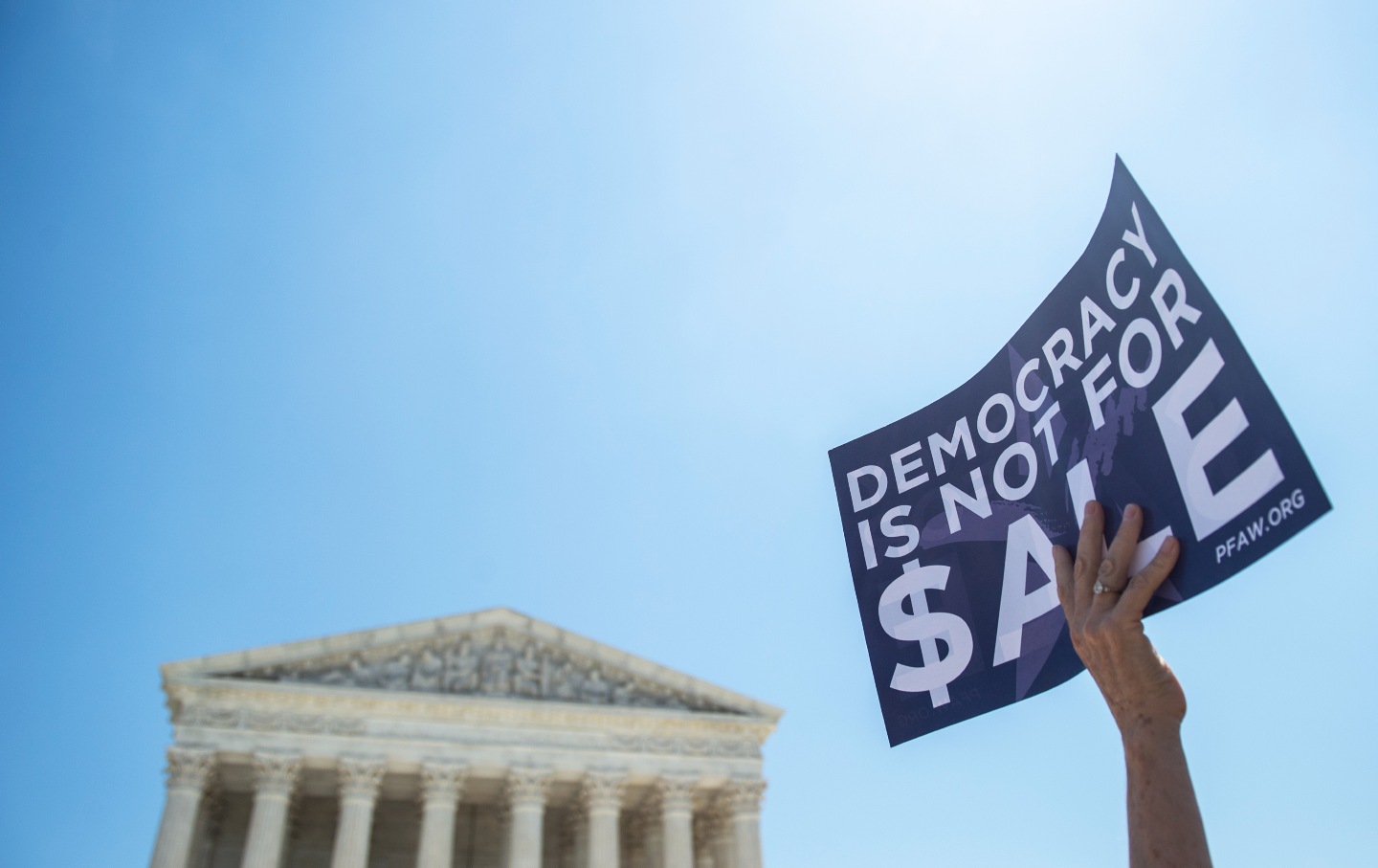
People gather outside of the Supreme Court Building to protest Citizens United in 2019.
(Caroline Brehman / Getty)
When voters in Maine passed a ballot measure last year to cap donations to super PACs—also known as independent political action committees—it appeared to be another milestone toward fairer elections. In a state known for election reforms such as public campaign financing and ranked-choice voting, the proposal looked like another way to successfully curb the flow of money from corporate and wealthy donors into local races.
Then came the lawsuit. In October, the US Court of Appeals for the First Circuit agreed to hear Dinner Table Action v. Schneider, a case that could decide the future of money in American politics.
Fifteen years after the Supreme Court opened the floodgates to dark money and unchecked spending with Citizens United, the Maine initiative has exposed a tension in the movement for clean elections: should advocates pursue state and local reforms, or bet on a high-stakes legal battle that could radically rewrite the rules of campaign finance nationwide?
In the summer of 2023, Maine residents began to think about how to place a question about limiting super PAC contributions on the ballot. Drawing on a legal theory developed by Harvard Law professor Lawrence Lessig, organizer Cara McCormick founded Citizens to End Super PACs, the ballot-question committee formed to lead the campaign.
McCormick, who pushed for Maine to adopt ranked-choice voting in 2016, crafted the initiative to cap donations at $5,000 based on efforts by Lessig’s nonprofit, Equal Citizens, which had pursued similar initiatives in Alaska and Massachusetts—both ultimately blocked in court.
“The Supreme Court has never addressed whether SuperPACs are constitutionally mandated,” McCormick wrote in January. “The people of Maine, by supporting this initiative, want to give the Court the chance to address the question—and finally, correct this awful mistake.”
On election day, voters agreed, with the measure receiving nearly 75 percent of the vote. But within a month, two political action committees sued to block the law. Backed by conservative groups, the Maine PACs argue that the cap infringes on their free speech.
Equal Citizens, led by Lessig and executive director Maia Cook, intervened in the case in February, filing a brief defending the law. “Our argument is not that we are trying to overturn Citizens United,” Cook explained. “We’re trying to raise a question about whether we can limit contributions to super PACs. That question goes back to this decision called SpeechNow v. FEC, which, although it’s treated as the law of the land, it is not.”
The 2010 ruling at the DC Circuit effectively gave birth to super PACs, holding that contributions “do not corrupt or create the appearance of quid pro quo corruption.” Lessig and Cook assert that this logic is fundamentally flawed and believe that their originalist argument could appeal to the Supreme Court’s conservative majority.
A successful case could restore states’ power to set their own limits on contributions to super PACs and amplify the role of public financing in elections. “If we level the playing field,” added Cook, “public financing can become an option—so regular people can run, and we’ll have a more representative government—not one run by rich people.”
But in Maine, the grassroots groups that built the state’s clean-elections system declined to endorse the super PACs measure. While local newspapers, including the Portland Press Herald, urged a “yes” vote, the group Democracy Maine, which includes Maine Citizens for Clean Elections (MCCE), the League of Women Voters of Maine, and Maine Students Vote, did not join the campaign.
“We wholeheartedly support the aspirations of this bill,” wrote Maine Citizens for Clean Elections in a statement before the election, “but we cannot fully endorse this ballot question.” The group warned that the measure could “open Pandora’s box,” and unintentionally allow the Supreme Court to roll back existing reforms.
That apprehension reflects years of legal defeats in a post–Citizens United landscape, where federal courts have repeatedly struck down state campaign finance reforms, including parts of Maine’s landmark clean-elections program.
MCCE was formed during the campaign for the 1996 Maine Clean Elections Act. “It’s always been this phrase that ‘as Maine goes, so goes the nation’ because back in the day, our elections were held in September,” said Jen Lancaster, MCCE’s communications director. “That independent spirit is what launched the effort in the mid-1990s.”
The initiative passed, establishing a first-in-the-nation program that allows gubernatorial and state legislative candidates to run entirely on public funds. But after the Supreme Court struck down matching funds in 2011, Maine was forced to repeal a key provision of its Clean Elections program. MCCE responded by gathering over 70,000 signatures to advance the 2015 citizen initiative, which restored and strengthened the program by creating new, legally compliant mechanisms to replace lost funds.
The group, which helped revitalize Maine’s Clean Elections program, took a more cautious stance toward Equal Citizens’ approach.
“The reason why we were neither for nor against is we did not believe in the legal strategy,” said Lancaster. “We thought the courts, especially in Maine, would not rule in our favor. It’s really hard to overturn Citizens United—national groups have been trying for 15 years, and we just did not see this as a reliable path forward.”
Maine Citizens for Clean Elections instead supports a constitutional amendment to overturn Citizens United, while pushing ahead with immediate state and local reforms. The nonprofit mobilizes its grassroots network to organize and testify for its legislative agenda, which this year prioritizes shoring up funding for the Clean Elections Program and increasing transparency in PAC spending—efforts the group sees as “defensible in the current court climate.”
After a federal judge blocked the law in July, Equal Citizens appealed to the First Circuit Court of Appeals, and last month, the court agreed to take up the case. As it’s the remaining circuit court that has not yet ruled on the issue of super PACs, a decision in Maine’s favor could bring it to the Supreme Court by next fall.
But for clean-elections groups, the work continues within the bounds of today’s legal landscape. Lancaster said MCCE’s primary challenge is keeping public financing viable as campaigns become more expensive. Heading into the 2026 governor’s race, not a single candidate has pledged to run on public funding—a sign, she notes, that the program needs renewed investment to be able to sustain competitive campaigns.
A recent poll found that 79 percent of Americans oppose the Supreme Court’s decision in Citizens United. Lancaster and Cook agree that the majority of Americans, across party lines, support reform. “The funny thing is that no one likes money in politics,” said Lancaster. “It’s truly a nonpartisan issue. Anyone can see, ‘Oh, you’re spending a lot of money in our elections. I don’t like that.’”
Popular
“swipe left below to view more authors”Swipe →“I think a lot of people might wrongly associate this as a fight that benefits one party over the other,” Cook said. “But the truth is, it’s disadvantaged both Republicans and Democrats, and created this arms race that people are just absolutely exhausted with.”
The Maine initiative exposes a central question for the clean-elections movement today: How do you deliver change when public opinion is on their side but the courts are not? What comes next at the First Circuit could shape the road ahead for clean-elections advocates across the nation—whether to keep reforming within a system restricted by these precedents, or to confront the legal structures that have fueled more than a decade of unchecked political spending.
“When I saw that 74.9 percent of Mainers voted in favor of this,” said Cook, “I saw that as public recognition that people are really tired with the political system born out of SpeechNow and Citizens United.”
Support independent journalism that does not fall in line
Even before February 28, the reasons for Donald Trump’s imploding approval rating were abundantly clear: untrammeled corruption and personal enrichment to the tune of billions of dollars during an affordability crisis, a foreign policy guided only by his own derelict sense of morality, and the deployment of a murderous campaign of occupation, detention, and deportation on American streets.
Now an undeclared, unauthorized, unpopular, and unconstitutional war of aggression against Iran has spread like wildfire through the region and into Europe. A new “forever war”—with an ever-increasing likelihood of American troops on the ground—may very well be upon us.
As we’ve seen over and over, this administration uses lies, misdirection, and attempts to flood the zone to justify its abuses of power at home and abroad. Just as Trump, Marco Rubio, and Pete Hegseth offer erratic and contradictory rationales for the attacks on Iran, the administration is also spreading the lie that the upcoming midterm elections are under threat from noncitizens on voter rolls. When these lies go unchecked, they become the basis for further authoritarian encroachment and war.
In these dark times, independent journalism is uniquely able to uncover the falsehoods that threaten our republic—and civilians around the world—and shine a bright light on the truth.
The Nation’s experienced team of writers, editors, and fact-checkers understands the scale of what we’re up against and the urgency with which we have to act. That’s why we’re publishing critical reporting and analysis of the war on Iran, ICE violence at home, new forms of voter suppression emerging in the courts, and much more.
But this journalism is possible only with your support.
This March, The Nation needs to raise $50,000 to ensure that we have the resources for reporting and analysis that sets the record straight and empowers people of conscience to organize. Will you donate today?
More from The Nation
Trump’s War in Iran Opens a Foreign Policy Debate Democrats Can No Longer Avoid Trump’s War in Iran Opens a Foreign Policy Debate Democrats Can No Longer Avoid
The war is forcing Democrats to confront a question they have long deferred: whether the party can offer a coherent anti-war alternative to Washington’s foreign policy consensus.

Disastrous Tides of Fortune Disastrous Tides of Fortune
The consequences of US actions on other nations.

Should Alexandria Ocasio-Cortez Run for President in 2028? Should Alexandria Ocasio-Cortez Run for President in 2028?
David Faris argues that the New York representative is the new national leader the Democrats need, but Daraka Larimore-Hall claims she can get more done in Congress.

Is AIPAC Doomed? Is AIPAC Doomed?
The hard-line pro-Israel lobby is facing more opposition than ever before. But fully defanging it won’t be easy.

A Trial by Fire for Tisch and Mamdani, New York’s Premier Odd Couple A Trial by Fire for Tisch and Mamdani, New York’s Premier Odd Couple
How this weekend’s failed attack outside Gracie Mansion could reinforce the strange-bedfellows alliance between the mayor and the police commissioner.
Anthropic’s Lawsuit Should Absolutely Destroy the Pentagon in Court Anthropic’s Lawsuit Should Absolutely Destroy the Pentagon in Court
But make no mistake: The company is not one of the good guys.

