
Establishment Democrats Tried to Derail Katie Wilson’s Campaign—and Failed
The precariat rose up, with passion, desire for change, and votes.
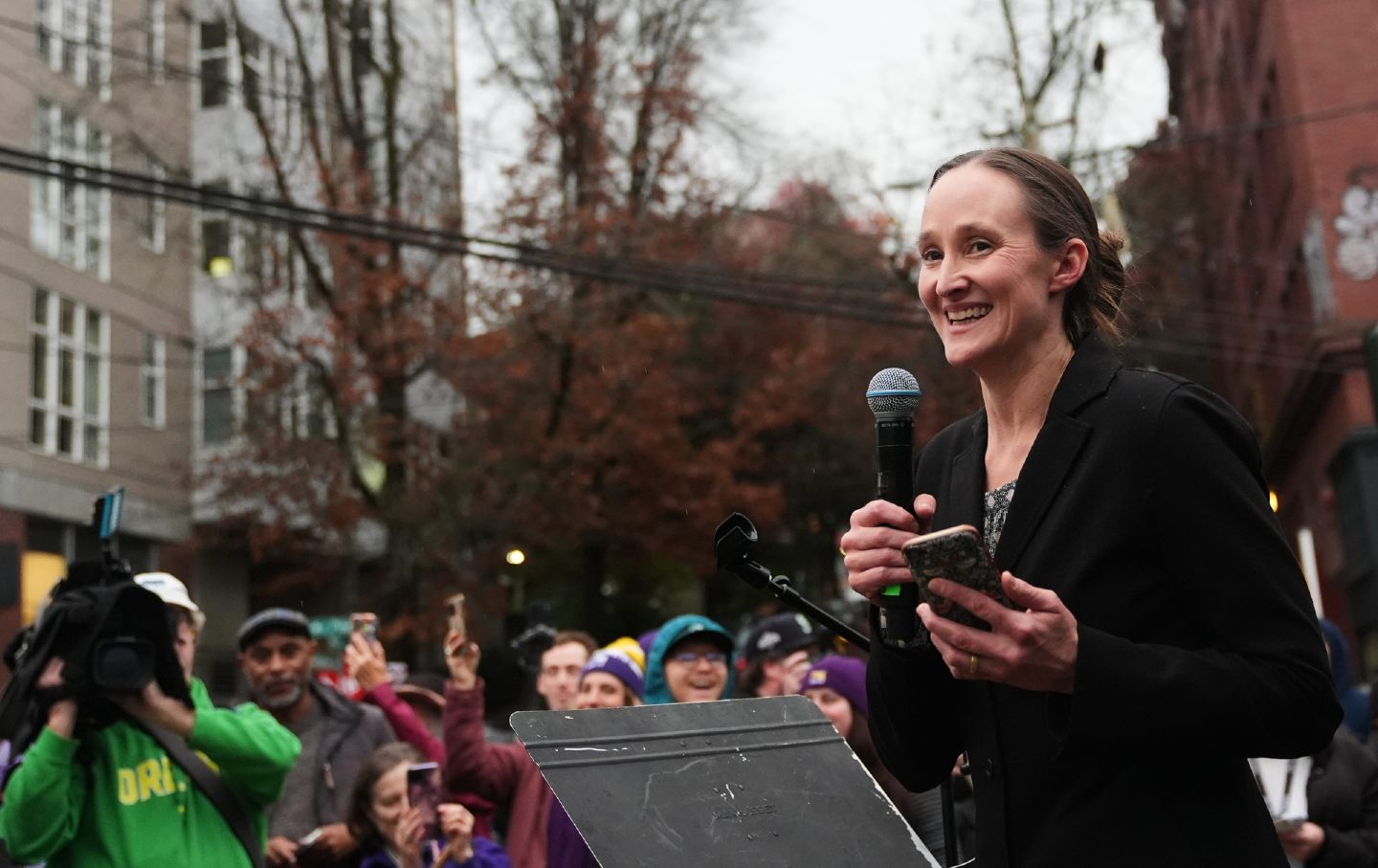
After a nail-biter contest that dragged out a week after election day, Katie Wilson is set to be Seattle’s next mayor. Wilson, a small-S socialist, built her campaign on progressive populism, and won the support of Gen Z and millennial voters—voters who graduated with massive college debt, who have navigated a dire job market and an even worse scramble for housing, who don’t know how they can afford to pay for childcare on top of their student loans, who know what it’s like to buy business attire at Goodwill, and who had little interest in retaining Seattle’s business-backed incumbent mayor, Bruce Harrell.
Nine months ago, Katie Wilson wasn’t even considering a run for any elected office. Harrell had sewed up endorsements from labor, business, mainstream Democrats including Governor Bob Ferguson, and progressive Democrats, including Pramila Jayapal. There was no alternative to Harrell, who at best was a transactional politician with bows to progressive initiatives when it was convenient.
But it was a progressive initiative opposed by Harrell, at the behest of the Seattle Chamber of Commerce, Amazon, and Microsoft, which set the stage for Katie’s entry and Harrell’s defeat. This initiative created an excess compensation tax on corporations to fund social, economically integrated, and affordable housing across Seattle. Harrell’s face was plastered on every piece of campaign literature opposing the initiative. After all the votes were counted, the initiative passed with a 26 percent margin.
The door opened up, and Katie walked in. She had just come in from another of her successful minimum wage campaigns in the Seattle suburbs, this one winning with 58 percent yes vote. Over the previous 15 years, Katie led the efforts for employer-sponsored free bus passes, free busing for kids, and subsidized busing for disabled people. Wilson thought up and then led the Trump-Proof Seattle campaign immediately after the first Trump election, which resulted in unanimous city council support for an income tax in Seattle (including a yea vote from Bruce Harrell). She cajoled the city council to enact a progressive payroll expense tax on the city’s largest businesses.
This may seem like a narrative about a progressive policy wonk. It is. But that is not enough to win. Katie also touched the lives and hearts of Seattle voters, especially the precariat, with her grassroots work. Voters were drawn to Wilson not for her polish or charisma, but for the opposite: her authenticity, her care, her sharp policy mind, and even her awkwardness. This is what made her such an appealing candidate, and it’s also why, when establishment Democrats launched attacks on her candidacy, they failed.
But they certainly tried: After Wilson won handily in the August primary, the Harrell campaign went negative, pushing the narrative that Wilson was an inexperienced outsider unfit for public office. In an election when voters wanted to see progressive change, this was the only thing that seemed to stick, but not enough. Indeed, many voters had enough of politicians with experience.
Harrell also shifted left after the primary, proposing to exempt small and medium-sized businesses from Seattle’s gross receipts tax and increasing this tax for companies with revenue exceeding $10 million. This was the ultimate transactional candidate, following the voters for their votes, not their hearts.
The Harrell campaign opined that Wilson’s parents had helped her pay for her child’s daycare. For millennials, this only made Wilson’s appeal more obvious. There was no need for the Harrell campaign to tell them that Wilson quite relatably needs help paying for childcare, which is too expensive for everyone, and that she might actually have cause to do something about it at city hall.
True to the Pacific Northwest’s slow, process-based politics, the procrastination of voting by millennials, and our robust mail-in voting system, Wilson’s win wasn’t a done deal last Tuesday. Initially, Harrell took the lead, suggesting that his attack ads had pulled some support from the more centrist voters who typically cast their votes earliest in Seattle elections.
But as the late ballot drops arrived over the days that followed, ballots counted exceeded 55 percent of registered voters (compare this to 42 percent in the NYC mayor’s election). Wilson’s share of the vote grew. It became clear on Tuesday that Seattle’s young people, marching to the ballot box, had risen up and voted.
Wilson’s win was one of many for progressive candidates in Seattle, where voters ousted the conservative city attorney with two-thirds vote of support for Erika Evans, the granddaughter of Black Power leader and Olympian medalist Lee Evans. They replaced the city council president, who had tried to roll back the minimum wage, with a progressive opponent, Dionne Foster. And the youngest and most progressive current city council member, Alexis Rinck, was reelected with over 80 percent of the vote.
In fact, progressive Democrats handily beat business Democrats in every special state legislative election in Washington. In Tacoma, Washington’s second-largest city, the progressive who ran on a platform of affordable housing, childcare, and utilities won the mayor’s office by 14 percent against a business Democrat. Progressives swept the slate for the city council in Burien. Its current mayor, who tried to prevent Burien’s minimum-wage initiative from taking effect, lost his race for the state legislature.
When Mamdani carried New York, the media asked if he was the new face of the Democratic Party. The same question is asked here in Washington State. The Democrats are going to need to a big tent to beat back fascism. With leaders like Mamdani and Katie Wilson they will build that tent, winning younger voters to the Democrats and passing universal social democratic policy into law. That’s how we can return to power.
More from The Nation
Jesse Jackson Reshaped the Democratic Party Jesse Jackson Reshaped the Democratic Party
The candidate may have started as a long-shot contender, but The Nation always took him—and his impact on political history—seriously.
The State of the Game Show The State of the Game Show
In this week’s Elie v. US, our justice correspondent explores how Trump’s State of the Union turned authoritarian violence into a titillating event. Plus Kansas’s vile ban on driv...


Cuba’s Oil Crisis Cuba’s Oil Crisis
Much of Cuba goes dark as a US oil blockade chokes the island’s energy supply. Major carriers have halted services now that aviation fuel is no longer available at nine internation...
For 108 Minutes, Trump Gave a Tedious Mussolini Impersonation For 108 Minutes, Trump Gave a Tedious Mussolini Impersonation
It was most mendacious State of the Union in US history. It was also the longest.
Clarence Thomas Just Struck Another Blow to Black Power Clarence Thomas Just Struck Another Blow to Black Power
In his majority ruling in a sleeper case about mail delivery, Thomas opened the door to a new way for Republicans to suppress the Black vote.

