
These 3 States Could Use Millions in Public School Funding for Private Schools
In Colorado, Kentucky, and Nebraska, referendums on “school choice” are on the ballot in the 2024 election.
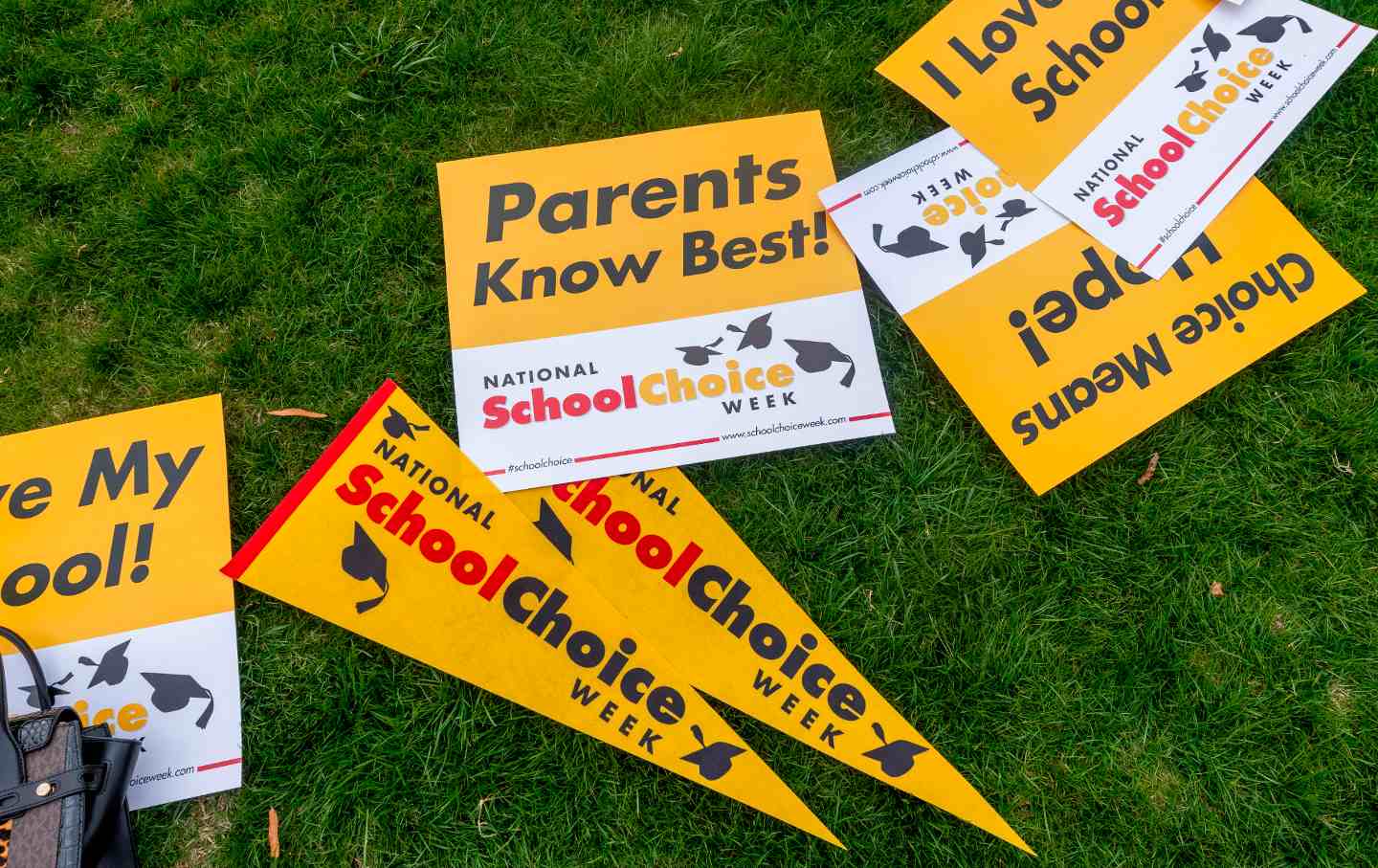
Signs lie in the grass during a rally celebrating National School Choice Week.
(Travis Long / Getty)
Ballot referendums on “school choice” in Colorado, Kentucky, and Nebraska will decide whether billions of dollars of public funding should be used to subsidize private-school education.
Campaigns around “school choice”—or the ability for parents to use funding originally allocated for their child’s public education for a private school instead—have attracted millions in political donations during the 2024 election cycle. While proponents argue that it gives them greater control over their child’s education, school choice can divert funding away from public schools and opens the door to using taxpayer money to fund private, religious education.
Such measures have been previously implemented in numerous other states through the establishment of education savings accounts, tax credits, and school vouchers. As of September, 29 states have at least one of these programs. In states with universal private school choice, more than $4 billion was spent on these programs, and $57.7 billion on public schools, according to FutureEd. The vast majority of these programs, a study found, exceeded their initial budget. And they’re growing.
The National Education Association, the largest labor union for educators in the United States, has been among the most fervent groups in opposition to the measures, pouring millions of dollars into campaigns opposing school choice ballot referendums.
“Every student needs well-resourced neighborhood public schools that allow them to thrive in an interdependent world and live into their brilliance,” NEA president Becky Pringle told The Nation. “Instead of spending taxpayer dollars on private schools, we should focus on funding our public schools, where 90 percent of our students attend.” Funding private schools is not what the people in these states want, she continued. “We are confident that voters will reject vouchers at the ballot box this November.”
In Kentucky, voters will decide whether to add an amendment to their state Constitution that would allow the legislature to “provide financial support for the education of students outside the system of common schools.” Originally introduced in the state legislature, the bill to add the amendment passed with overwhelming support: 65–12 in the House and 27–2 in the Senate.
State Representative Susanne Miles, who helped spearhead the amendment, told The Nation that “we are committed to continuing our support of public education, but know that there are far too many children left behind in the current system. If passed, this amendment would give us all more latitude to look at what’s working in other states, and help us ensure that every Kentucky child has the opportunity to reach his or her potential.” Kentucky’s Board of Education unanimously passed a resolution opposing the bill and reaffirming its support for using tax dollars exclusively to fund public education.
Charter schools are currently legal in Kentucky, but cannot be funded with tax dollars. This amendment could fundamentally change the model of education funding in the state, and allow parents to use public funds to support their child’s religious education.
In a statement to The Nation, the chair of the Kentucky Democrats said the “voucher scheme would be most destructive to our Commonwealth’s rural communities, which includes 75 counties that lack private schools, and could cost Kentucky taxpayers $1.2 billion each year.” The Kentucky GOP chair did not respond to a request for comment.
In Nebraska, voters will decide whether to repeal a state law known as LB1402, which authorizes $10 million annually in education scholarships to cover attendance costs for students at accredited private institutions. Support our Schools Nebraska put Referendum 435 on the ballot. “Nebraskans cannot afford to pay for two school systems,” Jenni Benson, the president of the organization, told The Nation.
Among the supporters of repeal are the Nebraska Democratic Party and the League of Women Voters of Nebraska, with their cause raising over $3.2 million in donations. In opposition are the Nebraska Family Alliance and the Omaha Catholic School Consortium. State Senator Lou Ann Linehan introduced the bill in question last year, passing it on a Senate vote of 32-14.
“Every child deserves an opportunity to attend the school that best fits his or her needs,” Linehan told The Nation. She said that approximately 2,000 students have applied for and are already receiving funding under her law. “I do not believe Nebraskans will take scholarships away from students,” she said.
Colorado will also vote on a new constitutional amendment, but the ballot measure’s vague phrasing has so far confused voters. The measure, as printed on the ballot, reads that “each K-12 child has the right to school choice” and defines school choice as “neighborhood, charter, private, and home schools, open enrollment options, and future innovations in education.”
Under current law, “students may attend any public school for free, even if they do not live in the school district,” but no public funding is spent on private schools or homeschooling. Although the ratification of the amendment would not immediately implement a school choice program, it would pave the way to doing so in the future.
Popular
“swipe left below to view more authors”Swipe →A Colorado-based group—Catholic Education Partners—supports the school choice amendment, with president Shawn Peterson calling school choice the “fundamental right of the parents, whom God in His Providence explicitly chooses for each child as the fruit of their love,” adding that it is an “amazing opportunity that will be and what a gift to all parents and children for generations to come.”
Colorado Democratic Party chair Shad Murib said that “school choice is something Coloradans already enjoy for their children, and this initiative is meant to sneakily open the door to taxpayers’ footing the bill for private institutions.”
“They know how unpopular that is when the truth is told, which is why they’re misleading voters with lies and no disclaimer on who is paying for it,” he said. “This is shameful politics at its worst, and should make every Coloradan question the motives of the proponents.”
Read the rest of StudentNation’s dispatches on the 2024 election here.
Support independent journalism that does not fall in line
Even before February 28, the reasons for Donald Trump’s imploding approval rating were abundantly clear: untrammeled corruption and personal enrichment to the tune of billions of dollars during an affordability crisis, a foreign policy guided only by his own derelict sense of morality, and the deployment of a murderous campaign of occupation, detention, and deportation on American streets.
Now an undeclared, unauthorized, unpopular, and unconstitutional war of aggression against Iran has spread like wildfire through the region and into Europe. A new “forever war”—with an ever-increasing likelihood of American troops on the ground—may very well be upon us.
As we’ve seen over and over, this administration uses lies, misdirection, and attempts to flood the zone to justify its abuses of power at home and abroad. Just as Trump, Marco Rubio, and Pete Hegseth offer erratic and contradictory rationales for the attacks on Iran, the administration is also spreading the lie that the upcoming midterm elections are under threat from noncitizens on voter rolls. When these lies go unchecked, they become the basis for further authoritarian encroachment and war.
In these dark times, independent journalism is uniquely able to uncover the falsehoods that threaten our republic—and civilians around the world—and shine a bright light on the truth.
The Nation’s experienced team of writers, editors, and fact-checkers understands the scale of what we’re up against and the urgency with which we have to act. That’s why we’re publishing critical reporting and analysis of the war on Iran, ICE violence at home, new forms of voter suppression emerging in the courts, and much more.
But this journalism is possible only with your support.
This March, The Nation needs to raise $50,000 to ensure that we have the resources for reporting and analysis that sets the record straight and empowers people of conscience to organize. Will you donate today?
More from The Nation
Celebrate Kristi Noem’s Firing. But Keep Protesting ICE. Celebrate Kristi Noem’s Firing. But Keep Protesting ICE.
Finally, someone in the administration is paying for their cruelty and incompetence.
We Don’t Need an Autopsy to Tell Us the Democrats Failed on Gaza We Don’t Need an Autopsy to Tell Us the Democrats Failed on Gaza
The DNC is allegedly hiding a report showing that Kamala Harris’s Gaza policy helped cost her the 2024 election. But that report won’t tell us anything we don’t already know.
Texas’s Senate Primary Has Already Made History—and It’s Not Over Yet Texas’s Senate Primary Has Already Made History—and It’s Not Over Yet
Democratic nominee James Talarico is getting national media attention, but the real story is sky-high voter turnout, even amid GOP bids to suppress balloting
Quilted Messages Quilted Messages
Sunbonnets carrying not-so-sunny truths.
How the Theatrics of Mamdani’s Trump Meeting Backfired How the Theatrics of Mamdani’s Trump Meeting Backfired
By pandering to the president’s vanity, the New York mayor reinforced Trump’s image as a strongman commanding deference—an especially bad look on the eve of Trump’s war with Iran
Students in New York Are Going Hungry. How Can Mamdani Help? Students in New York Are Going Hungry. How Can Mamdani Help?
With plans for city-owned grocery stores and a focus on affordability, the new mayoral administration offers fresh hopes of successfully confronting the food crisis among students...

