Even in Oregon, the Fight for Marriage Equality Might Not Be Over
After the state’s ban on gay marriage was lifted in 2014, advocates took a breath. But more than a decade later, with Obergefell now at risk, there’s still more work to be done.
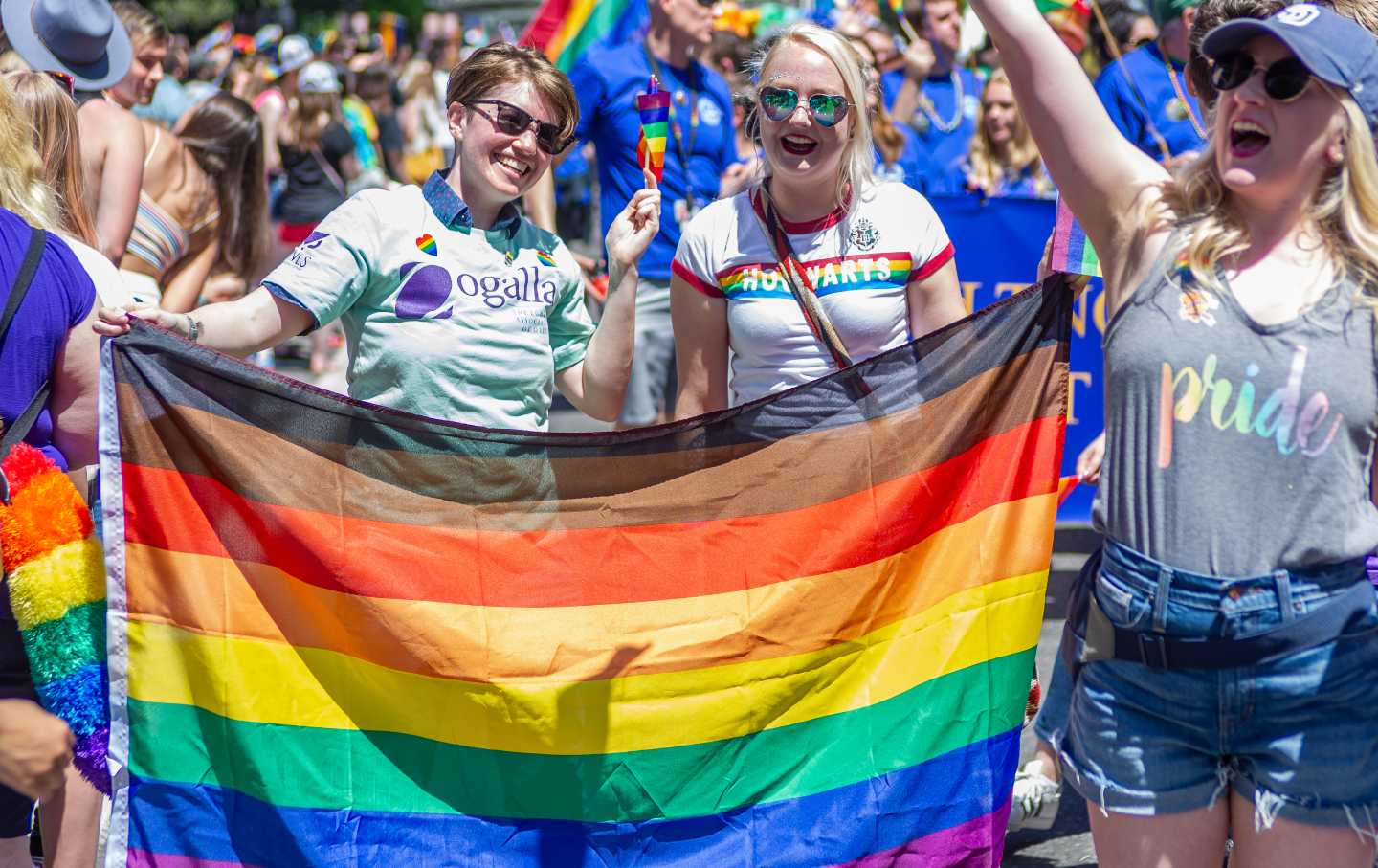
The Portland Pride Parade and Festival in June 2019.
(Diego Diaz / Getty)
In 2014, one year before Obergefell v. Hodges, a US district court decision in Geiger v. Kitzhaber finally lifted the ban on gay marriage in Oregon. Advocates had been gathering signatures for a statewide ballot measure, but dropped the campaign as county officials began issuing marriage licenses to same-sex couples. “We are confident that the freedom to marry is secure in Oregon and that we do not need to move forward with the ballot measure,” said Oregon United for Marriage after the ruling. “It is time to celebrate this victory.”
The advocates who had worked tirelessly on the issue took a breath. Marriage equality was finally protected across Oregon—or so they thought.
More than a decade later, in light of a federal frenzy of budget cuts and worrying Supreme Court rulings, advocates fear what might come next, including the prospect that Obergefell could soon be overturned. Although the Geiger decision allowed gay marriage in the state, the Oregon constitution still maintains that “only a marriage between one man and one woman shall be valid or legally recognized as a marriage” in Article 15 Section 5A.
“Now we’re seeing there’s more work to be done,” said Gaby Gardiner of Basic Rights Oregon. “The fight isn’t over. We still have marriage defined as a man and our women in [the state] Constitution.”
The statewide “Equal Rights for All” campaign aims to amend the nondiscrimination clause in the Oregon constitution with more inclusive, specific language, ensuring reproductive access, gender-affirming care, and marriage equality. “It’s not entirely clear what would happen with marriage equality in Oregon if [Obergefell] were overturned,” said Blair Stenvick, communications manager at Basic Rights Oregon. “But we do know that marriage equality here would be at risk, and the question would likely have to be figured out in the courts. Our amendment would provide clarity.”
Since a ballot measure must be submitted as one issue, the through line for these topics is equal rights. “Until our rights to personal freedom and bodily autonomy are protected in the Oregon constitution,” the campaign writes on its website, “we are always just one election or one bad US Supreme Court decision away from losing the right to abortion, gender-affirming care, and marriage equality in Oregon.”
To get onto the November 2026 ballot, the initiative—introduced by Basic Rights Oregon, the American Civil Liberties Union, and Planned Parenthood—needs around 156,000 signatures from voters by summer 2026. (As a precaution, the campaign is aiming for more than 200,000.) So far, according to Gardiner, 40,000 signatures have been gathered as dozens of organizations across Oregon have endorsed the campaign. “We’re feeling really good about where we’re at, especially because those [signatures] were all collected by volunteers,” said Stenvick.
The campaign has served as both a legal and symbolic statement for the many queer people who live in Portland, often seeking refuge from social persecution. “A lot of people come [to Portland] from other states, because it’s a little bit more open here,” said Haydyn Davila, an organizing intern for Basic Rights Oregon. But the Equal Rights for All campaign takes a broader approach than just marriage equality. “The marriage campaign was very singularly focused on some members of our communities and not all members,” Gardiner said. “We’re not one-dimensional. There’s a wide scope of intersectionality within our communities, of folks who are immigrants, who are transgender, who have disabilities. Giving everyone their right to personal autonomy and choice is really important.”
At first, after the overturning of Roe v. Wade, the group tried to get the “Equal Rights for All” amendment passed through legislative referral. In 2023, Senate majority leader Kate Lieber introduced the amendment to the Constitution under the same premise of protecting same-sex marriage, abortion, and gender-affirming care. “We really thought that, at the time, we had a slam-dunk issue,” Gardiner said. The amendment made it through the initial Committee on Rules voting, but ultimately died to end a six-week Republican walkout over measures surrounding abortion, gender-affirming care, and gun regulation.
Instead, Basic Rights Oregon, the ACLU, and Planned Parenthood collaboratively took the measure straight to the constituents, announcing the campaign as a proposed ballot measure in June 2024. “What we want to do is have a campaign that builds momentum,” said Gardiner, “to get people to understand the importance of bodily autonomy and right to privacy.”
Since then, signature collection materialized and has created a grassroots network of volunteers across the state—from Portland Pride events and No Kings demonstrations to small-town fairs—including Olivia Han, a 16-year-old high school student, who has been collecting signatures at her local farmers market in addition to her schoolwork. Although advocacy organizations in Portland have no shortage of work—especially with Trump’s threat to deploy the National Guard—the campaign continues to be a central focus. “It’s true, tangible change,” Han said. “It’s really pushing for the rights and for the equality of all people.”