
The Redistricting Proposal That Could Transform Ohio Politics
Ohio is considered one of the most gerrymandered states in the country, but Issue 1 could be the way to fix it.
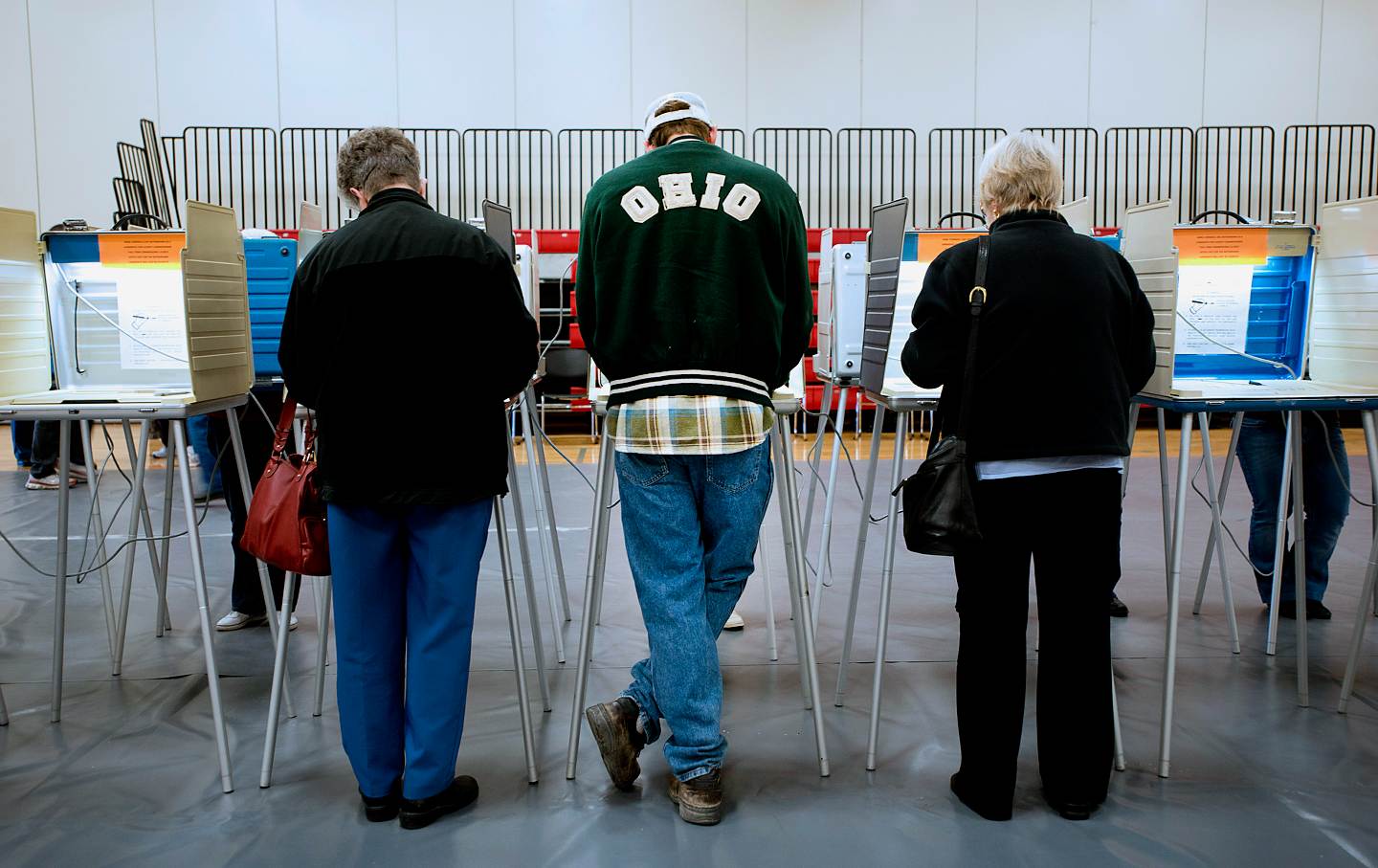
Voters casting their ballots at the Alexander High School polling location in Albany, Ohio.
(Ty Wright / Getty)
A proposed constitutional amendment on Ohio’s 2024 ballot would permanently change how congressional districts in the state are drawn.
The proposal, titled Issue 1, would create a 15-member Citizens Redistricting Commission—made up of Democrats, Republicans, and independents—to draw district maps. Current and former politicians, political party officials, and lobbyists would be banned from sitting on the commission, and attempts to draw districts in a way that favor one political party or lawmaker would be made unconstitutional.
“Ohioans have lived with partisan gerrymandering for more than 80 years,” said the Rev. Terry Williams, an ordained minister and an organizer with Faith Choice Ohio, a religious advocacy group that advocates for abortion rights. “Both parties have gerrymandered our state at different times in different ways, and each time gerrymandered maps are drawn, one thing always happens: Our politicians become less accountable to the people they are supposed to serve.”
Members of the current Redistricting Commission are appointed by the governor, the secretary of state, and the auditor, along with the majority and minority leaders in the statehouse. Of those, only two are Democrats.
Comparatively, Issue 1 would require an open application process for membership of the commission. A screening panel of two Republican and two Democratic retired judges—each chosen by the legislative members of the Ohio Ballot Board—would review and select applicants.
While there is currently no polling on what Ohio voters think of Issue 1, other proposals have shown that those in the state skew more liberal when voting on ballot initiatives. For example, polling from Baldwin Wallace University shows that 58 percent of voters favored enshrining abortion rights in the state Constitution, and 57 percent supported legalizing recreational marijuana. In Ohio, amendments need only a simple majority to pass, or just over 50 percent of voters.
Ohio is considered one of the “most gerrymandered states” in the country, along with Texas, Louisiana, and Arkansas. Research from the Brennan Center found that 9 million Ohioans—around 77 percent of the state’s population—live in districts where the election for state representative lacks electoral competition. Of those, half featured no primary contest. Redistricting maps drawn by the Ohio Redistricting Commission have been declared unconstitutional—and rejected—by the state Supreme Court on several occasions.
Issue 1 was submitted to the secretary of state’s office with over 700,000 signatures—almost 60 percent more than required to get on the state ballot—after receiving support from Citizens Not Politicians, the American Civil Liberties Union, the League of Women voters, and labor organizations like AFSCME and the SEIU.
Reverend Williams specifically highlighted anti-abortion measures as an example of disregard for voters by Ohio’s political leaders. “At Faith Choice Ohio, we know Ohioans don’t support abortion bans, needless restrictions on abortion providers, and laws that make the lives of abortion seekers harder.” If Issue 1 is approved, the reverend and his colleagues “hope to see an Ohio where the legislature stops bullying abortion seekers and starts supporting them,” he said. “We believe fairness matters & gerrymandering is unholy.”
The Ohio GOP, which controls the statehouse, the state Supreme Court, and the governor’s office, opposes the amendment. In March, the press secretary of the Ohio Senate Majority Caucus called it an “exceedingly complex, harebrained, and radical scheme” that would “install a citizen’s commission to replace your elected representative.” Governor Mike DeWine claimed that the proposal would actually make gerrymandering worse. “If this amendment were to be adopted, Ohio would actually end up with a system that mandates—that compels—map drawers to produce gerrymandered districts.”
The proposed ballot language for Issue 1—crafted by Republican Secretary of State Frank LaRose and approved by the Ohio Ballot Board—outraged Citizens Not Politicians, arguing that the language painted the amendment in a negative light. The amendment, according to this language, would “create an appointed redistricting commission not elected by or subject to removal by the voters of the state,” “repeal constitutional protections against gerrymandering approved by nearly three quarters of Ohio electors,” and “establish a new taxpayer-funded commission of appointees required to gerrymander the boundaries of state legislative and congressional districts.”
“The language was, in my opinion, the argument for why you should not vote for it,” Democratic state Senator Paula Hicks-Hudson, a member of the Ohio Ballot Board, told The Nation. “The language did not meet the constitutional standard.” Hicks-Hudson and fellow Democratic board member House Representative Terrence Upchurch voted against the language, and eventually submitted a brief to the Ohio Supreme Court renouncing it. “We received the language the day of the meeting,” Senator Hicks-Hudson said, adding that “there was no give and take,” between her, Upchurch, and the majority-Republican members of the board. “The ballot board is just one victim of the gerrymandering in the state of Ohio.”
Despite these concerns, the Ohio Supreme Court approved the language with only minor revisions. “I don’t agree with their decision,” said Senator Hicks-Hudson, but she ultimately hopes “that the people who believe Citizens Not Politicians is a good thing for this state will go out and educate themselves, as well as others, about the value of a new way of drawing these maps.”
As Republicans pass bills restricting abortion and gender-affirming care, many in Ohio see Issue 1 as the only way to combat the state’s increasing turn toward extremism. “The extreme politics being brought to the statehouse are a direct result of gerrymandering,” said CJ Wilson, a 22-year-old regional organizer with Common Cause Ohio. “If you’re not worrying about losing in the election anymore, you can kind of do whatever you want.”
Wilson also discussed gerrymandering in places like New York, and other liberal states, believing the practice to be inappropriate across the board. “It disenfranchises voters, especially minority voters,” Wilson explained, calling it an issue across the country. “This is a bipartisan problem, depending on the state, and this is a bipartisan solution,” said Wilson on Issue 1. “This is the only sure way to keep politicians in check.”
“I was very young when this was the case, but Ohio used to be a swing state,” said Wilson. “Nowadays, it’s one of the reddest.” For Wilson, voting for Issue 1 is a great chance to get your voice heard in 2024 and beyond. “Even if you don’t want to vote for a single politician,” Wilson said. “The time to get out and vote is now.”
Popular
“swipe left below to view more authors”Swipe →More from The Nation

We Don’t Need an Autopsy to Tell Us the Democrats Failed on Gaza We Don’t Need an Autopsy to Tell Us the Democrats Failed on Gaza
The DNC is allegedly hiding a report showing that Kamala Harris’s Gaza policy helped cost her the 2024 election. But that report won’t tell us anything we don’t already know.

Texas’s Senate Primary Has Already Made History—and It’s Not Over Yet Texas’s Senate Primary Has Already Made History—and It’s Not Over Yet
Democratic nominee James Talarico is getting national media attention, but the real story is sky-high voter turnout, even amid GOP bids to suppress balloting
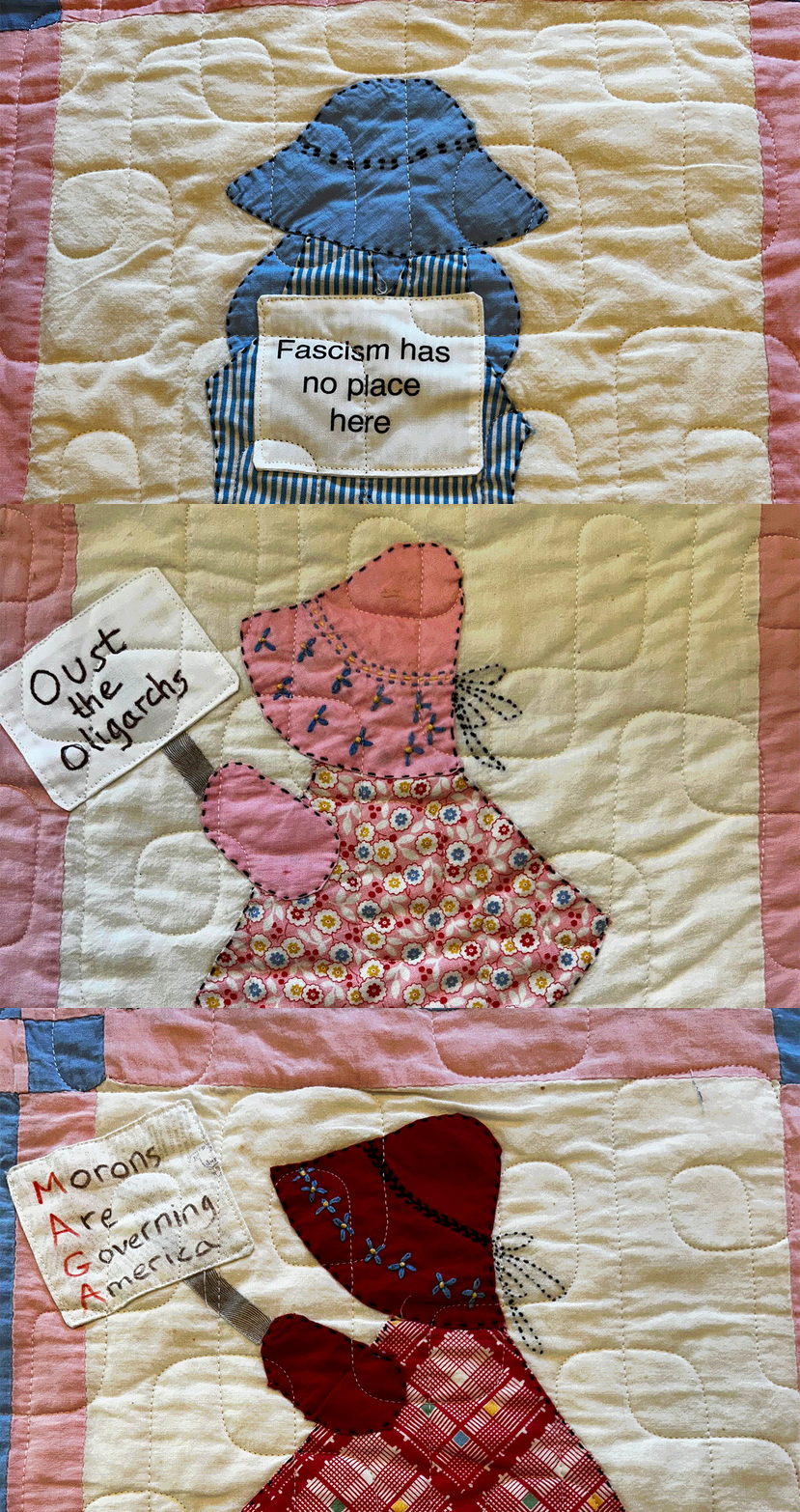
Quilted Messages Quilted Messages
Sunbonnets carrying not-so-sunny truths.
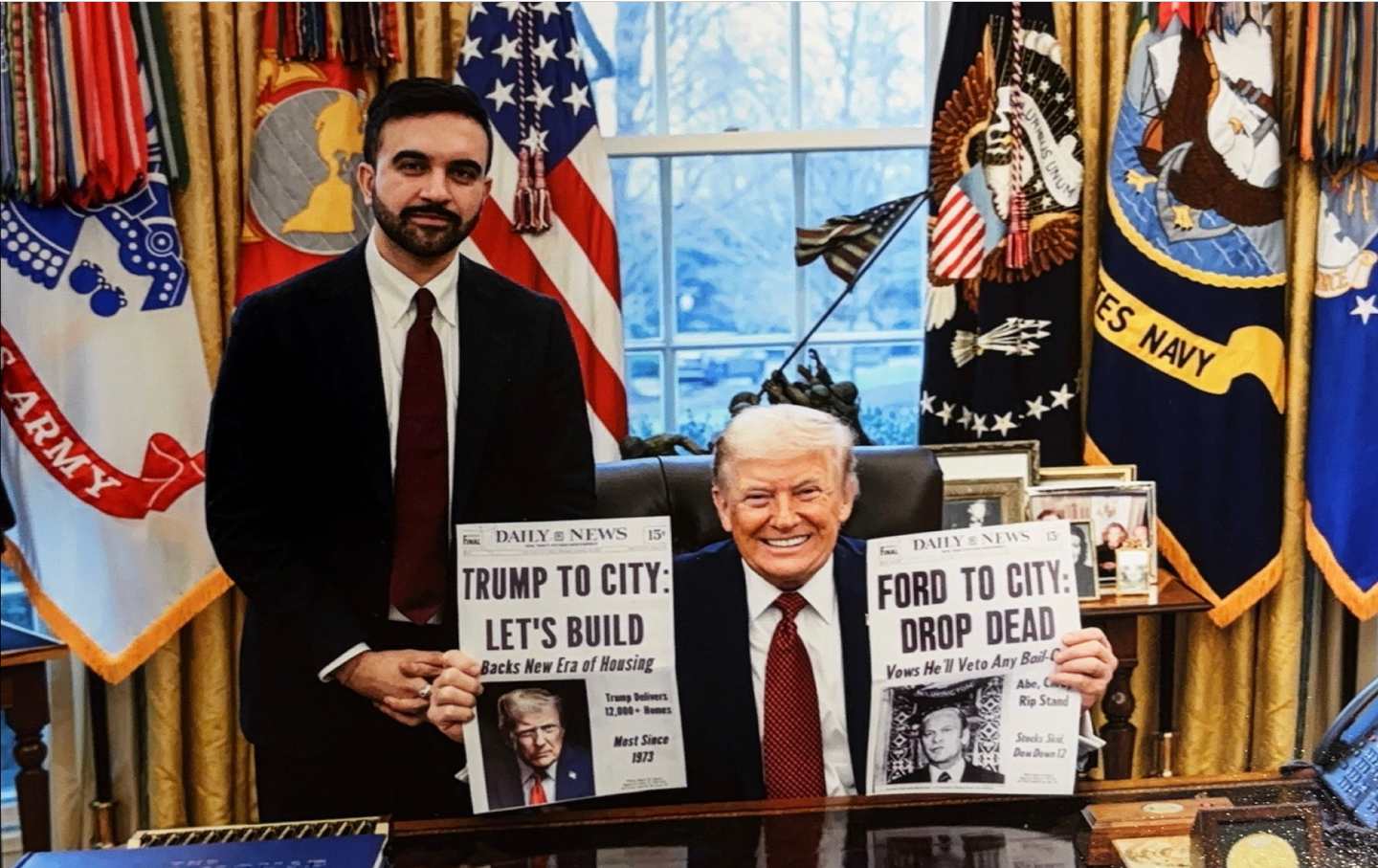
How the Theatrics of Mamdani’s Trump Meeting Backfired How the Theatrics of Mamdani’s Trump Meeting Backfired
By pandering to the president’s vanity, the New York mayor reinforced Trump’s image as a strongman commanding deference—an especially bad look on the eve of Trump’s war with Iran

Students in New York Are Going Hungry. How Can Mamdani Help? Students in New York Are Going Hungry. How Can Mamdani Help?
With plans for city-owned grocery stores and a focus on affordability, the new mayoral administration offers fresh hopes of successfully confronting the food crisis among students...

We Are the Fire That Melts the ICE We Are the Fire That Melts the ICE
Oaxaca, Mexico, street art.

