
The New “Lavender Scare” in America’s Schools
Modern anti-gay legislation mirrors the mass hysteria of the Lavender Scare, when thousands of gay people were fired or forced to resign from their jobs.
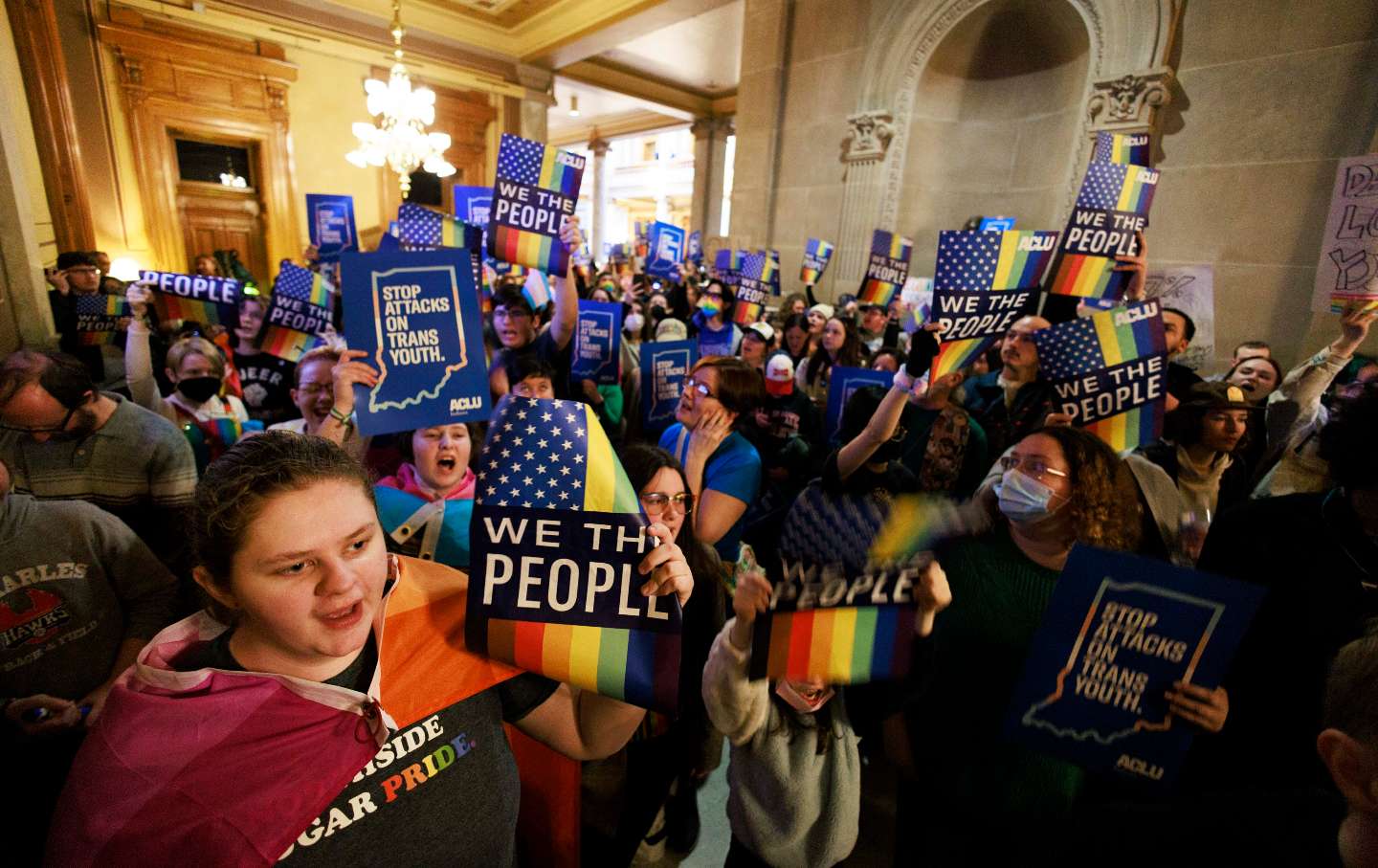
Protesters outside the Indiana House of Representatives during the education committee’s hearing on HB 1608, also known as the “Don’t Say Gay” bill, in Indianapolis.
(Jeremy Hogan / Getty)For this series, five young journalists responded to our calls for articles detailing critical issues that impacted young people this year. The group of high school and young college writers pitched and reported on urgent topics like lack of access to mental health support for homeschooled students, student voices being silenced in schools, book bans, attacks on LGBTQ+ students, and school shootings. Of course, these are just a fraction of the issues that shape the lives, conditions, and experiences of young people—not to mention how these issues intersect with each other. We received more important pitches than we could publish this round. As we close out the year, this package centers the work of young journalists reporting on what affected their schools, communities, and peers in 2023.
—Rainesford Stauffer
It has been 70 years since the Lavender Scare, when thousands of gay people in the US government were fired or forced to resign from their jobs. Now, this same discrimination is driving modern-day legislation. “We’re talking about the systematic, intentional targeting of queer people,” says Jay Jones, the first openly transgender vice president of the Howard University Student Association.
In May of 2023, the Human Rights Campaign tallied over 520 anti-LGBTQ+ bills that have been introduced in state legislatures, along with 70 laws ranging from bans on gender affirming care for transgender youth to the censorship of school curriculum.
A staggering two-thirds of LGBTQ+ youth report that potential state or local laws banning the discussion of queer topics in education has made their mental health “a lot” worse. Acts passed by governments in red states, such as Florida’s controversial HB 1557, commonly referred to as the “Don’t Say Gay or Trans” bill, contest queer inclusion, mirroring the mass hysteria of the Lavender Scare and contributing to the stigmatization of queer youth and educators nationally.
“I think it’s scary. I’m not even gonna lie,” says Jones of legislation methodically targeting LGBTQ+ youth. She explains that she sees Florida’s legislation as a “test,” gauging how far anti-LGBTQ+ legislation can expand as other states adopt similar laws. In June, Jones’s home state of Texas signed into law Senate Bill 17, making it the second state to ban diversity, equity, and inclusion offices at public universities. According to the Human Rights Watch, Texas is also responsible for more than 20 percent of anti-LGBTQ+ bills introduced nationally.
“It’s a scary thing, not only for LGBTQ youth, but also for folks who aren’t knowledgeable and can easily fall into this indoctrination,” says Eshe Ukweli, a transgender digital creator and journalist.
Although southern states have gained the most scrutiny for anti-LGBTQ+ legislation, “it’s occurring everywhere,” according to Matthew Juarez, a queer student activist and executive director of StudentsActNow.
Introduced in early 2023, Pennsylvania’s HB 216 calls for gendered sports teams to be expressly designated by biological sex, ostracizing transgender athletes and students. On March 8, the bill was referred to the Committee on Education, leaving transgender youth fearful for their future in their respective sports.
In Indiana, a state with a Republican stronghold, House Bill 1447 banned “harmful materials” from school libraries, which were considered damaging and unsuitable for minors. Some reports say educators or librarians who share materials deemed “obscene” could face criminal prosecution. Indiana teachers and LGBTQ advocates have mobilized in opposition to the bill, arguing that it sets a dangerous precedent for the future of education and public opinion surrounding LGBTQ literature. Similar to Florida’s “Don’t Say Gay or Trans” bill, the legislation is ambiguous in nature, opening the grounds for personal interpretation. The American Civil Liberties Union of Indiana stated that the amendment’s “vagueness” as “almost certainly meant to ban books about LGBTQ topics and sex education.”
“I think that the best way that we can improve protections is by actually discussing LGBTQ topics in school,” says Juarez. He notes that limiting discussions surrounding LGBTQ+ issues and history in schools furthers conservative efforts to “limit what’s been in schools, from CRT [to] the founding of the United States, erasing all these indigenous cultures and all of that history.” In Juarez’s view, everything revolves around education.
Political attacks on queer youth are a major contributing factor for deteriorating mental health. According to a nationwide survey conducted by the Trevor Project, nearly 1 in 3 LGBTQ young people described their mental health as “poor” most of the time or always due to anti-LGBTQ legislation.
Ukweli describes nationwide anti-LGBTQ+ legislation as “scary,” adding that she wishes she’d learned about queer figures such as Marsha P. Johnson in school”. Yet acknowledgment is futile without establishing meaningful changes. “LGBTQ folks just want to live. LGBTQ youth just want to live. And they not only want to live, they want to thrive.”
The ACLU details the anti-LBGTQ bills that have been enacted across the United States, ranging from limitations on healthcare to laws “restrict[ing] how and when LGBTQ people can be themselves.”
“These policies [are] not eliminating the number of people who are LGBT; [they are] just eliminating the people who are willing to be who they are,” said Juarez.
As the 2024 elections draw near and Republican lawmakers across the country move to enact more anti-LGBTQ+ legislation, young people are pushing back. “The time is now, and the time is not to be silent, nor is it to be quiet,” says Jay Jones. “It’s to be loud.”
Support independent journalism that does not fall in line
Even before February 28, the reasons for Donald Trump’s imploding approval rating were abundantly clear: untrammeled corruption and personal enrichment to the tune of billions of dollars during an affordability crisis, a foreign policy guided only by his own derelict sense of morality, and the deployment of a murderous campaign of occupation, detention, and deportation on American streets.
Now an undeclared, unauthorized, unpopular, and unconstitutional war of aggression against Iran has spread like wildfire through the region and into Europe. A new “forever war”—with an ever-increasing likelihood of American troops on the ground—may very well be upon us.
As we’ve seen over and over, this administration uses lies, misdirection, and attempts to flood the zone to justify its abuses of power at home and abroad. Just as Trump, Marco Rubio, and Pete Hegseth offer erratic and contradictory rationales for the attacks on Iran, the administration is also spreading the lie that the upcoming midterm elections are under threat from noncitizens on voter rolls. When these lies go unchecked, they become the basis for further authoritarian encroachment and war.
In these dark times, independent journalism is uniquely able to uncover the falsehoods that threaten our republic—and civilians around the world—and shine a bright light on the truth.
The Nation’s experienced team of writers, editors, and fact-checkers understands the scale of what we’re up against and the urgency with which we have to act. That’s why we’re publishing critical reporting and analysis of the war on Iran, ICE violence at home, new forms of voter suppression emerging in the courts, and much more.
But this journalism is possible only with your support.
This March, The Nation needs to raise $50,000 to ensure that we have the resources for reporting and analysis that sets the record straight and empowers people of conscience to organize. Will you donate today?
More from The Nation
An Argument Against Voting for the “Electable” Guy An Argument Against Voting for the “Electable” Guy
In this week’s Elie v. US, The Nation’s justice correspondent shares his thoughts on the Texas primaries. Plus, a terrible Supreme Court decision and a bad play by Major League Ba...

A Conflict Without Reason Has Become a Dangerous Holy War A Conflict Without Reason Has Become a Dangerous Holy War
Lacking a clear rationale for the attack on Iran, Trumpists are increasingly talking like crusaders.
RFK Jr.: America’s Snake Oil Salesman RFK Jr.: America’s Snake Oil Salesman
Raw truth: MAHA is NUTS.
The Unfathomable Toll of the Syrian Civil War The Unfathomable Toll of the Syrian Civil War
How to make sense of the 13-year conflict?
Celebrate Kristi Noem’s Firing. But Keep Protesting ICE. Celebrate Kristi Noem’s Firing. But Keep Protesting ICE.
Finally, someone in the administration is paying for their cruelty and incompetence.

