
For Voters in Kentucky, Trump Is Losing His Luster
In Martin County, the government shutdown and attacks on food stamps have exposed Donald Trump’s empty promises. To many, that makes him just another politician.
On an April morning in 1964, President Lyndon B. Johnson landed in Martin County, Kentucky, stepping from Marine One to the hollers of a rural county where 60 percent of residents lived in poverty. With reporters and photographers from Time and Life in tow, Johnson ended up on the cabin porch of Tom Fletcher, a father of eight who had been unemployed for two years. After listening to the Fletchers tell him their story, Johnson came down from the porch, turned toward the press corps, and declared: “I have called for a national war on poverty. Our objective: total victory.”
Johnson was referring to a pronouncement he had made earlier that year, before a joint session of Congress during his State of the Union address, when he declared his “War on Poverty.” Martin County, he made clear, would be on the front line.
By August, Johnson signed the Food Stamp Act, which—along with Medicaid, Medicare, and Head Start—federalized the tools he had promised to deploy during that tour through places like Martin County.
This month, the longest government shutdown in US history brought the deepest disruption to the Supplemental Nutrition Assistance Program since Johnson made it permanent. In Martin County, families are preparing for Thanksgiving as roughly 23 percent of residents, or around 1,300 households, rely on SNAP to put food on the table. And while the shutdown is over, a return to the status quo is not enough for many voters.
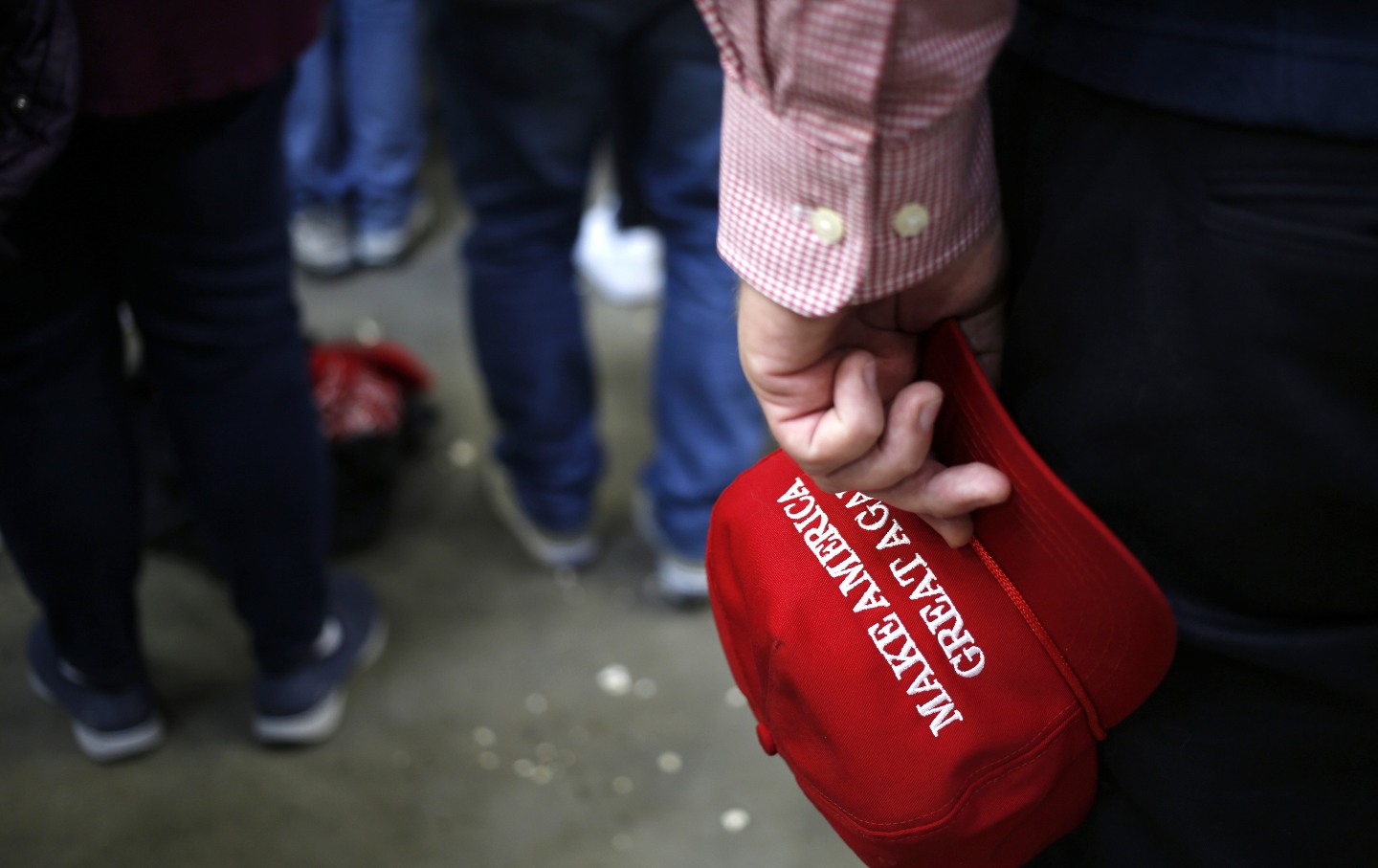
In 2024, 91 percent of voters in the county backed Donald Trump. Yet, as The New York Times recently reported, it was the Trump administration that pressured states like Kentucky to roll back efforts to deliver full food stamp benefits during the shutdown. “Full SNAP benefits were paid out for October, so recipients would have only seen an impact on their household budgets starting in November,” said Harris Eppsteiner, the associate director of economic analysis at the Yale Budget Lab, a nonpartisan policy research center. The effects “depend on what state you’re in,” he said. “Some states had issued full SNAP benefits for November, while around two-thirds had issued partial or zero benefits.”
Kentucky was one of the two-thirds, according to the Kentucky Center for Economic Policy, whose director, Jason Bailey, said that SNAP recipients in Kentucky received partial benefits on November 6.
In response to the government shutdown, Kentucky Governor Andy Beshear issued $5 million to support food banks—an amount Bailey called a“stopgap,” given that the monthly SNAP allocation in Kentucky is around $105 million.
“SNAP is a program designed to fight hunger,” Bailey said. “Many people who work also qualify because their wages are too low.” What Washington calls “work requirements,” he argued, are more accurately “paperwork requirements” that strip people of benefits “because of systems intentionally made too complicated to comply with, rather than a failure of people to work.” The shutdown, he said, was only a preview of what’s coming.
Trump’s “One Big, Beautiful Bill” will also jeopardize SNAP benefits for 114,000 people, or roughly one-fifth of recipients, in Kentucky, where work requirements will now expand to roughly 50,000 people aged 54 to 65, along with caregivers whose children are older than 14, starting in early 2026. The bill also expanded work requirements for military veterans and people experiencing homelessness—effectively pushing many out of a program they rely on to not go hungry. “This is particularly problematic,” Bailey said, “as we have the second-highest food insecurity in the United States for adults over 50.”
Beginning next year, Bailey told me, the Kentucky State Assembly will have to fund the shortfall caused by Trump’s bill—up to $188 million per year.
In Martin County—where there isn’t a single big-box grocer—SNAP dollars circulate through six small stores: two Dollar Generals, two Family Dollars, a Save A Lot, and Warfield Market, a once IGA-affiliated store that is now the county’s only independently owned grocer. “We had low sales the first couple weeks of November,” said Ron Jones, the assistant manager. “Everybody has been coming together to try to help out. I live in an apartment complex, and the office has been making food for all of the kids living in the building.” In the final days of the shutdown, Jones told me, “the office cooked 30 pounds of soup beans and cornbread.”
“Honestly,” he said, “I see people coming in and out of the store every day that are affected. They’re really worried about making it, because they have kids to feed.” The store’s regular customers disappeared for nearly two weeks. “We typically do $15,000 per day, and our sales dropped to $7,000 per day during the shutdown.”
Thomas Howell, a 25-year-old line worker at a fast-food restaurant in Martin County, works five days a week for $8 an hour. “It sucks, but right now I don’t have my own vehicle, and it’s pretty much the only work opportunity I have,” he said. “If I make $170 per week, I consider that a really good week. And I get $110 per month in food stamps. It’s pretty much all the food I have unless someone else buys it for me.”
Without food stamps, he had to find other ways to afford to eat. “There’s a discount candy store near me that sells food items that are about to expire for a quarter a piece.” During the government shutdown, Howell ate discounted candy bars and beef jerky that couldn’t be sold by grocers. “I don’t like going to food banks unless I’m truly about to starve, because I know there’s people who if they don’t have the food they will starve.”
Howell liked Trump in 2016, when he was too young to vote; and voted for the president in 2020 and 2024. But he told me his support ended this year. During the shutdown, “he seemed unwilling to cooperate with any amount of funding when it came to Food Stamps and just shifted blame toward Democrats.” He believes both parties are at fault, but emphasized that the only ones that suffered were “the poor people.” His grandmother—who taught her entire life as a public school teacher and now survives on less than $900 a month including Food Stamps—has to rely on food banks.
“I’m truly disappointed in the minimal effort Trump’s been giving us poor people,” he told me. “I think most of this country voted for Trump on empty promises,” he said, “hoping he’d give us a better future—but instead it seems it’s going the exact opposite direction. I pray to God I’m wrong.”
According to recent projections, Trump’s net approval rating in Kentucky is now just 0.2 percent. “Once the honeymoon is over, presidents tend to lose popularity quickly,” writes The Economist. “But no recent president has fallen so low so quickly as Donald Trump.” And while the majority of Martin County’s voters backed President Trump in 2024, a majority of the county’s registered voters simply didn’t vote. In the last presidential election, the county had the second-lowest voter turnout of any county in Kentucky—just 49 percent.
Popular
“swipe left below to view more authors”Swipe →“I did not and would not vote for him, because I know he wouldn’t help people in Martin County,” said another voter, who spoke under the condition of anonymity because she fears retribution at her workplace. Although she’s a Republican, she believes that “he absolutely has not kept his campaign promises.”
But disillusionment with Trump or other past Republicans doesn’t seem to have directly translated to enthusiasm for Democrats either. The last Democrat that Kentucky backed for president was Bill Clinton in 1992 and 1996. “The last time I voted was when Bush ran,” said Deana Lynn Howell (who isn’t directly related to Thomas Howell), a 58-year-old in Martin County. “I don’t believe or trust anyone running for president,” she said.
In Kentucky, there isn’t a political realignment taking shape so much as an abandonment. While presidential elections have been won exclusively by Republicans, Kentucky has elected Democratic governors—including its current governor, Beshear, whom Thomas Howell voted for. “A lot of people here see ‘Democrat’ as a bad word,” he told me, “but it’s all about the specific person.” But regardless of who Martin County has supported for president, or what strides have been made in alleviating poverty, life doesn’t seem to be getting any easier, voters said. It doesn’t feel like anyone is listening. “No one cares to talk to us,” Thomas Howell told me.“They just like to point the finger at the downtrodden hillbillies.”
Become a Sustaining Donor This September
Between the reemergence of right-wing red-baiting and Donald Trump’s use of the chilling National Security Presidential Memorandum–7 to criminalize left political organizing, we’re seeing McCarthyism reborn before our eyes.
This assault on democracy cannot be ignored or wished away. Resisting it requires bravery in the face of threats and repression, a steadfast commitment to the truth, and the unwavering belief that we can—and will—overcome this darkness.
We must have an independent media that sets the record straight, unearths corruption and abuses of power, and advances a politics of justice and dignity for all if we’re to win this fight.
That’s why I’m writing to you today. This September, The Nation needs to add 100 monthly donors to sustain our progressive journalism. Your contribution makes the next investigative report, the next truth-speaking column, and the next pathbreaking essay all possible.
I hope you’ll support our work with a recurring donation today. If you donate $10 or more a month, we’ll send you a brand new “Hands Off the Free Press!” sticker to recognise your commitment to our cause. Please, donate today.
Onward,
Katrina vanden Heuvel
Editor and Publisher, The Nation
More from The Nation

CEOs Are Losing Control of AI CEOs Are Losing Control of AI
With no slowdown from Trump’s administration.
Gina Hinojosa: “We Flip Texas, and It’s Over” Gina Hinojosa: “We Flip Texas, and It’s Over”
Talking to Texas gubernatorial candidate Gina Hinojosa about what redistricting could mean and how a new generation of Democrats is speaking more directly to voters.
Trump Wants to Keep Journalists Out of the White House. He Should Get His Wish. Trump Wants to Keep Journalists Out of the White House. He Should Get His Wish.
The president has banned MS NOW, CNN, and Politico from attending press briefings. The rest of the media should respond with a boycott.
The GOP’s Incredible Shrinking Senate Map The GOP’s Incredible Shrinking Senate Map
Trump has so badly damaged the Republican Party’s brand that strategists are contemplating bitter fights—and losses—in races they’d been banking on as sure things.
Bernie Sanders: “People Are Sick and Tired of the Status Quo. People Want Change” Bernie Sanders: “People Are Sick and Tired of the Status Quo. People Want Change”
Exclusive: Read the text of a major foreign-policy address delivered by the independent senator at Riverside Church.

Even Republicans Are Figuring Out That Pete Hegseth Is a Disaster Even Republicans Are Figuring Out That Pete Hegseth Is a Disaster
Hegseth was always a horrible choice for defense secretary. At long last, some in the GOP are admitting it.

