Intimidation, Voter Suppression, and Racism in Indian Country
Obstacles to voting come in many forms during an election year—especially if you’re a Native voter.
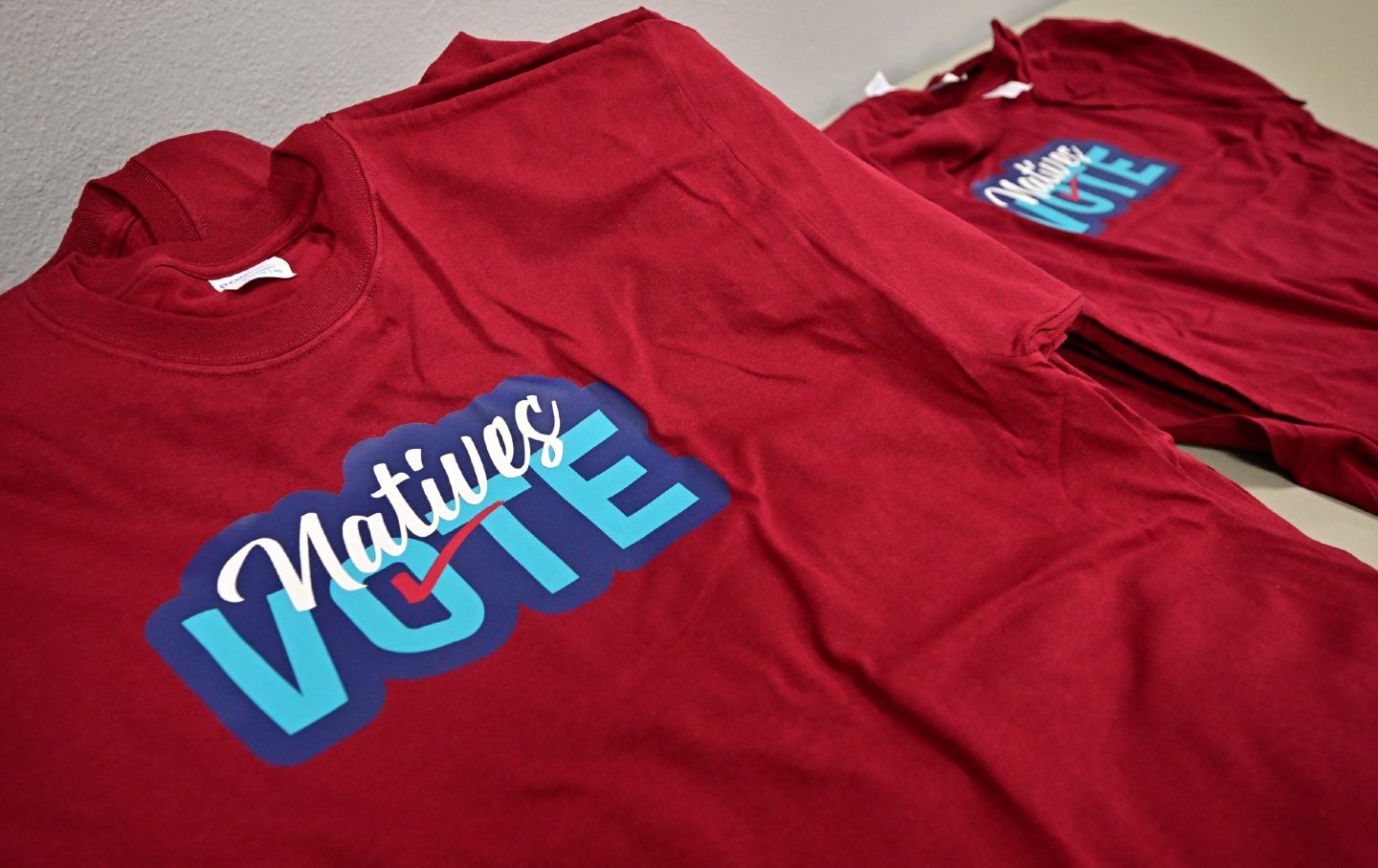
T-shirts reading “Natives Vote” are pictured at the Walker River Paiute Reservation’s administrative offices in Schurz, Nevada, on October 16, 2024. Neither presidential candidate has visited a reservation in 2024.
(Frederic J. Brown / AFP via Getty Images)
A MAGA fanatic hits the gas and rides the bumper of a Democrat-driven four-door sedan emblazoned with “Vote Blue” and “Pro-Choice” decals. The white man in a cowboy hat swerves and slams on his horn. He speeds up and pulls alongside the driver, a brown woman, and revs his engine, sending plumes of black smoke into the air. Two flags flap from the back of his massive Ford-150—one is the American flag and the other is a Make America Great Again banner.
His bumper stickers include GOP slogans from the past 20 years: One reads, “Pro-Life Voter,” another includes a silhouette of an M-16, a third reads “LIBTARDS,” but I can’t make out the text below on account of the truck’s wild zigzagging.
The woman seems unfazed; she doesn’t flinch and never speeds up or slows down. The MAGA driver, however, loses patience and slams the accelerator. He makes a hard left on a yellow light and disappears into the distance, presumably to locate another brown person to harass and endanger.
Intimidation comes in many forms during an election year, especially in Indian country. This rotten incident occurred in Bemidji, Minnesota, in 2020 right before the Biden-Trump election. Bemidji is surrounded by Indian reservations—Leech Lake, Red Lake, White Earth, Bois Forte, among others.
But it’s not just the overt menacing that attempts to prevent democratic participation. Reservations are generally geographically isolated communities, and politicians, almost always Republicans, will sometimes use the isolation and the physical conditions of these areas to suppress the Indigenous voice at the polls.
It’s not uncommon that on November 5 reservations in states like Alaska, Minnesota, Montana, North Dakota, and South Dakota are bombarded with ice and snow. And many families, including elders, on many of these reservations lack transportation. And the ones who do own a car or truck sometimes lack gas money. Unemployment and poverty rates are high on numerous reservations in the West, and so it becomes a question of food on the table or gas in the tank to go vote 50 miles away through snow- and ice-packed roads.
And that’s if there’s a road at all. In Alaska, Natives in some villages are expected to fly sometimes more than 100 miles over mountains, tundra, and the ocean to get to a polling place. Back in the Lower 48, not all roads on reservations are maintained. Some are dirt covered in snow drifts; others are paved, but below the snow drift is a minefield of potholes.
The Native American Rights Fund (NARF), a nonprofit that advocates for the rights of Indigenous peoples, found that the farther Natives are from a polling place the less likely they’ll participate in a state or federal election. If you move a polling place as little as a quarter of a mile farther away from people, the organization writes in a report titled, “Obstacles at Every Turn, Barriers to Political Participation Faced by Native American Voters,” there is a decrease in the propensity to vote. The report concludes, “It makes common sense.”
Many of the country’s 574 Indian reservations do not have polling places, and it leaves thousands of Natives in states like Utah, South Dakota, Nevada, and New Mexico driving nearly a 100-mile round trip to cast their vote.
Popular
“swipe left below to view more authors”Swipe →And the Natives that can travel that far to vote are faced not only with racist intimidation when they walk up to the building but also bureaucratic red tape having to do with their IDs.
As a result of generations of land theft by the United States and the creation in the West of a large swath of prison of war camps, now known as Indian reservations, many homes in these territories lack physical addresses. For decades, Natives have been able to vote by simply displaying their tribal ID, which often does not show an address.
Then, in 2012 in North Dakota, Senator Heidi Heitkamp, a Democrat, won by just 3,000 votes, and so the state legislature, controlled by Republicans, banned voting by anyone with an ID that lacks a physical address. In 2020, the state settled two federal voting-right lawsuits and agreed to allow Natives without an address to vote. But this form of suppression targeting Indigenous peoples still occurs in Arizona, where an estimated 40,000 Native homes do not have a physical address.
“They are modern day literacy tests,” said Allison Neswood, a Diné attorney with NARF. “They are tests that people cannot overcome because of the structure of their communities.”
And then there are the language barriers. English comes from England and Spanish from Spain, but Oglala, Diné, Yup’ik, Cree, and hundreds of other Indigenous languages were created here in North America, and many elders to this day struggle with the English language. Indeed, NARF found that when there is a lack of culturally competent language assistance when registering, it can discourage Natives who do not speak English—or do not speak English well—from voting.
More on the politics of Indian Country:
Sadly, some of the barriers to voting that Natives are faced with are part of larger systemic problems. In major cities, Indigenous people are more likely to be homeless, which makes voting more difficult. According to a study by the National Alliance to End Homelessness, 55 percent of Indigenous people in the US experience homelessness, which is the highest rate of any demographic.
In 1956, following the discovery of oil, gas, and mineral deposits on reservations, Congress passed the Indian Relocation Act, which, through fiscal coercion, forcibly removed Natives from their homes on the reservations to the nearest big city, such as Denver, Minneapolis, or Los Angeles. Consequently, homelessness among Natives became so rampant that, in Denver particularly, street corners were de facto named after the dominant tribe that would panhandle there. Sixth Avenue and Broadway, just outside of downtown, was dubbed Lakota Corner.
It’s been 100 years since Indigenous peoples were first considered American citizens, and racism and discrimination against Indigenous peoples still create massive barriers to the voting process. We Natives have survived a genocide, the founding fathers, and centuries of brutal oppression. We are not easily intimidated, as much as they try, and we’ll never give up. We’re still here, and with groups like NARF on the case, we’ll keep fighting to vote.