The Government Shutdown Is a Cartoonishly Bad—but Still Terrifying—Sequel
The latest congressional villains are the GOP’s hard-right nihilists, but their motives for sabotaging the government make no sense.
Government shutdowns are like horror-movie sequels: carelessly plotted and cast, scripted for maximal salaciousness, and promising ever greater complements of bloodshed. If one were to give a title to the production unspooling in the US House of Representatives under the notional direction of GOP Speaker Kevin McCarthy, it would likely be The Impeachment Conjuring or The Devil’s Absent Backbone.
Indeed, with the House GOP majority careening into performative chaos as the fiscal deadline of September 30 approaches, it becomes harder to divine just what the endgame will be. McCarthy himself confessed as much late last week, when he emerged from a Republican conference meeting and told a reporter, “I had a plan for this week. It didn’t turn out exactly as I had planned.”
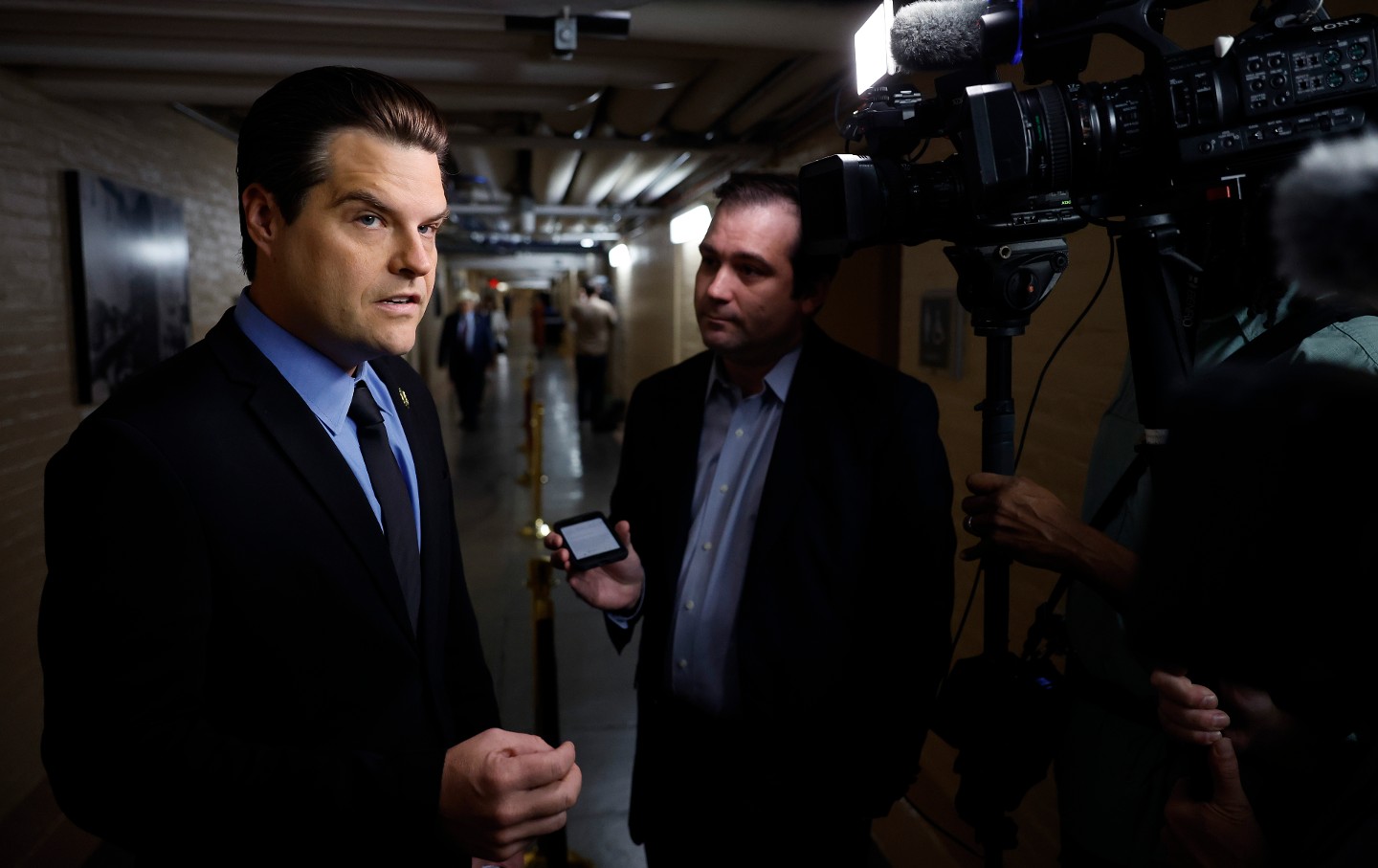
McCarthy again stressed the importance of not provoking a needless shutdown over the weekend, telling Fox News, “I’ve been through shutdowns, and I’ve never seen somebody win a shutdown, because when you shut down, you give all your power to the administration.” But this counsel counts for little among the hard-right members of McCarthy’s caucus, who began the week denouncing a proposal for a continuing resolution to keep the government functioning while a spending deal might come together. Even though the deal was brokered by the GOP’s anti-government Freedom Caucus in conjunction with the party’s marginally more pragmatic Main Street caucus, the nihilist caucus denounced the agreement as more Biden appeasement—a plan in line with the deal McCarthy struck with Biden to prevent a debt-ceiling crisis back in June. Even before a committee vote could be scheduled, a chorus of hard-right “no”s arose, damning the deal in advance, thanks to the GOP’s ultra-narrow five-vote majority. The tenor of dissent was captured by longtime McCarthy foe Matt Gaetz, a bomb-throwing GOP House member from Florida: “I will not support this 167-page surrender to Joe Biden.”
What the hard-right House faction will support is a mystery, marking the pending shutdown apart from the strategic reckonings behind past GOP-led shutdowns. Newt Gingrich’s shutdown effort in 1995 and ’96 was a putsch designed to enact core budget provisions of the Contract with America—though, per McCarthy’s analysis, that far stronger GOP House majority emerged only with damaged credibility and a broad 10-year framework for future spending cuts. “That was pretty thin gruel,” recalls Catholic University political scientist Matthew Green, coauthor of a Gingrich political biography and a Democratic Hill aide during the Gingrich shutdown. “It wasn’t much, given all the political pain inflicted.”
Still, not much was still something; today’s shutdown battle involves little in the way of clear policy objectives beyond McCarthy’s rapid capitulation to far-right House demands to launch Biden impeachment inquiries and the perennial demand for more draconian measures to police the US southern border. “In many ways, the shutdown is the goal,” says Princeton University historian Julian Zelizer, another Gingrich biographer. “Meaning, to create chaos and dysfunction has become an animating goal for the GOP, which makes negotiation much harder to achieve even within the party.”
“In 1995, Republicans were saying, ‘The voters are with us, so shutting down the government is going to teach the Clinton White House a lesson,’” Green observes. “This is more like Kevin McCarthy saying, ‘I’ve got to keep my speakership somehow.’”
Even so, the grievance arm of the GOP caucus is hard-pressed to mount a credible challenge to McCarthy’s rule, despite Gaetz’s repeated threats to invoke a motion-to-vacate vote to throw the speakership open. In that same gruesome conference meeting last week, McCarthy reportedly told the restive would-be bolters clustered around the Freedom Caucus to “go ahead” with a motion-to-vacate vote. “I’m not fucking scared of it,” the frustrated House leader explained. “Any new speaker will do what I’m doing. If you think you scare me because you want to file a motion to vacate, move the fucking motion.” McCarthy knows that the threats to his speakership are empty, for one simple reason: No other quasi-reasonable Republican leader wants the thankless job of marshaling the entropic forces of GOP House governance into line. “The influence of the so-called motion to vacate relies heavily on the perception that it’s effective, but it’s never actually been used to remove a speaker,” Green says. “And if you look at who would actually vote for it on the Republican side today, the votes aren’t there.”
Still, this just means that McCarthy and the GOP’s hard-right nihilists are stuck with each other—and their mutual antipathy is far from a prescription for successful governance. It’s also proving to be Kryptonite to viable legislative compromise. Last week also saw the failure of a continuing resolution for defense spending—formerly one of the first things GOP majorities would secure during shutdown negotiations. This failure bodes ill for Ukrainian President Voldymyr Zelensky, who is scheduled to address Congress this week in search of more support for the Ukraine war effort. And combined with Alabama GOP Senator Tommy Tuberville’s blockade of military promotions, it puts the GOP in uncharted, if not exactly dovish, policy territory. The party’s seeming defection from traditional military-spending priorities “is a big change, one of the most notable shifts within the GOP,” Zelizer says. The collapse of the continuing resolution on military spending, Green notes, “is another example of how we’re headed to shutdown because McCarthy can’t manage his party.”
Indeed, across the past quarter-century of Republican-engineered shutdowns, the clearest lesson is that the triumph of procedural nihilism only ensures that things will get worse. Since this budget bloodsport launched in 1995, Zelizer says, “we have seen a continual ratcheting up of what the GOP is willing to do: shutdowns, debt-ceiling threats, and the rest are all part of the new normal. McCarthy…accepts this and agreed to rules that made these forces stronger than ever.” In other words: If you’re set on leading the congressional GOP, be careful what you wish for.