
Congress Must Reject a Bill That Would Give Trump New Power to Silence Critics
How a new House bill could chill dissent from nonprofits.
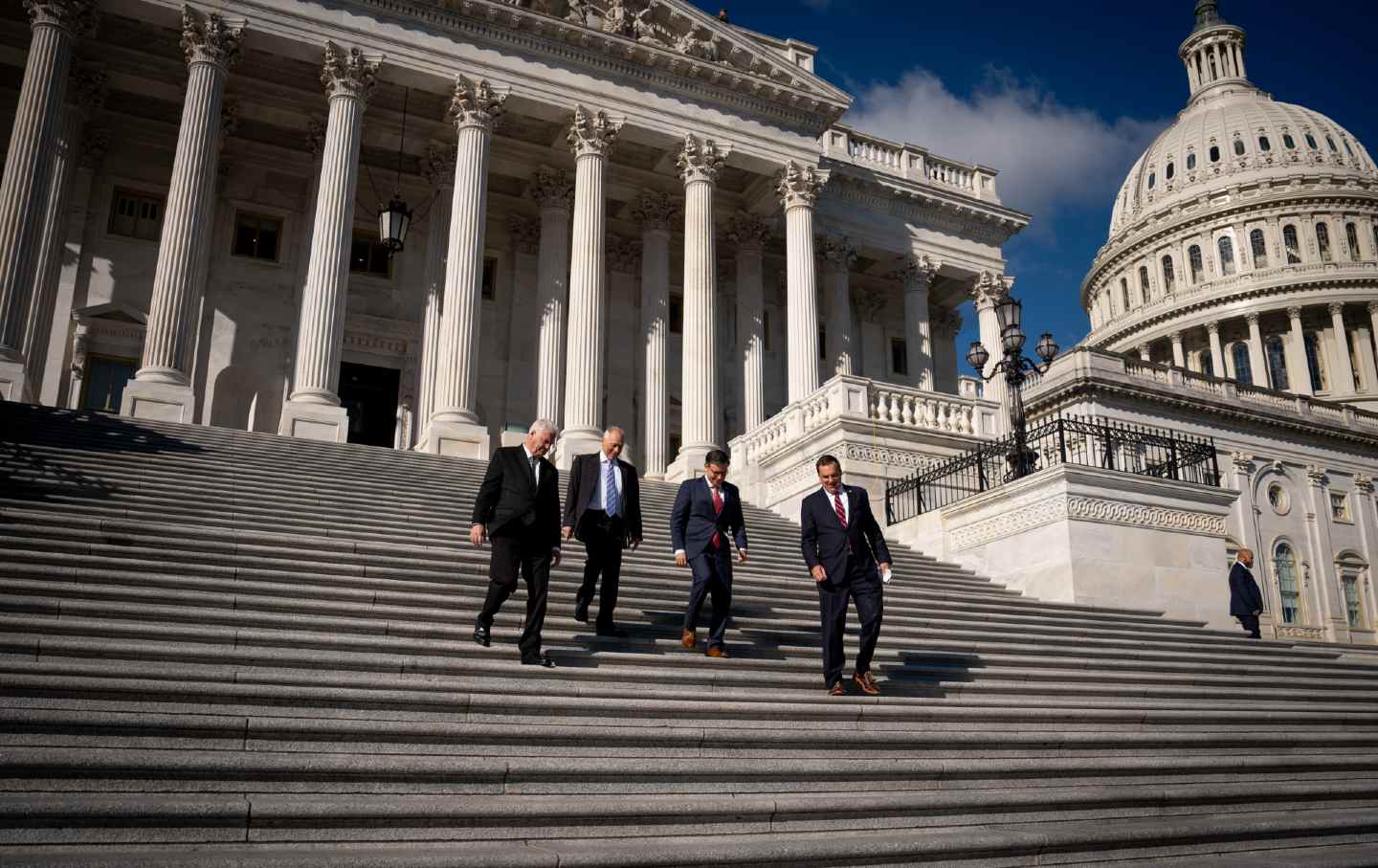
Yesterday, for the second time, the House of Representatives voted on a bill that President Donald Trump and the executive branch could use to investigate and effectively shut down particular groups he views as his political enemies. Candidate Trump repeatedly threatened his “enemies” on the campaign trail, and this bill would put tax exempt organizations directly in the crosshairs.
While the legislation received 256 votes, it did not meet the required two-thirds threshold required to suspend the rules and fast-track the bill towards passage. The House of Representatives, however, can bring the legislation up again at any time under normal procedure, which would only require a majority vote for passage.
One might ask why any member of Congress would vote for such legislation. One reason is that on its face the legislation purports to terminate the tax-exempt status of what it refers to as terrorist-supporting organizations. At first glance, most would see that as a laudable purpose, and that may be why similar legislation passed the House of Representatives earlier this year. But the true goal and consequences of this legislation are much more insidious.
As a starting point, nonprofits are already prohibited, under federal criminal laws, from providing material support to terrorists. And while the ACLU has long-standing concerns with how the executive branch has interpreted and enforced material-support laws, it remains the case that the executive branch does not lack tools to address transactions with individuals and entities it deems connected to terrorism.
Moreover, as a recent report from the Congressional Research Service makes clear, tax-exempt organizations are already “subject to existing requirements that enable the IRS to revoke the tax-exempt status of an organization that provides material support to a terrorist organization.” The same report notes that the main difference between current IRS rules and the bill is that “revocation under existing authority comes after” an IRS audit, notice, an administrative appeal, and judicial review, while under this legislation, due process basics would come only once the damage is done: “after designation as a terrorist supporting organization.” In other words, the new legislation turns fairness on its head and provides only the façade of due process.
Even the proponents of the bill seem to think that the executive branch already has wide-ranging authority given the numerous letters they have written to the IRS asking it to strip groups of tax-exempt status. Speaker of the House Mike Johnson has himself joined in such calls.
Under this legislation, a damaging “terrorist-supporting” a designation will be made unilaterally by a treasury secretary who will be handpicked by Donald Trump. They will not be required to provide a nonprofit with a full accounting of the reasons and evidence for such a designation, nor will they have to provide any evidence that undermines their designation decision. This means that a nonprofit could be left completely in the dark as to what conduct the government believes qualifies as material support. In effect, a nonprofit could have its tax-exempt status stripped before it has ever had a real chance to make its case before a neutral decisionmaker.
While the sponsors of the bill have said that the legislation is necessary to avoid what they call a “time-consuming bureaucratic process,” in reality they are trying to evade fundamental due process. The executive branch will be able to use the stigma that would come with such a designation, the legal fees and costs that it would incur, coupled with the likely loss of donors fleeing controversy, to stifle dissent and chill speech. And while applications of this authority may ultimately fail when tested in court, the reputational and financial costs of this designation could mean the functional end of an accused nonprofit before it ever got to that point. Many nonprofits may choose to curtail their activities and advocacy in order to avoid such a punishment.
And while the current efforts are clearly very focused on the campus protests regarding the situation in Gaza, it is not hard to imagine a Trump administration using this authority to target and harass nonprofits in a far broader set of circumstances. The chilling effects could be immense. Any organization that criticizes government policies or powerful interests could potentially have its tax-exempt status stripped away arbitrarily by a designation that it is “terrorist-supporting” as part of a broader far-right assault on democracy and the right to protest
The question Congress should be asking is whether now is the time to give the executive branch new, unnecessary, broad, and easily abused powers. This legislation provides no real protection against an executive branch led by Trump and intent on using executive power to effectively shut down organizations he disagrees with. Instead, it is an open invitation for abuse.
This time around, the bill’s proponents have attached it to legislation making clear that Americans held hostage by foreign governments or terrorist groups do not owe penalties to the IRS for failing to pay taxes while they are hostage. Understandably, this is a rare policy that no one in Congress seems to oppose, and it passed the Senate unanimously earlier this year. The fastest way for IRS relief for hostages to become law would be for the House of Representatives to pass a version that does not include the unrelated and dangerous provisions targeting nonprofits. It could then be sent immediately to the president for his signature.
And that is the approach that the Congress should take, instead of working to hand the incoming Trump Administration a tool it can use to stifle free speech, target political opponents, and punish disfavored groups.
More from The Nation
Will the GOP’s Big Money Save Jon Husted in Ohio? Will the GOP’s Big Money Save Jon Husted in Ohio?
Former senator Sherrod Brown is leading in most polls, but a tidal wave of spending may prop up the struggling incumbent.

James Talarico Is Preaching a Gospel of Pluralism James Talarico Is Preaching a Gospel of Pluralism
He’s not the only progressive doing it.
Even Republicans Are Waking Up to Trump’s Corruption Even Republicans Are Waking Up to Trump’s Corruption
And, somewhat shockingly, so are Democratic elites.


Mamdani Can No Longer Avoid the Issue of the NYPD Mamdani Can No Longer Avoid the Issue of the NYPD
The mayor has been able to put difficult questions about policing on the back burner—until now.

Why Democratic Leaders Keep Waging War on the Young Why Democratic Leaders Keep Waging War on the Young
The party's silver-haired establishment is caught up in an existential culture war.

