The GOP-Controlled House Returns to the Work of Doing Nothing Except Backbiting
Congress has a vast tranche of unfinished business, but House Republicans seem awfully busy fighting amongst themselves.

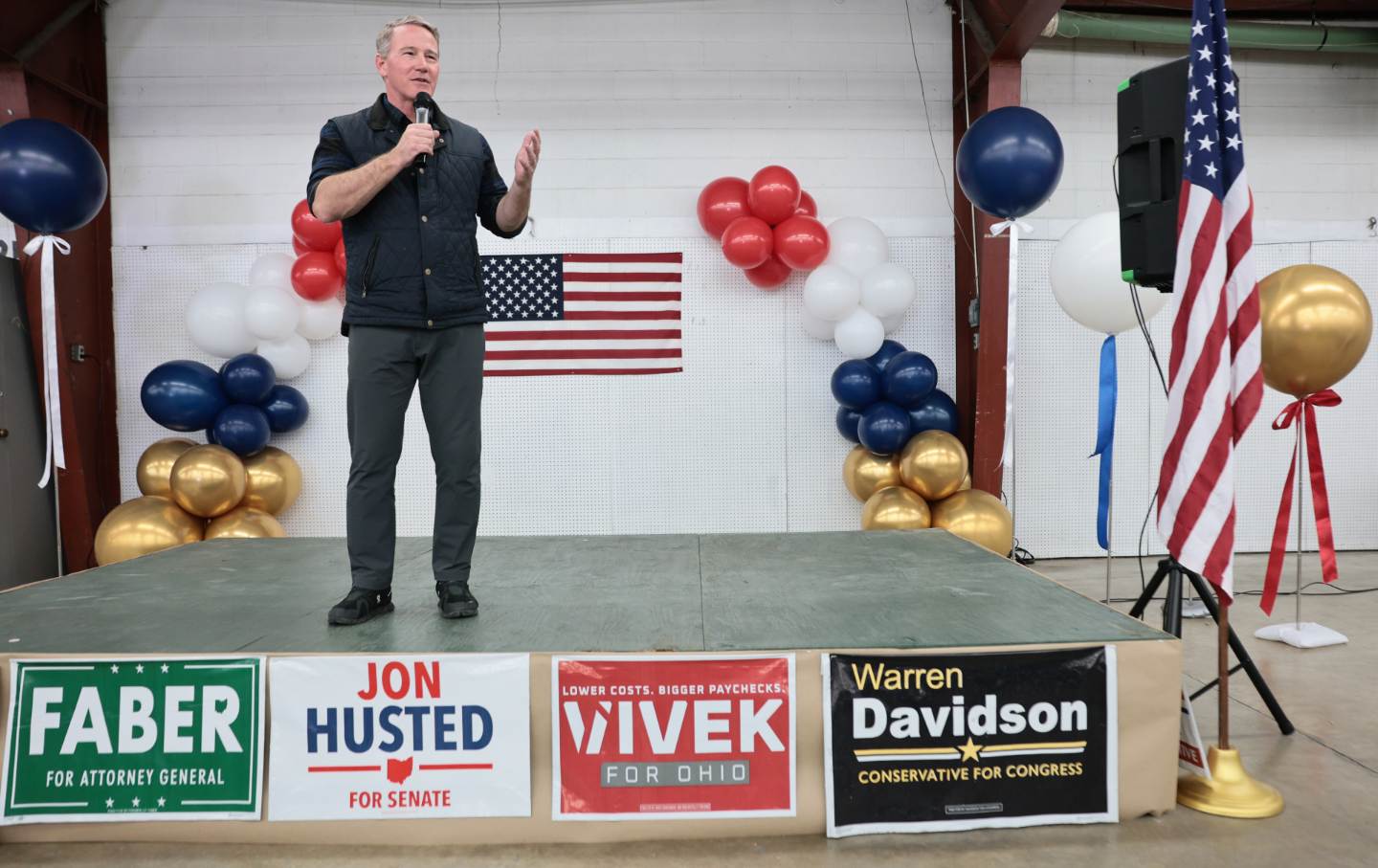
House Speaker Mike Johnson, a Republican from Louisiana, speaks during a news conference at the US Capitol in Washington, DC, on February 14, 2024.
(Graeme Sloan / Bloomberg via Getty Images)After a winter characterized by historic unproductivity, petty backbiting, and procedural inertia, Congress returns this week for more of the same. With 15 weeks to go before the general election, the House’s GOP majority has a vast tranche of unfinished business before it—from funding the war in Ukraine to reauthorizing the Foreign Intelligence Surveillance Act (FISA) to renewed spending legislation as the fiscal year winds down in a few months. Basic government operations are also awaiting congressional approval, with 25 jurists President Joe Biden has nominated to the federal bench needing Senate confirmation and the Senate slated to weigh in on extensions of the child tax credit and several business tax breaks. The Affordable Internet Connectivity Act requires a House reauthorization vote, with some 23 million Americans poised to lose online access without it. Federal funding to rebuild Baltimore’s Francis Scott Key Bridge likewise needs House approval as does a newly brokered Senate bill to protect online privacy.
At the center of this great legislative speed-up is House Speaker Mike Johnson, whose first few months in office supplied a crash course in its fundamental impossibility. As long as Johnson wants to move lawmaking forward, he will have to suspend normal sign-offs from the House Rules committee to move legislation onto the suspension calendar for straight general votes requiring a two-thirds majority. That’s how he’s won approval for emergency spending bills to avert government shutdowns—and it’s likely how he’d finesse a vote to extend military aid to Ukraine. (The other main foreign military-aid packages, earmarked for Israel and Taiwan, are trickier prospects, due mostly to growing dissent resulting from Israel’s brutal and inhumane conduct in the Gaza War.) But, of course, the cost of getting legislative work done is alienating the far right of the GOP. And the more Johnson’s brittle majority fragments, the more he must rely on House Democrats for critical votes—a tactic that will further alienate the Freedom Caucusers and MAGA bomb throwers in Johnson’s conference. This same recursive race to the nihilist bottom claimed the speakership of Johnson’s predecessor Kevin McCarthy—and just before Congress went into recess last month, Georgia Representative Marjorie Taylor Greene launched a motion to vacate the speakership that could produce the same bathetic coda to Johnson’s leadership career.
Indeed, as Congress made its way back to Washington, Greene was hitting the media circuit to tell Johnson, in essence, “Nice leadership post you’ve got there. It’d be a shame if something happened to it.” “If he passes that $60 billion to Ukraine and then follows up with FISA reauthorization, you’re going to see a lot more Republicans than just me coming out saying his speakership is over with,” Greene told The Washington Post. Citing Johnson’s backing of the Ukraine aid package after his prior votes against sending military support to the country, Greene said he’d betrayed MAGA orthodoxy: “He has made a massive departure of who he is, who we knew him to be.”
Greene insists that she doesn’t want to trigger another plunge into leadership chaos—particularly since the House majority, wracked by early retirements and the expulsion of New York Representative George Santos, will be operating on a single-vote majority after Wisconsin Representative Mike Gallagher scarpers on April 19. With that shrinking balance of power, a vacated Johnson speakership could actually elevate House minority leader Hakeem Jeffries into the post—which is why oleaginous chaos-merchant Matt Gaetz (R-FL), who orchestrated the overthrow of McCarthy, has said he intends to sit out any effort to topple Johnson. Greene herself has yet to petition for the motion to be formally recognized—an action that would automatically trigger a House vote on Johnson’s speakership within two days, citing her desire to shun more reputation-damaging infighting for the conference. (If such self-undercutting reflections leave you wondering why Greene would have resorted to the motion to vacate in the first place, let me once more remind you that the Trumpified GOP is a place where empty theatrics dominate and words have no real meaning.)
The next two weeks will produce the two biggest stress tests of Johnson’s brief, addled tour in the speaker’s chair so far, with scheduled votes on FISA reauthorization and Ukraine aid. To underscore the absurdist futility of the task before him, Johnson’s ever-restive hard-right flank is once more pushing to tie any proposed Ukraine outlay to major crackdowns on immigration enforcement. Never mind that this was the very tactic that Senate leaders pursued for months in crafting an appropriations bill for Ukraine, Israel, and Taiwan funding—only to have the most thoroughgoing right-wing legislation on immigration blown up on Donald Trump’s Truth Social account. Since traditional MAGA overtures on the economy are evidence-challenged and the GOP’s presidential nominee is a walking concordance of executive lawbreaking, border demagogy is the principal general-election strategy left to the Trump cult. That meant, in turn, that actual legislation adopting GOP immigration goals would be “a gift to Democrats,” as Trump ranted at the time.
During his 1992 election campaign, one of Bill Clinton’s stock applause lines on the GOP-led recession was that one definition of insanity was to keep trying the same failed approach over and over again while expecting a different result. It will require future forensic political psychologists to diagnose what manner of pathology lies behind adopting a strategy that’s foreordained to fail while expecting exactly that result.