It’s Hard to Imagine a Worse Idea Than a Hybrid Democratic Convention
If Democrats try to sideline protesters by opting for a semi-virtual convention, it will be a huge betrayal of the Democratic base.
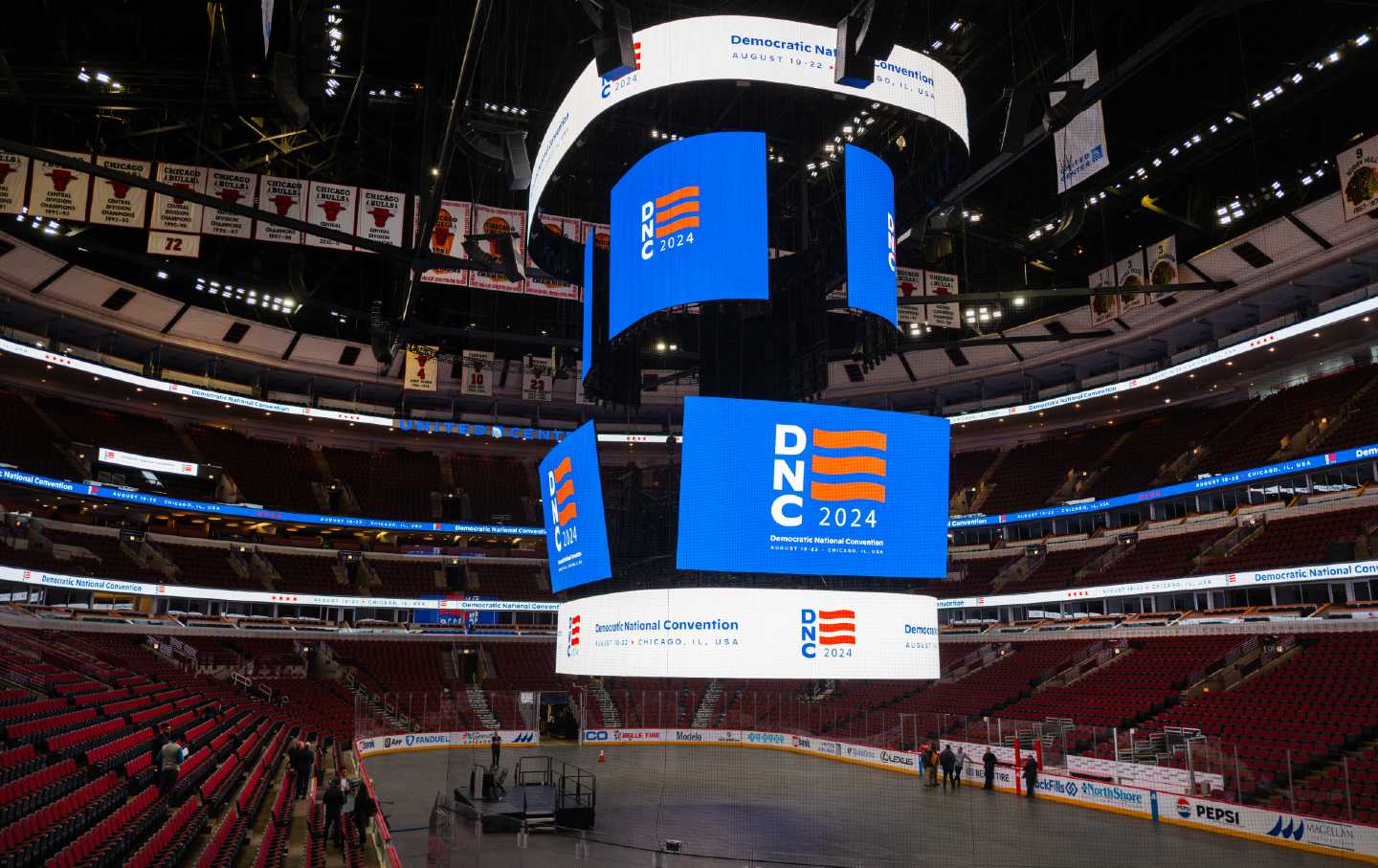
If you believe the headlines, the specter haunting the minds of Democrats today is not communism but the shadow of Chicago 1968, when young people protesting the Vietnam War—and the machine-backed nomination of Hubert Humphrey (presented to the Democratic National Convention though he hadn’t won a single primary)—flooded into the city, where they were met by Mayor Richard Daley’s cops. The ensuing riot, broadcast on national television, is widely blamed for propelling Richard Nixon into the White House.
If Israel is still using American weapons to kill Palestinian civilians this August, the anti-war movement may well show up in Chicago again. Even so, it strains credulity that, as Politico recently reported, “some in Biden’s orbit are aggressively pushing” the Democrats to adopt a hybrid mode for their 2024 convention, featuring live speeches by Biden, Kamala Harris, and rising (and politically compliant) party stars, while “moving party business, such as rules and platform votes, off the floor and denying would-be demonstrators a chance to seize on contentious debates.”
It’s hard to imagine a worse idea (though with two months to go before the convention, we can’t exclude the possibility). For many progressives—including key segments of the Democratic base—the only thing more dispiriting than having to vote for Biden and Harris again is having to watch them get renominated. A floor debate over unconditional aid to Israel might not be pretty, but it would reflect what Democrats are actually arguing about, allowing at least some of those who are passionate about Palestine to feel that their views are being represented. It would also give the party a chance to demonstrate that, while its national convention may be back in Chicago, 2024 is not 1968. And not just because—apart from Israel, Gaza, and foreign policy more broadly—Biden has easily been the most progressive Democratic president since Lyndon Johnson. In 1968, Shirley Chisholm wasn’t even a candidate for president; in 2024, Kamala Harris is vice president. And Chicago’s incumbent mayor, Brandon Johnson, is as far from Richard Daley Sr. as can be imagined.
As sometime Nation contributor (and longtime Democratic National Committee member) Larry Cohen recently observed, the party’s rules matter as much as its rulers. And debates over those rules, and over the roles of superdelegates and dark money, need to happen live and in public. Shunting them onto the Internet—like hiding (in plain sight) from dissent—shows a contempt for the party’s base that Democrats can ill afford. Especially in contrast with the fired-up Republicans.
As with everything Trump, the GOP convention promises plenty of surprises: the vice presidential nominee, for one, but also whether the man at the top of the ticket will, by then, be on his way to prison. Or bankruptcy. But of one thing we can be certain: Four more years of Trump would be a disaster.
During Trump’s first term, sheer inexperience—and divisions within his administration—arguably kept some of his worst impulses from becoming policy. This time, as the contributors to this special issue remind us, we can’t count on rookie mistakes to save us. Or divisions. Thanks to the Heritage Foundation and the unpopular front of right-wing ideologues it has assembled under the banner of Project 2025, an incoming conservative president will have a detailed policy playbook available from day one. And that playbook, as the 11 essays in this issue demonstrate, aims to do nothing less than rewrite the essential terms of our democracy.
Still, all is not lost. Veteran activists like Heather Booth, who is profiled by Joan Walsh in this issue, continue to fight like hell, while Jennifer Berkshire and Jack Schneider turn our attention to an overlooked front in the education wars.
Reminding us of what’s at stake—and keeping hope alive—is also the work of our Books & the Arts section, which features Emily Wilson on the poetry of Anne Carson, Bijan Stephen on Philip Glass, and Ken Chen on Frantz Fanon. Plus a critical look at New York’s Billionaires’ Row by Karrie Jacobs. Not to mention our excellent cast of columnists, dispatch writers, artists, and commentators.
As always, let us know what you think.
D.D. Guttenplan
Editor
Support independent journalism that does not fall in line
Even before February 28, the reasons for Donald Trump’s imploding approval rating were abundantly clear: untrammeled corruption and personal enrichment to the tune of billions of dollars during an affordability crisis, a foreign policy guided only by his own derelict sense of morality, and the deployment of a murderous campaign of occupation, detention, and deportation on American streets.
Now an undeclared, unauthorized, unpopular, and unconstitutional war of aggression against Iran has spread like wildfire through the region and into Europe. A new “forever war”—with an ever-increasing likelihood of American troops on the ground—may very well be upon us.
As we’ve seen over and over, this administration uses lies, misdirection, and attempts to flood the zone to justify its abuses of power at home and abroad. Just as Trump, Marco Rubio, and Pete Hegseth offer erratic and contradictory rationales for the attacks on Iran, the administration is also spreading the lie that the upcoming midterm elections are under threat from noncitizens on voter rolls. When these lies go unchecked, they become the basis for further authoritarian encroachment and war.
In these dark times, independent journalism is uniquely able to uncover the falsehoods that threaten our republic—and civilians around the world—and shine a bright light on the truth.
The Nation’s experienced team of writers, editors, and fact-checkers understands the scale of what we’re up against and the urgency with which we have to act. That’s why we’re publishing critical reporting and analysis of the war on Iran, ICE violence at home, new forms of voter suppression emerging in the courts, and much more.
But this journalism is possible only with your support.
This March, The Nation needs to raise $50,000 to ensure that we have the resources for reporting and analysis that sets the record straight and empowers people of conscience to organize. Will you donate today?