How the Freedom Caucus Bomb Throwers Guarantee Bloated Spending Bills
By rejecting the appropriations process, House Republicans fuel the opaque, last-minute adoption of continuing resolutions and messy omnibus packages.
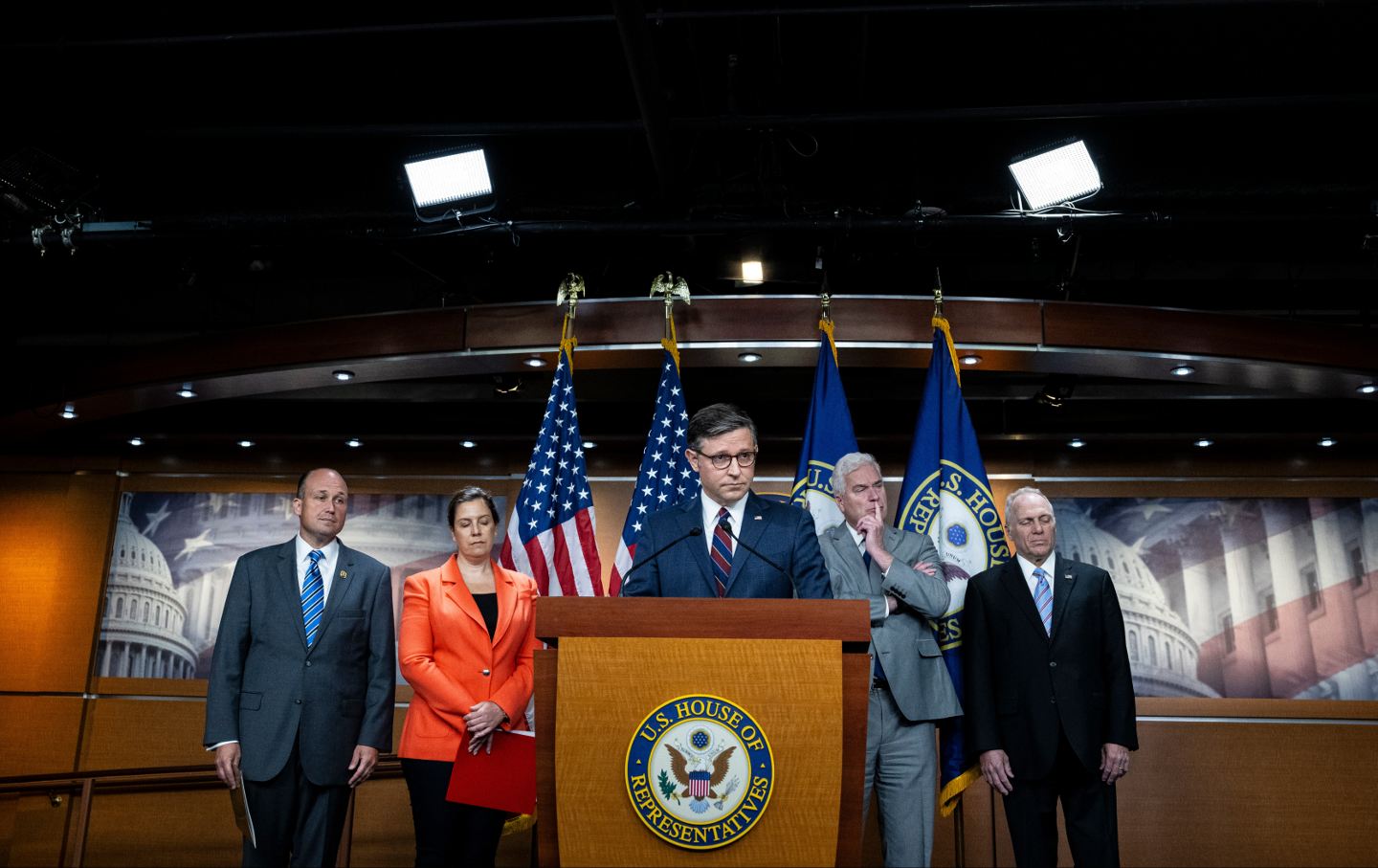
House Speaker Mike Johnson with fellow Republican members of the House at a news conference at the Capitol in July.
(Graeme Sloan / Boomberg via Getty Images)
As the grand fireworks display of our radically recalibrated presidential politics continued bursting overhead, the leaders of the world’s most dubiously functional deliberative body, aka the US House of Representatives, calmly reverted to form. Since there was no conceivable way that his conference would reach any accord on funding the government weeks in advance of their latest self-imposed deadline in September, in late July Speaker Mike Johnson declared that the House’s August recess would start early, setting the stage for yet another installment in the Republican majority’s seemingly endless regress of 11th-hour continuing resolutions and omnibus spending packages. Months of delay taken up mostly by election-driven culture-war inquisitions now routinely segue into harum-scarum budget votes that serve mostly to generate more raw yet impotent rhetoric from the hard-right Freedom Caucus, and cannibalize the House GOP’s own leadership. It’s a safe bet this isn’t what the republic’s founders had in mind when they empowered the House with the solemn responsibility of controlling the government’s purse strings.
The House GOP’s dilatory handling of its budget responsibilities is especially logic-defying less than four months out from a general election. With Johnson presiding over a razor-thin five-vote majority, and the party’s presidential standard-bearer losing traction in the polls, one would think that now is the time for the Republican House to showcase its basic governing chops. It’s hard to make a case to the electorate to expand and extend your majority when you fail over and over again to discharge the one basic job the Constitution imposes on you.
Yet governance is not really in the lexicon of the MAGA-fied GOP. All the many prior blown budget deadlines bear witness to that—as did Congress’s decision, under Trump’s instruction, to tank a long-negotiated immigration bill that stood athwart the former president’s plans to demagogue the immigration issue into hyperspace during the homestretch of his campaign. (Indeed, even with the House gaveled out of business for August, the GOP Senate conference continued pursuing the party’s program of maximum legislative entropy by engineering a filibuster vote blocking the extension of the popular and widely beneficial child tax credit.) And for the conference’s most hardcore anti-government faction, the spending impasses are perverse promotional opportunities: They can rail about the broken insider politics of Beltway influence-peddling, block any efforts to reopen early negotiation on spending in the Appropriations Committee, await the next unwieldy continuing resolution or omnibus bill, and issue cost-free votes against those as well, knowing the Johnson will have to broker deals with the Democrats to win their passage—and that opens inevitably into more intraparty feuding and spittle-flecked speechifying on the floor before the C-Span cameras. Lather, rinse, repeat.
The process has gotten so sclerotic and counterproductive that some Republicans—including key congressional players in the budget process—are actually pondering a return to measured bipartisan dealmaking—a first-order political sin in the house of MAGA, but plainly the only path forward if sane and intelligible spending agreements are ever to be back within the House’s reach. “The solution is very easy—it’s right in front of everyone,” says Brendan Buck, a partner in the PR firm Seven Letters and former counselor to onetime House speaker Paul Ryan and press secretary for Ryan’s predecessor John Boehner. Buck’s proposal is essentially a return to something like regular order in the chamber—a front-loaded process of negotiation among principals from both parties on the Appropriations Committee, and then later deals to hash out preferred spending priorities. Instead, these days, the House only erratically engages with the appropriations process as an afterthought—and that directly fuels the opaque, last-minute adoption of continuing resolutions and messy omnibus packages that now typify the House spending miasma.
It speaks volumes about the present state of play in the House that this return to bipartisan lawmaking sounds downright utopian—and Buck himself is none too sanguine about its immediate prospects. “It’s the most acute example of the broader problem that the conference has, for sure,” he says. “There’s no benefit to compromise. And if there is compromise, the willingness to vote for those things isn’t there.” Still, he notes, the pending election might help concentrate the conference’s attention on the stark consequences of such short-term and self-interested calculations. “The politics that flows up to leadership is that if you want to keep your majorities, if you want to save vulnerable members, then you have to get deals done.” And such tradeoffs aren’t unprecedented, even in the recent, rancor-prone GOP conference. “In 2018 we made a little progress,” Buck says. “We sort of made a trade with the Democrats where we said, ‘Well, we want Department of Defense funding, and you want Labor, Health, and Human Services. Let’s make a swap.’ And you know, that was half of discretionary spending, right there.”
But the problem is that there’s no clear path to direct the restive GOP conference toward compromise spending packages—and plenty of perverse incentives for them to flee 180 degrees in the opposite direction. “The irony is that the people who claim to want a continuing resolution or omnibus the least are the ones making it possible by basically saying that none of the current appropriations bills are good enough and thus blocking passage,” says Doug Heye, former spokesman for the Republican National Committee, who has also held senior communications posts in the House and Senate. “That we are in a media and campaign finance incentive structure that rewards those same members only exacerbates the problem.”
Even hardline fiscal conservatives in the House understand the need for a drastic overhaul. “The Appropriations Committee, they come up with as many wins as they can—and we passed four bills—but even those are on partisan lines,” Texas GOP Representative Dan Crenshaw told the DC politics site NOTUS. But as Crenshaw went on to explain, these are only Potemkin sorts of lawmaking—designed principally to gin up enthusiasm among the GOP’s anti-government base. The spending bills that now emerge from Appropriations “are just starting points in negotiations with the Senate,” he says. “And you’ve got members who would rather grandstand and pretend to fight for their constituents as opposed to actually getting some wins for them.… And then we end up with whatever the Senate puts in an omnibus. That’s a summary of the appropriations process.”
House Appropriations chairman Tom Cole of Oklahoma has signaled that he’s also receptive to a more transparent, measured, and chaos-resistant approach to reaching spending accords on his panel. “Appropriations has typically been bipartisan,” Heye says. “Cole is an adult in the room and wants to return that so we avoid continuing resolutions, omnibuses and shutdown threats.”
But again, there’s simply no way to get there from here; The adults in the room are simply outnumbered, and often outflanked by bomb throwers aligned with the Freedom Caucus. “This is a boring answer, but it’s a matter of member education,” Buck says. “One of the issues we confront is that some of the loudest voices tend to be the newest members, who come in and think they can fix it all.… They all come in beating their chest, and it’s hard to turn the room at that point, and say, ‘Yeah, that doesn’t really work.’” There’s an allied education deficit in Johnson’s case, he notes; Johnson’s close alliance with the bomb throwers in the conference ends up, perversely, creating just the sort of rushed and unwieldy spending packages that fiscal conservatives profess to hate: “We also have a speaker who hasn’t really been around the block with this process—and you know, all of this finally ends up in the speaker’s lap, so people need to say, ‘Here’s what we’re going to do to avoid that.’ ”
Unless and until such teachable moments coalesce into an intelligible governing program, the House GOP conference is ticketed to court maximum delay, disorder, and dissension on the fundamental question of government spending—a seeming recipe for an ugly Election Day reckoning. “It’s not going to change right now,” Buck admits. “Nobody wants to be accused of being a traitor, or be seen waving the white flag. Even if you’ve seen all this before, and you know what’s happening, you’re not going to support a bipartisan compromise.”
Support independent journalism that does not fall in line
Even before February 28, the reasons for Donald Trump’s imploding approval rating were abundantly clear: untrammeled corruption and personal enrichment to the tune of billions of dollars during an affordability crisis, a foreign policy guided only by his own derelict sense of morality, and the deployment of a murderous campaign of occupation, detention, and deportation on American streets.
Now an undeclared, unauthorized, unpopular, and unconstitutional war of aggression against Iran has spread like wildfire through the region and into Europe. A new “forever war”—with an ever-increasing likelihood of American troops on the ground—may very well be upon us.
As we’ve seen over and over, this administration uses lies, misdirection, and attempts to flood the zone to justify its abuses of power at home and abroad. Just as Trump, Marco Rubio, and Pete Hegseth offer erratic and contradictory rationales for the attacks on Iran, the administration is also spreading the lie that the upcoming midterm elections are under threat from noncitizens on voter rolls. When these lies go unchecked, they become the basis for further authoritarian encroachment and war.
In these dark times, independent journalism is uniquely able to uncover the falsehoods that threaten our republic—and civilians around the world—and shine a bright light on the truth.
The Nation’s experienced team of writers, editors, and fact-checkers understands the scale of what we’re up against and the urgency with which we have to act. That’s why we’re publishing critical reporting and analysis of the war on Iran, ICE violence at home, new forms of voter suppression emerging in the courts, and much more.
But this journalism is possible only with your support.
This March, The Nation needs to raise $50,000 to ensure that we have the resources for reporting and analysis that sets the record straight and empowers people of conscience to organize. Will you donate today?