
Chuck Schumer Is the Weakest Link
The Senate minority leader wants to make sure everyone else is fighting for democracy—so he’s not at risk.
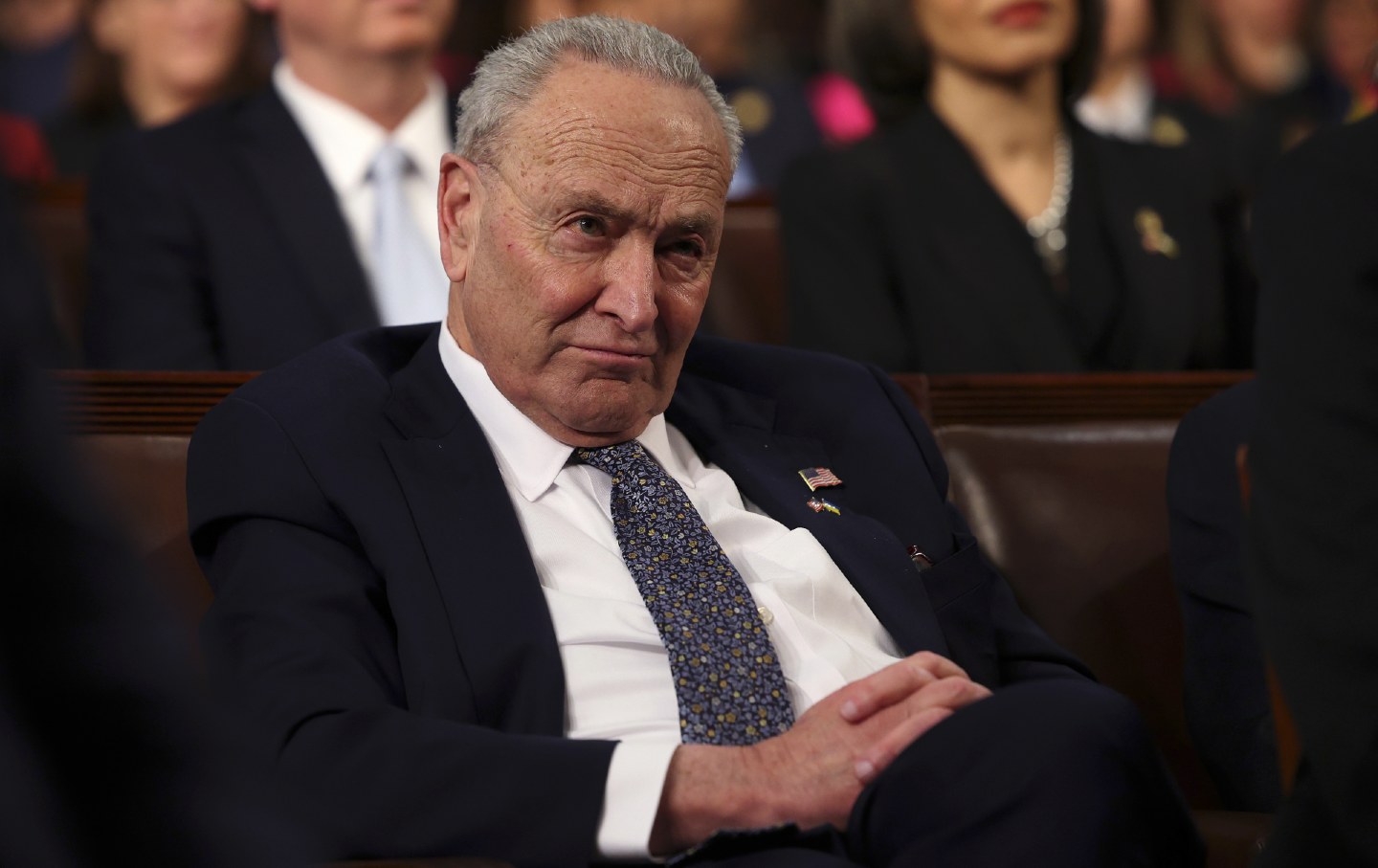
Chuck Schumer is in trouble, and he knows it. His decision to cave and help pass a six-month funding bill crafted entirely by Republicans put him odds with most of his party. All House Democrats and most Senate Democrats (with the exception of eight lawmakers and independent Angus King) voted against the bill. Those who opposed the funding bill saw it as a rare opportunity for Democrats, who are in a minority in both houses of Congress, to exercise some leverage. Schumer and his small gang argued that the risk of a shutdown was too severe and could allow Donald Trump and his grand vizier Elon Musk a chance to use the crisis to further slash the federal government.
Schumer knows his stance is unpopular, so much so that he’s had to postpone a book tour for fear of encountering enraged voters. Seeking a safe space to make his case, Schumer took to the media to do a full-court press, granting a major interview with The New York Times and twice appearing in the last week on the MSNBC show All In With Chris Hayes, on Friday and Tuesday.
These appearances reeked of crisis management by a besieged leader who knows the mob is ready to break down the gates. The Tuesday appearance on Hayes’s show was especially revealing, because the host allowed Schumer ample room to explain himself, which rendered visible all the contradictions and holes in the Senate minority leader’s position. Schumer was defending himself in the court of public opinion—but his testimony made a guilty verdict more likely.
Near the start of the interview, Hayes played clips where an array of prominent Democrats ridiculed Schumer’s surrender. Former House minority leader Nancy Pelosi sarcastically observed, “I, myself, don’t give away anything for nothing, and I think that’s what happened the other day.” More diplomatically, House minority leader Hakeem Jeffries said he was unhappy with Schumer’s “approach and outcome.” Representative Alexandria Ocasio-Cortez said, “I think there is a deep sense of outrage and betrayal, and this is not just about progressive Democrats. This is across the board, the entire party.” Pennsylvania Governor Josh Shapiro simply said that Schumer should have used his “leverage” to make concrete demands. Taken together, these major party figures, representing different generations and factions within the party, had a common message: Schumer is the weakest link in the battle against Trump.
Schumer, already visibly upset as he listened to this litany of rebuke, was seething with anger at Shapiro’s remark about “leverage.” Fidgeting in his chair, Schumer looked like he was ready to shake his fists at the TV clip. Schumer denied that he had any leverage at all because current Republicans were so dangerously extreme they would use a shutdown to eviscerate the government rather than negotiate. “You have these fanatics, vicious nihilists in charge,” Schumer said. He said he spoke to one Republican senator who was gleeful at the prospect of a six-month shutdown.
This account of Republican zealotry is plausible enough, but it is in tension with Schumer’s claim, made elsewhere in the interview, that once Trump’s polling numbers fall to 30 percent, a significant cohort of Republican senators will moderate and hold Trump in check.
Another seemingly plausible Schumer claim is that the main check on Trump is the courts, which would be closed during a shutdown. The senator told Hayes, “Now, if you don’t have a shutdown, you can go to the courts. We’ve had a lot of successful results in the court…. we’ve won about 85 percent of the cases. Shut down, no courts.”
But this position is belied by an important fact. David Dayen, executive editor of The American Prospect, posted on X: “The internal contradictions of Schumer’s surrender: He essentially said that only the courts can stop Trump’s pillaging of the government. But the government funding bill he passed *hurts* the cases currently in the courts, as it lets the president decide where money can be spent.”
Spelling out the argument in an article, Dayen noted that
numerous legal groups, states, unions for federal workers, and others are entrenched in litigation over whether the Trump administration is illegally firing workers, canceling programs, and shuttering entire agencies of the government. The nominal grounds for these lawsuits are that the executive branch cannot usurp the power of the purse from Congress and violate the separation of powers by controlling decisions over what parts of the government get what portions of federal dollars.
But Congress literally just handed over that authority to the president in the continuing resolution.
The contradiction of Schumer’s position came through in an exchange with Hayes on the question of whether Trump is a threat to democracy:
Schumer: If our democracy is at risk….
Hayes: It is at risk.
Schumer: It is certainly at risk.
Hayes: Do you believe it is at risk? I don’t want to put words in your mouth.
Schumer: If Trump doesn’t obey the Supreme Court…then we will have two courts. We will have the federal courts, which hopefully John Roberts will stand up and make it happen. But we’ll have the court of public opinion…. We have had the rule of law since the Magna Carta and [if] the rule of law goes by the wayside, I believe that there will be very, very, you know, there will be strong and immediate reaction from one end of the country to the other in ways that we have never seen. And it is not just up to us, the people will have to rise up, not just Democrats, not just Republican, not just, you know, people. Everybody. But our democracy will be at stake then and if the people make their voices heard and are strong and stand up and we join them, I believe we can try to beat that back. We can beat that back…. If democracy is at risk, that’s a little different than what we’re talking about now.
Schumer’s words are rambling and verge at times on the incoherent. But the gist seems to be this: He thinks Trump is not at the moment a threat to constitutional order—but soon might be one. Further, he believes that once Trump threatens the rule of law, then the job of stopping him belongs to a large coalition consisting of the courts and mobilized protesters (made up, he believes, of not just Democrats but “everybody”).
Much can be said about this strategy. As Chris Hayes noted in a segment of his show that ran on Wednesday, Schumer’s position that he should keep his powder dry and wait to fight another day is at odds with the real alarm that many Democrats feel about Trump’s attack on constitutional checks and balance. Hayes observes:
Some people think we are in a constitutional crisis—that there is a plan in place to impose a dictatorship in the United States. On Tuesday’s show, Schumer told me he was not quite ready to declare a constitutional crisis yet. Now, I truly hope Schumer is right, but it makes it very hard to imagine a leader “meeting the moment” if they don’t believe the moment is even here.
Popular
“swipe left below to view more authors”Swipe →To be less charitable, Schumer’s position is that of a general who doesn’t want to fight but is hoping that some other force (the mythical moderate Republicans, the courts, mobilized public opinion) will take up the battle. If he has the strength of numbers that comes from having other battalions on his side, Schumer is willing to challenge Trump, preferably (one suspects) from the very back of the battlefield.
There’s a strange passivity to Schumer’s self-conception. Despite being the highest-ranked Democratic elected official in America, he is incapable of seeing himself as an agent in history. He seeks always the comfort of numbers, even inventing imaginary friends to give him counsel. In early February he told The New York Times, “We’re not going to go after every single issue. We are picking the most important fights and lying down on the train tracks on those fights.” Writing in Jacobin, Liza Featherstone described this as “the Anna Karenina approach to politics (after Leo Tolstoy’s unfortunate character who, spoiler alert, does not survive this move).”
But Anna Karena at least picked her own destiny, however dire her end. Schumer by contrast has constructed a scenario where he has to throw himself on the mercy of Donald Trump and MAGA Republicans. If he expects to survive in that scenario, Schumer is a fool. If he expects to die, he’s constructed a singularly meaningless martyrdom, one that will only earn him scorn.
Trump is creating a constitutional crisis by claiming monarchal powers over Congress and the courts. But Schumer, whose job is to be the leader of the opposition and one of the checks on presidential power, is himself a source of this constitutional crisis. Trump’s transgression is criminality; Schumer’s, a compulsive fecklessness.
More from
Jeet Heer 

Pete Hegseth Is Scapegoating Career Soldiers for His Own Failures Pete Hegseth Is Scapegoating Career Soldiers for His Own Failures
Trapped in a disastrous war, the defense secretary is intensifying a purge of the military.
Trump’s Iran Speech Showed the Desperation of a Loser Trump’s Iran Speech Showed the Desperation of a Loser
The president’s war is an ever-escalating disaster. He is increasingly reviled. And his speech won’t change either of those things.
Pete Hegseth’s Holy War Is an Unholy Nightmare Pete Hegseth’s Holy War Is an Unholy Nightmare
The defense secretary is talking about Iran in bloodcurdling tones of religious extremism—and underscoring how much of a dangerous fanatic he is.

The Politicians Won’t Stop This War. Only the People Can. The Politicians Won’t Stop This War. Only the People Can.
The No Kings movement needs to become a mass anti-war movement.
Robert Mueller Never Should Have Been a Liberal Hero Robert Mueller Never Should Have Been a Liberal Hero
The cult of Mueller foolishly prioritized legal prosecution over political organizing.

Will the Iran War Destroy MAGA? Will the Iran War Destroy MAGA?
Trump’s coalition is splintering over nationalism and Israel.

