
Trying to Outflank the GOP on China Is a Mistake
Why China bashing is a dead end for Democrats.
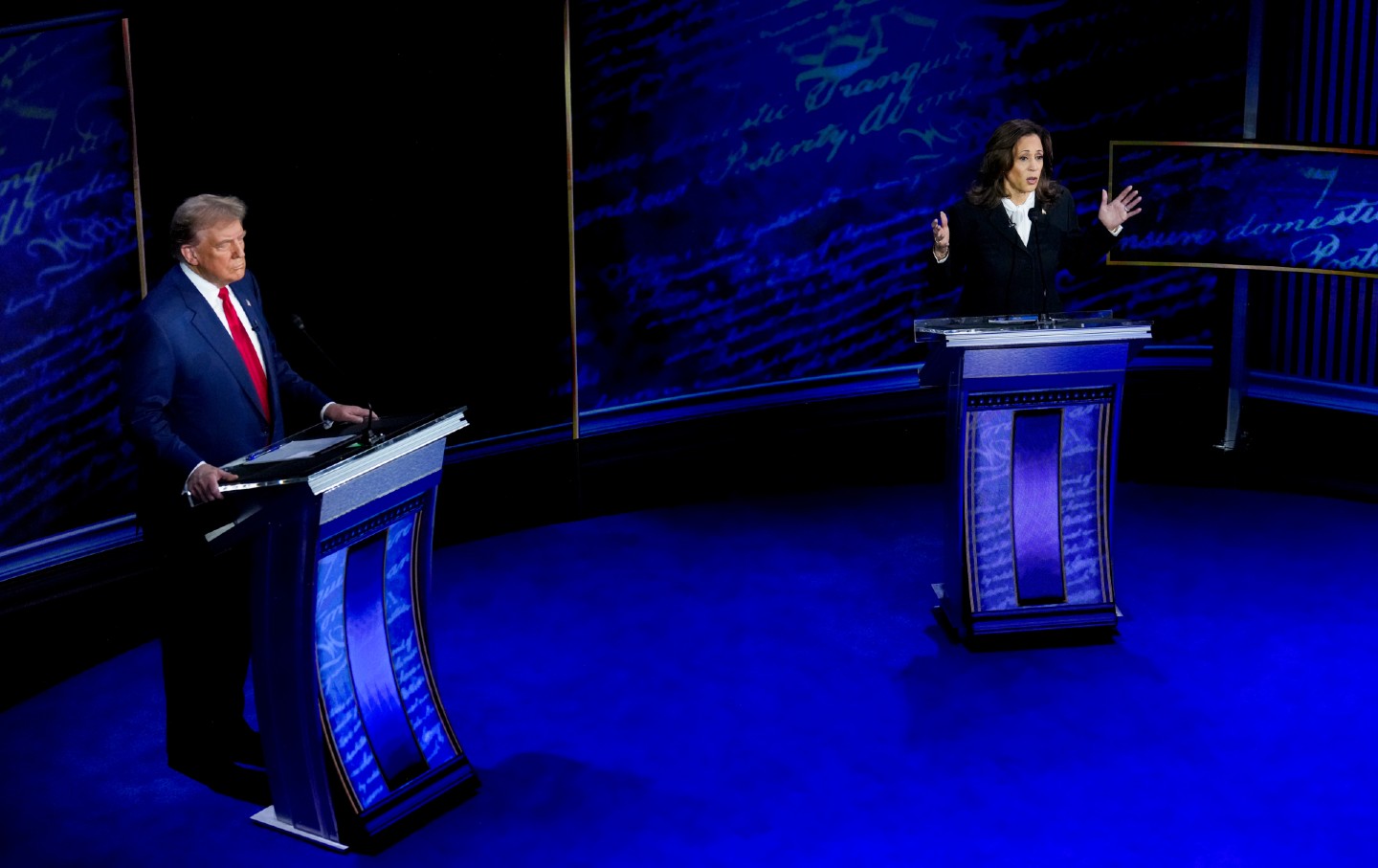
In their debate Tuesday night, Donald Trump and Kamala Harris each sought to cast their opponent as a lackey of China. Bipartisan one-upmanship pushing conflict in the world’s most important geopolitical relationships was a fitting scene to land on “China Week,” House Speaker Mike Johnson’s bid to cast a mishmash of China-related bills as a concerted effort to “win” a confrontation with China. “China poses the greatest threat to global peace,” says Johnson, so “Congress must keep our focus on countering China with every tool at our disposal.”
Nearly 30 bills aimed at extirpating China’s presence in the United States and restricting its activities abroad will have a vote this week. None of the bills under consideration would encourage a constructive relationship between the two powers or mutually beneficial connections between them.
Republicans consistently vilify Democrats as weak on China, with Johnson complaining that “Joe Biden doesn’t treat China like an enemy.” Yet, as reflected in the Trump-Harris debate, Republican leadership is confident of bipartisan support for their confrontational approach. Indeed, by Wednesday night all of the China Week bills thus far considered—over 20—had passed. Most passed on a voice vote, which means they were so uncontested that no recorded vote was taken. Of the six bills on which a vote was recorded, three gained a majority of the Democratic caucus in favor.
That allows Johnson to boast of legislative achievements for a Republican caucus that has demonstrated an unusual inability to pass legislation—even by the extremely low standards that Congress usually maintains. It also allows him to pose as a statesman presiding over bipartisan concern for national security.
The problem is that the sharply imbalanced Republican approach toward China endangers both the future of the international system and hopes for progressive reforms in the United States. Republicans are setting a trap for Democrats, and most Democrats are taking the bait.
China Week has more to do with scoring “tough on China” political points than meaningfully addressing real problems in the world’s most important geopolitical relationship. Like the legislation that Congress approved in April to expropriate TikTok from its Chinese owners, many of the China Week bills focus on attacking Chinese involvement in a given problem rather than confronting the problem itself.
The BIOSECURE Act, for example, targets pharmaceutical companies’ misuse of human multiomic data but imposes restrictions only on those from officially designated adversary nations (China being the overriding concern). Just as the campaign against TikTok played on Americans’ revulsion against rampant privacy abuses among social-media companies but directed that anger against foreigners, so China Week encourages us to channel our anxieties toward China and away from inequalities and injustices issuing from elites closer to home. The outcome is not only a failure to address the underlying problems but an increasingly tense relationship with Beijing as well.
If you’re a Republican member of Congress, embracing a quixotic effort to exclude China from American society and international influence offers obvious political advantages. As the party’s prior emphasis on selfish individualism and unimpeded corporate power have fallen into disrepute, Republicans have turned with renewed vigor to long-standing traditions of uncritical nationalism, cruel nativism, and swaggering militarism. China provides a single villain against which to promote all these themes.
China is the first country in half a century capable of matching American economic dynamism and military might, throwing into doubt the sense of unchallenged dominance the United States has enjoyed since the end of the Cold War. Repudiating the idea that the two countries could advance together through exchange or healthy competition, the nationalists insist that all of China’s activities are a plot to enfeeble and displace the United States. China must not be allowed to gain power. As John Moolenaar, head of the House Select Committee on China, said, “This week, we will draw a line in the sand. With one voice, the US Congress will tell Xi Jinping, this far, and no further.”
If nationalists fear China’s power, nativists regard Chinese people in American society as culturally alien or perceive them as a sinister extension of the Chinese state. After years of economic and cultural exchange, Chinese and American society are interwoven. Chinese students, researchers, exporters, and investors are regular participants in US universities and markets. Chinese companies like TikTok and Shein have made an impact on American culture. All of these provide inviting targets for nativist campaigns to expel foreign influences. Among the China Week legislation, for example, one bill would reinstitute the Department of Justice’s China Initiative, a crackdown on Chinese connections to US research institutions that under Trump engaged in widespread racial profiling and baseless prosecutions against professors who had pursued joint research with their Chinese colleagues.
China also offers militarists a powerful justification for continuing to push Pentagon spending (and arms industry profits) ever higher. Despite the fact that China poses little direct military threat to the US—Beijing spends roughly half as much as Washington on its military—China is regularly cast in Washington as an existential danger. Bold distortions of the Chinese military’s ambitions and capabilities have become as good as fact in some US policymaking circles, promoted by Pentagon contractors like Palantir, whose CEO, Alex Karp, told The New York Times that America will “very likely” end up in a war with China. Calls for Washington to “get serious” about winning an inevitable war with China over Taiwan—coming from influential figures like former representative Mike Gallagher (R-WI), previously chair of the Select Committee and now the head of Palantir’s defense business—will play an important part in pushing annual US military spending above $1 trillion next year.
Best of all, China bashing allows Republicans to posture as anti-elite populists while continuing to secure the interests of their wealthy benefactors. Business was pursuing deindustrialization and offshoring to break the power of unions and drive down wages decades before China was considered a suitable site to exploit labor. American automakers started out with huge advantages over their Chinese counterparts but frittered away their competitive position by refusing to pursue the transition to electric vehicles. The primary threat to rural communities is not minuscule Chinese purchases of land but the consolidation of American agribusiness and the environmental devastation that came in its wake. Rather than confronting the corporate interests responsible for all these problems, Republicans would allow greed and corporate domination to continue unimpeded as long as the plutocrats pledge to fight the Chinese menace.
International conflict and xenophobia are the native terrain of right-wing politics. Democrats in Congress, on the other hand, have much to lose (and little to gain) by embracing confrontation. Key Democratic priorities—whether overcoming the climate crisis or addressing destabilizing actions by Beijing—can only be achieved within the context of a functional relationship, in which consequences for bad behavior are balanced by mutual respect and recognition of shared interests. The one-sided antagonism embodied in China Week forecloses action on shared, existential challenges like pandemic disease and climate disaster, while calling forth destabilizing pushback from Beijing.
Popular
“swipe left below to view more authors”Swipe →Tim Ryan’s 2022 Senate campaign against now-vice-presidential nominee J.D. Vance put this proposition to the test. Ryan ran his campaign on “One Word”: China. Rather than arguing against Vance’s strategy of pitting American workers against Chinese workers, he joined in, insisting, “It’s us versus them.” Confirming the Republican framing of the China threat, voters decided to stick with the party of nationalism and militarism. Ryan lost by over six points.
Many politicians treat China bashing as a cheap way to gain political advantage that will cause no lasting damage. But the stakes are far greater now than they were three decades ago. With China much more powerful and the global system significantly less capacious, the United States and China are at risk of falling into a permanent state of hostility. Should that come to pass, it would indefinitely marginalize progressive priorities in both foreign and domestic policy. Another path is possible—one that would create a foundation for healthy US–China relations without sacrificing progressive values—but it would require Democrats to begin charting their own course rather than mimicking that of their political opponents.
Support independent journalism that does not fall in line
Even before February 28, the reasons for Donald Trump’s imploding approval rating were abundantly clear: untrammeled corruption and personal enrichment to the tune of billions of dollars during an affordability crisis, a foreign policy guided only by his own derelict sense of morality, and the deployment of a murderous campaign of occupation, detention, and deportation on American streets.
Now an undeclared, unauthorized, unpopular, and unconstitutional war of aggression against Iran has spread like wildfire through the region and into Europe. A new “forever war”—with an ever-increasing likelihood of American troops on the ground—may very well be upon us.
As we’ve seen over and over, this administration uses lies, misdirection, and attempts to flood the zone to justify its abuses of power at home and abroad. Just as Trump, Marco Rubio, and Pete Hegseth offer erratic and contradictory rationales for the attacks on Iran, the administration is also spreading the lie that the upcoming midterm elections are under threat from noncitizens on voter rolls. When these lies go unchecked, they become the basis for further authoritarian encroachment and war.
In these dark times, independent journalism is uniquely able to uncover the falsehoods that threaten our republic—and civilians around the world—and shine a bright light on the truth.
The Nation’s experienced team of writers, editors, and fact-checkers understands the scale of what we’re up against and the urgency with which we have to act. That’s why we’re publishing critical reporting and analysis of the war on Iran, ICE violence at home, new forms of voter suppression emerging in the courts, and much more.
But this journalism is possible only with your support.
This March, The Nation needs to raise $50,000 to ensure that we have the resources for reporting and analysis that sets the record straight and empowers people of conscience to organize. Will you donate today?
More from The Nation

An Argument Against Voting for the “Electable” Guy An Argument Against Voting for the “Electable” Guy
In this week’s Elie v. US, The Nation’s justice correspondent shares his thoughts on the Texas primaries. Plus, a terrible Supreme Court decision and a bad play by Major League Ba...


A Conflict Without Reason Has Become a Dangerous Holy War A Conflict Without Reason Has Become a Dangerous Holy War
Lacking a clear rationale for the attack on Iran, Trumpists are increasingly talking like crusaders.
RFK Jr.: America’s Snake Oil Salesman RFK Jr.: America’s Snake Oil Salesman
Raw truth: MAHA is NUTS.

The Unfathomable Toll of the Syrian Civil War The Unfathomable Toll of the Syrian Civil War
How to make sense of the 13-year conflict?
Celebrate Kristi Noem’s Firing. But Keep Protesting ICE. Celebrate Kristi Noem’s Firing. But Keep Protesting ICE.
Finally, someone in the administration is paying for their cruelty and incompetence.

