
Biden Begins 2024 With Better Poll Numbers Than His Foes—and Fans—Recognize
Has Biden turned a corner? Several recent survey have him leading Trump.
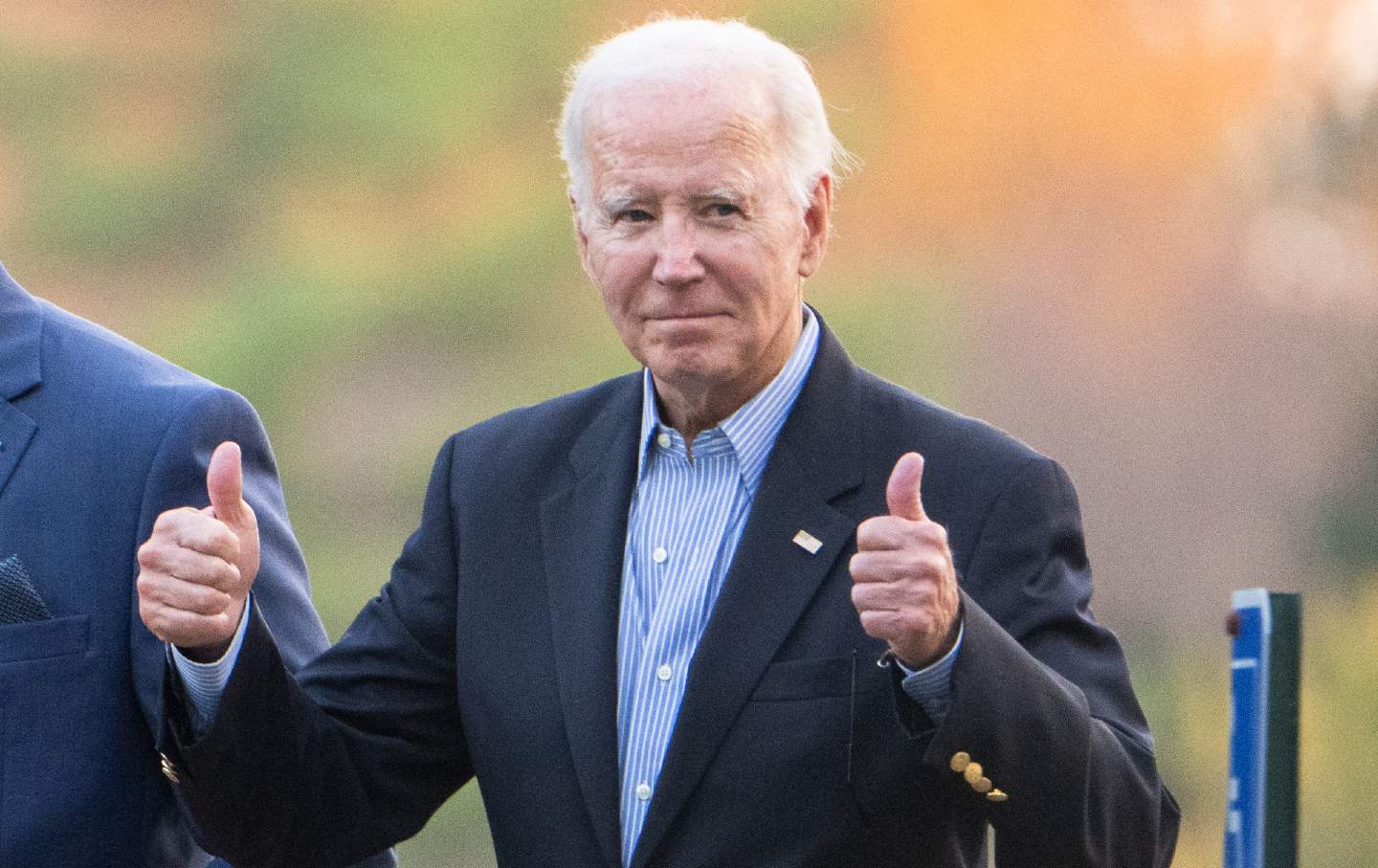
President Joe Biden gives two thumbs up as he leaves St. Joseph on the Brandywine Catholic Church in Wilmington, Del., on October 28, 2023.
(Manuel Balce Ceneta / AP Photo)The biggest mistake that politicians and pundits make when they try to discern the direction of a presidential race is that they read a single poll and think it’s definitional.
A lot of Democrats did exactly that on November 5 when The New York Times published a poll that showed President Joe Biden losing five out of the six most hotly contested battleground states. That, Doug Gordon observed in Newsweek, inspired “a palpable chorus of Democratic freakout and bedwetting.” Yet ensuing surveys from several of those same battleground states put Biden back in the lead. Moreover, Biden’s numbers in national polls, which in early November were distressing for Democrats, weren’t looking all that bad as 2023 came to an end.
Of the 10 most recent polls listed on Real Clear Politics, as of December 29, Biden was leading in three of them and tied in two others. There were five polls in which former president Donald Trump—the twice-impeached and 91-times-indicted front-runner for the Republican presidential nomination—was ahead. But at least three had significant enough margins of error to suggest Trump’s advantage was, at best, shaky.
That polling pattern is not cause for New Year’s celebration among Democrats. They have a lot of work to do if they’re going to prevail in what always was, and still is, likely to be a close contest. But the end-of-the-year survey data challenges the notion, which took hold in November and lingers to this day among Republicans and many fretful Democrats, that Biden has little chance of holding the White House.
To be sure, the president’s approval ratings remain miserable—but then Trump’s favorability ratings are even dismal.
Barring an unexpected development that denies one or both front-runners their party nomination, this year’s presidential race won’t pit a pair of popular contenders against one another. This isn’t going to be like Franklin Roosevelt against Wendell Willkie in 1940 or even Jimmy Carter against Gerald Ford in 1976. This is going to be a bitter slog involving two much-maligned candidates setting themselves up to argue that the other guy is worse. But in a close race, the issues—especially issues related to the economy—will play a role, too. And if Biden delivers his message effectively, it should benefit the incumbent.
Biden knows this, which is one reason he doesn’t panic over polls in the way some of his supporters do.
Biden’s been running for the presidency since, at least, the mid-1980s, and his poll numbers have rarely been great. His strength has never been his popular appeal. It’s been the notion that he is an experienced hand who can do the job. Sometimes that hasn’t been enough to win, as in his 1988 and 2008 bids for the Democratic presidential nomination—although the 2008 run did yield an invitation to run on Barack Obama’s ticket and ultimately the vice presidency. And in the chaotic presidential election year of 2020, it was enough to finally secure his party’s nomination and the presidency.
On the way to his 2020 victory, Biden’s polls were seldom inspiring. He trailed during most of the primary race, and even toward the end of the fall competition, there were polls that put him up only by a point or so. Surveys from the battleground states, while generally favorable to the Democrat, were all over the place when it came to the size of the split between the candidates. Ultimately, Biden won 51.3 percent of the popular vote nationally, leading Trump by more than 7 million ballots. Biden carried the Electoral College—after many state-based challenges, recounts, court battles, and an insurrection—by a comfortable 306-232 margin.
If Biden gets his disjointed reelection campaign together and starts to deliver a coherent and consistent message, it’s a good bet that 2024 will turn out similarly or, perhaps, even better for Democrats than 2020. Biden’s message will focus on Trump’s many scandals and the increasingly authoritarian rhetoric of his desperate candidacy. But what may be president’s greatest strength going into the 2024 race was summed up by Steven Rattner in an end-of-2023 New York Times opinion piece that used multiple charts to convey the point that the US economy “beat the odds in 2023, coming in with far lower unemployment, far higher growth, and far better stock performance than projected.”
The economy is not, by a long shot, the only issue that will matter in 2024. Abortion rights concerns will undoubtedly turn out voters who favor Biden. By the same token, the president’s flawed response to the Israel-Palestine conflict, and especially to the Israeli assault on Gaza, could depress enthusiasm among young voters and Muslim Americans in swing states such as Michigan. And even if the economy were the only issue, Biden’s approach still leaves plenty to be desired in the eyes of many voters.
But as veteran pollster and commentator Cornell Belcher said after reviewing Rattner’s upbeat assessment of the numbers, “Maybe, just maybe, Democrats should say this over and over and over again to voters at every turn and on every platform—kinda like a coordinated message or something, while taking credit for it.”
If the president and his partisan allies take that advice and the economy remains strong, there’s a compelling case Biden’s polling position will improve as the 2024 race unfolds.
Support independent journalism that does not fall in line
Even before February 28, the reasons for Donald Trump’s imploding approval rating were abundantly clear: untrammeled corruption and personal enrichment to the tune of billions of dollars during an affordability crisis, a foreign policy guided only by his own derelict sense of morality, and the deployment of a murderous campaign of occupation, detention, and deportation on American streets.
Now an undeclared, unauthorized, unpopular, and unconstitutional war of aggression against Iran has spread like wildfire through the region and into Europe. A new “forever war”—with an ever-increasing likelihood of American troops on the ground—may very well be upon us.
As we’ve seen over and over, this administration uses lies, misdirection, and attempts to flood the zone to justify its abuses of power at home and abroad. Just as Trump, Marco Rubio, and Pete Hegseth offer erratic and contradictory rationales for the attacks on Iran, the administration is also spreading the lie that the upcoming midterm elections are under threat from noncitizens on voter rolls. When these lies go unchecked, they become the basis for further authoritarian encroachment and war.
In these dark times, independent journalism is uniquely able to uncover the falsehoods that threaten our republic—and civilians around the world—and shine a bright light on the truth.
The Nation’s experienced team of writers, editors, and fact-checkers understands the scale of what we’re up against and the urgency with which we have to act. That’s why we’re publishing critical reporting and analysis of the war on Iran, ICE violence at home, new forms of voter suppression emerging in the courts, and much more.
But this journalism is possible only with your support.
This March, The Nation needs to raise $50,000 to ensure that we have the resources for reporting and analysis that sets the record straight and empowers people of conscience to organize. Will you donate today?
More from The Nation
An Argument Against Voting for the “Electable” Guy An Argument Against Voting for the “Electable” Guy
In this week’s Elie v. US, The Nation’s justice correspondent shares his thoughts on the Texas primaries. Plus, a terrible Supreme Court decision and a bad play by Major League Ba...

A Conflict Without Reason Has Become a Dangerous Holy War A Conflict Without Reason Has Become a Dangerous Holy War
Lacking a clear rationale for the attack on Iran, Trumpists are increasingly talking like crusaders.
RFK Jr.: America’s Snake Oil Salesman RFK Jr.: America’s Snake Oil Salesman
Raw truth: MAHA is NUTS.
The Unfathomable Toll of the Syrian Civil War The Unfathomable Toll of the Syrian Civil War
How to make sense of the 13-year conflict?
Celebrate Kristi Noem’s Firing. But Keep Protesting ICE. Celebrate Kristi Noem’s Firing. But Keep Protesting ICE.
Finally, someone in the administration is paying for their cruelty and incompetence.

