Memo to Biden: Israel and Ukraine Are Not the Same
In linking two very different wars, Biden undermines Ukraine’s moral and legal case for sovereignty.
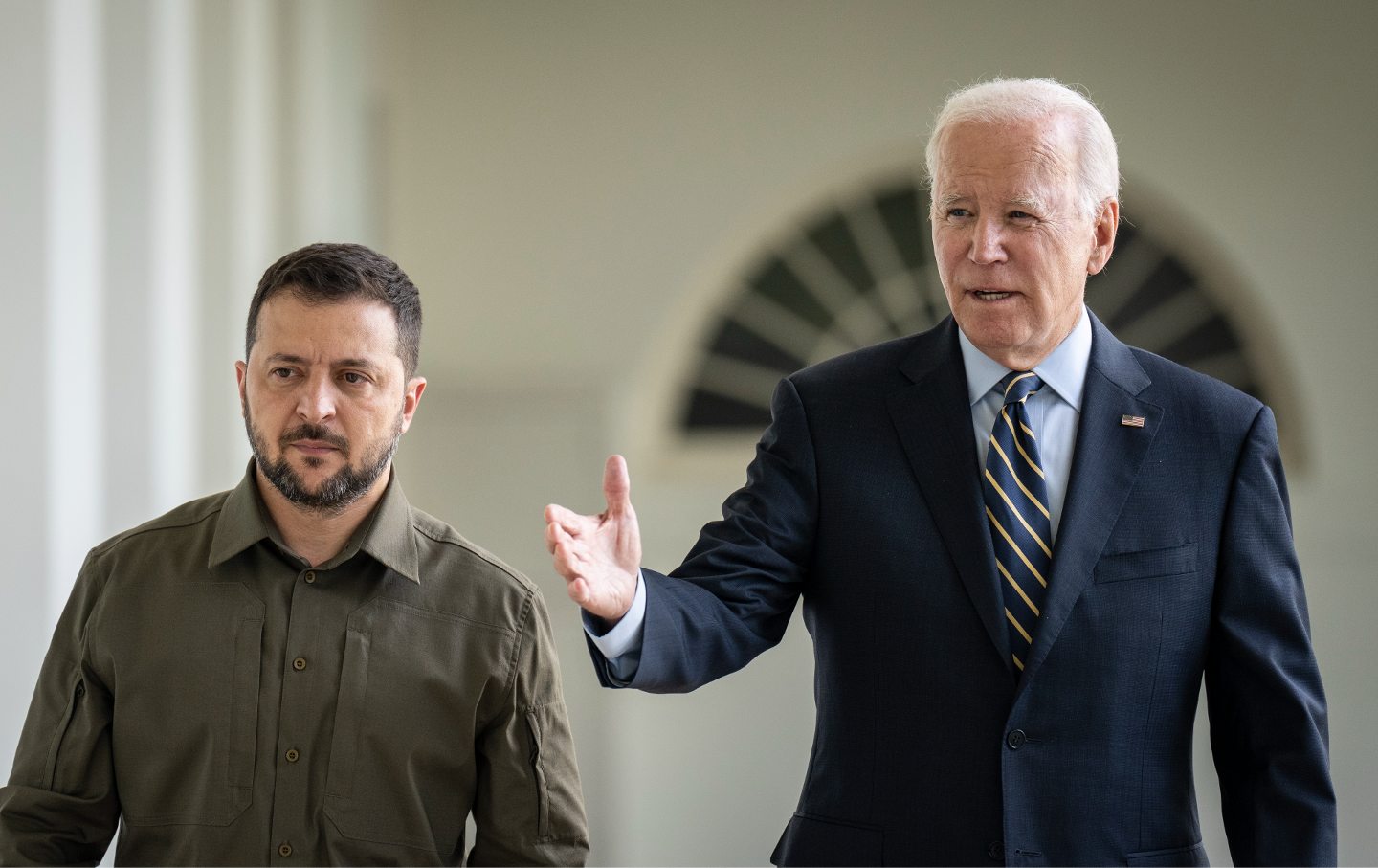
President of Ukraine Volodymyr Zelensky and US President Joe Biden walk to the Oval Office of the White House September 21, 2023, in Washington, D.C.
(Drew Angerer / Getty Images)In his speech from the Oval Office on October 20, President Biden drew a direct parallel between two ongoing wars in which the United States is intimately involved: the Russia-Ukraine war that has raged since February 2022, and Israel’s rapidly expanding war in the Palestinian territories following the October 7 Hamas attacks. “The assault on Israel echoes nearly 20 months of war, tragedy, and brutality inflicted on the people of Ukraine,” said Biden. “Hamas and Putin represent different threats, but they share this in common: They both want to completely annihilate a neighboring democracy.” It’s an awkward, even offensive, comparison.
Russia is Ukraine’s former imperial master and a much larger and more powerful country. Most Americans rightly understand Russia to be waging a straightforward war of aggression—and that by refusing to surrender to Russia, Ukrainians have been engaged in a war of resistance, defending their basic right to sovereignty. By contrast, it is Israel that militarily dominates the Palestinians, not the other way around. It’s Israel that occupies the West Bank and colonizes it with settlers in violation of international law; Israel that maintains the suffocating blockade that keeps more than 2 million Palestinians trapped in Gaza and dependent on Israel for food, water, and electricity; Israel that has international legal recognition, a high-tech army, and, like Russia, nuclear weapons.
And yet in Biden’s framing, Israel is the underdog, which is how he morally justifies his proposal to grant Israel billions of dollars in new military aid (part of a $105 billion package that also includes additional aid to Ukraine and money for US border security). Biden’s comparison of Putin, the dictator of a major world power with a permanent seat on the UN Security Council, to Hamas, a militant faction officially recognized by no government on earth, is laughable; it is also a succinct encapsulation of US policy.
But as strange as Biden’s formulation may seem, he’s not alone; Ukrainian President Volodymyr Zelensky drew a similar analogy just days after Hamas’s incursion into Israel, telling the NATO Parliamentary Assembly that Russia and Hamas are “the same evil, and the only difference is that there is a terrorist organization that attacked Israel, and here is a terrorist state that attacked Ukraine.” In fact, Zelensky has been associating Ukraine with Israel since well before the Hamas attacks; in April 2022, he told Haaretz that he expected Ukraine to develop less as a “liberal, European” state than as a “Big Israel.” “We will not be surprised if we have representatives of the armed forces or the national guard in cinemas, supermarkets, and people with weapons,” said Zelensky. “I am confident that the question of security will be issue number one for the next ten years.”
From the perspective of international law, it should be clear that Russia and Israel are the occupying powers in their respective wars, and that Ukrainians and Palestinians are occupied peoples resisting domination. But from a different perspective, Ukraine as a “Big Israel” almost makes sense. Both countries present themselves as being on the front lines of a global struggle between the developed West and the proverbial barbarians at the gates. The globe-trotting French intellectual Bernard-Henri Lévy recently drew a set of parallels between Ukraine and Israel on Twitter: “Same values at stake (democracy & liberalism),” Lévy wrote. “Therefore, same fight. #StandwithIsrael #StandwithUkraine” To Lévy, Israel and Ukraine belong to the liberal West, while Russia, Iran, and Hamas are the West’s civilizational enemies.
Ukraine’s long-term geopolitical goal is membership in the European Union and NATO, confirming its status as an integral part of Europe. Its support has come primarily from the major Western countries, led by the United States; in the rest of the world, there has been an almost uniform refusal to accept Washington’s framing of the conflict, while Putin, who has attempted to position himself as a leader of the resistance to Western global hegemony, was one of the first world leaders to call for a diplomatic resolution to the current crisis, as opposed to backing Israel’s military response. Israel likewise relies heavily on Western—above all US—support and has often struggled diplomatically in the Global South, where public opinion typically regards the Palestinians as fighting an anti-colonial struggle. (Israel has stayed essentially neutral between Russia and Ukraine, given its extensive ties to both countries.)
At least in the United States, Ukraine has had little difficulty presenting itself to a receptive public as the clear underdog. Israel has traditionally played a similar role in the US imagination since its 1948 founding; as its position in the Middle East has grown steadily more secure (and its position over the Palestinians steadily more dominant) over subsequent decades, Israeli has put considerable resources into propaganda casting itself as besieged and vulnerable. The US media has overwhelmingly accepted this framing, which helps explain why Americans tend to sympathize with Israel over the Palestinians—especially in the wake of the October 7 attacks, a rare and viscerally upsetting example of mass violence against Israeli civilians.
In general, US progressives have tended to support Ukraine while being far more critical of Israel and increasingly vocal about the basic justice of the Palestinian cause. By drawing close parallels between the two conflicts, Biden risks weakening progressive support for Ukraine—already fragile in some quarters given a stalled counteroffensive, global anxiety about food and energy price spikes, and the skepticism many on the left feel about long-term US military commitments. Biden’s conflation of these two very different wars undermines any argument that the US supports Ukraine out of a principled defense of the right to self-determination. Instead, he’s sent a message to the world that these principles only apply to Western-coded client states fighting America’s geopolitical and civilizational rivals. Given Biden’s sagging approval rating, it could even create an opening for the Trump-led Republicans to push to withdraw aid to Ukraine and to find more cross-partisan support for that position than they might have.
That would be a tragedy for the Ukrainians, whose right to freedom from foreign military occupation is inherent and shouldn’t depend on anyone’s particular political alignment any more than Palestinians’ should. Writing in this magazine the week of Russia’s invasion, Yousef Munayyer criticized the double standards of those in Western media who (rightly, in his view) champion the right of Ukrainians to resist occupation by force while hypocritically denying Palestinians the same right. “If we want there to be an international norm against aggression, colonization, and the acquisition of land by force, we can’t keep making exceptions for our friends when they violate it,” Munayyer wrote. But not only has Biden made an exception for Israel; he’s made a tortured case that Israel is in fact the victim of the very aggression it carries out.
Those of us on the left who support both the Ukrainians and the Palestinians in their respective struggles should continue to do so, even if the Biden administration has made that harder with its clumsy and misleading analogy. The US government may not have consistent principles, but we still can.