Barack Obama Is the Last American Transcendentalist
The former president’s preternatural optimism is still powerful—and contagious. But is it justified?
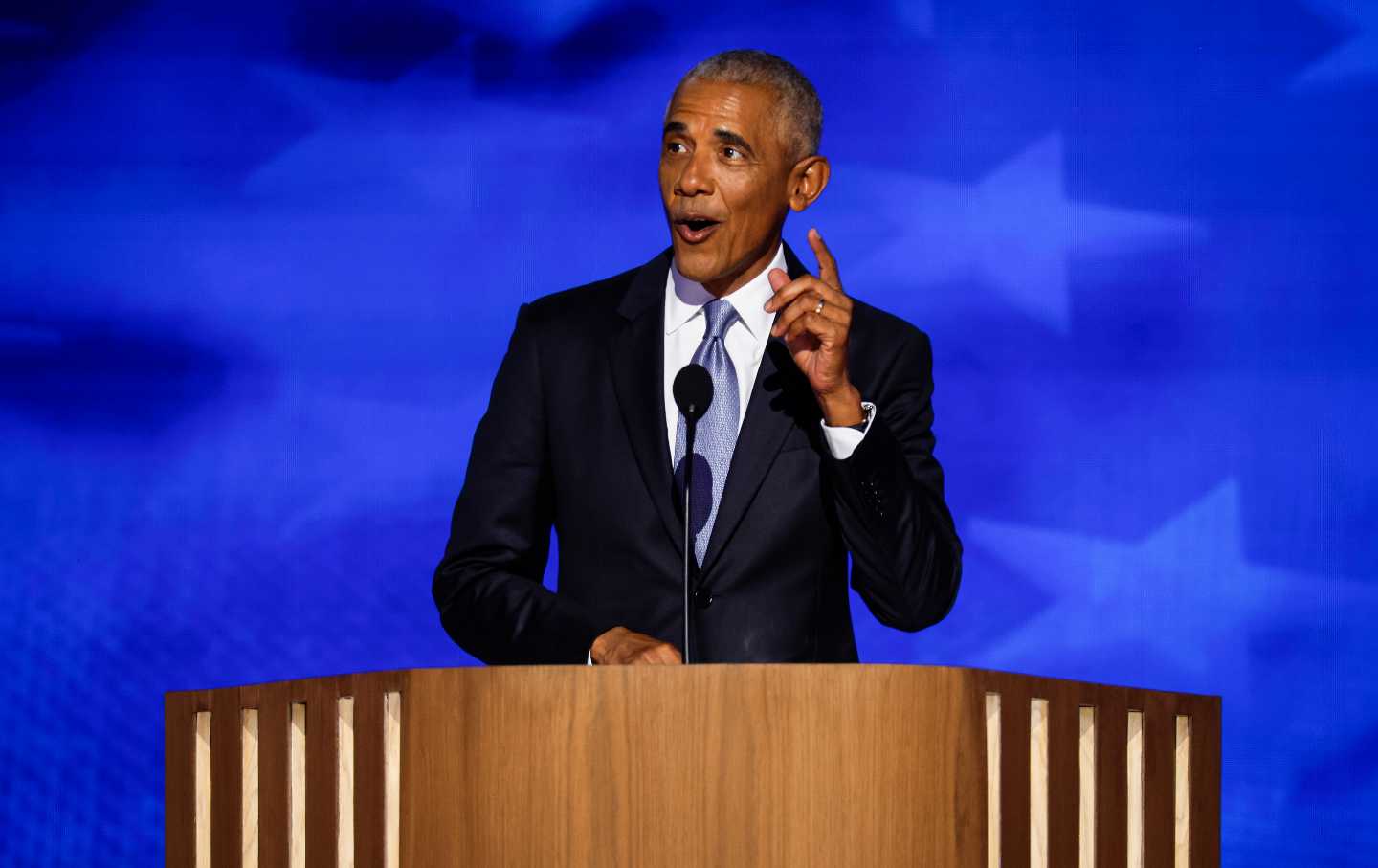
Contrary to what you may have read elsewhere, and with the greatest respect to my colleague Jeet Heer, Barack Obama is not the greatest living orator in American politics. Or even, for that matter, in the city of Chicago. For as long as he still draws breath, that title will belong to Jesse Jackson, as those of us lucky enough to have seen him in his prime can attest. The reverend’s voice may have been diminished by age and illness. But at a Nation tribute on Sunday night, on the eve of the convention, his spirit shined as brightly as ever.
Obama may not even have been the best speaker on the podium Tuesday night. That palm probably goes to his wife, Michelle Obama, whose very presence in the spotlight electrified the crowd of 22,000, and whose poise and political acumen had some of us scratching our heads and wondering, “Is this really the woman who is supposed to hate politics?” Michelle—who famously and reluctantly endured eight years of public scrutiny, probing everything from her physique to her fashion choices—got personal, disclosing just how much Donald Trump’s “ugly, misogynistic, racist lies” attacking her husband and her family had stung. She also got off the best line of the night when she asked, “Who’s going to tell him that the job he’s currently seeking might just be one of those ‘Black jobs’?”
But then Obama, whose heat-seeking barbs belittling Trump at the 2011 White House correspondents’ dinner reportedly so enraged the failed casino operator and mid-level Manhattan real estate developer that he decided to run for president himself, didn’t come to Chicago seeking revenge. (Though he couldn’t resist having a little fun with Trump’s “weird obsession with crowd sizes,” a now-viral remark he punctuated with a suggestive hand gesture.) Instead, Obama did what he did so often as president, and rose above.
A long time ago, in another country, I wrote that “all successful politicians have superpowers,” that Obama’s was “intelligence—and the capacity to make some people forget his race.” Trump’s, on the other hand, was “to be consistently underestimated.”
That may have been true at the time. But now I’d want to amend both suggestions. There may still be a few liberal pundits foolish enough to believe that Donald Trump is stupid, his finances precarious, his campaign a shambles. To which the only reasonable retort is: If you’re so much smarter, why aren’t you rich? Or president? Underestimating Trump has proven to be such a dangerous business few even try anymore. (J.B. Pritzker may just have the standing to pull it off.) Still, having survived two impeachments, too many indictments to list here, 34 felony convictions, a disastrous VP choice, and an attempted assassination, it seems fairly clear that Trump’s real superpowers are preternatural luck—and “the power to cloud men’s minds.” Though unlike The Shadow, Trump uses that power for evil ends.
As for Barack Obama, he’s still the smartest person in any room. But his real superpower has little to do with intelligence or race—or even politics. Not since Abraham Lincoln has any US president possessed such a power for summoning “the better angels of our nature.”
In concluding his first inaugural address—delivered two and a half months after South Carolina’s secession—with the phrase, “We are not enemies, but friends. We must not be enemies,” Lincoln drew on his accommodating temperament. But he also revealed himself as a product of his time—an era when American Transcendentalism, rooted in the rocky soil of New England but spreading through the land, proclaimed the innate goodness of human beings and the ultimate perfectibility of human nature.
Some observers have criticized Obama’s convention remarks for lowering the temperature in the room after his wife’s barnburner of a speech. My guess is that this was deliberate. Both of them are clearly strong supporters of Kamala Harris. And deeply committed to defeating Donald Trump. But, as was often the case during his presidency, Barack Obama has his eye on a prize beyond mere politics.
Compare Henry David Thoreau’s admonition “rather than love, than money, than fame, give me truth,” with what, at least to this member of the audience Tuesday night, seemed less like a digression and more like the heart of what Obama had come to tell us:
We live in a time of such confusion and rancor, with a culture that puts a premium on things that don’t last: money, fame, status, likes. We chase the approval of strangers on our phones. We build all manner of walls and fences around ourselves, and then we wonder why we feel so alone. We don’t trust each other as much because we don’t take the time to know each other. And in that space between us, politicians and algorithms teach us to caricature each other and troll each other and fear each other.
What does this have to do with electoral politics? Maybe nothing.
But Obama’s appeal as a politician has never depended on his espousal of particular policies or programs. That’s why his presidency proved such a bitter disappointment to so many progressives who convinced ourselves that the shape-shifting community organizer from Chicago was one of us.
He was, and remains, a transformative figure in American life. Not for what he delivered as chief executive, but for what he summoned—and continues to summon—in us. Coalition politics of the kind practiced by Democrats from Franklin Roosevelt to Lyndon Johnson to Joe Biden relies on simple addition. And when the numbers add up, it can be a powerful mechanism for demanding and generating change.
But as we saw in the months before Biden withdrew from the campaign, the sums weren’t in our favor this time. The Biden coalition was headed for a defeat that, given the opposition, would have been catastrophic for the country.
In his speech last night Obama conjured an alternative path, beyond the sordid “What have you done for me lately?” demands of conventional politics. Even though I’m a lot older, and hopefully a little wiser, than I was in 2008, I found it thrilling.
Are the better angels of our nature still listening? We’re about to find out.