With Trump in Office, How Much Will TV Networks Self-Censor?
US broadcasters’ cowardice around the “Gulf of America” throws into question their future coverage of climate change.
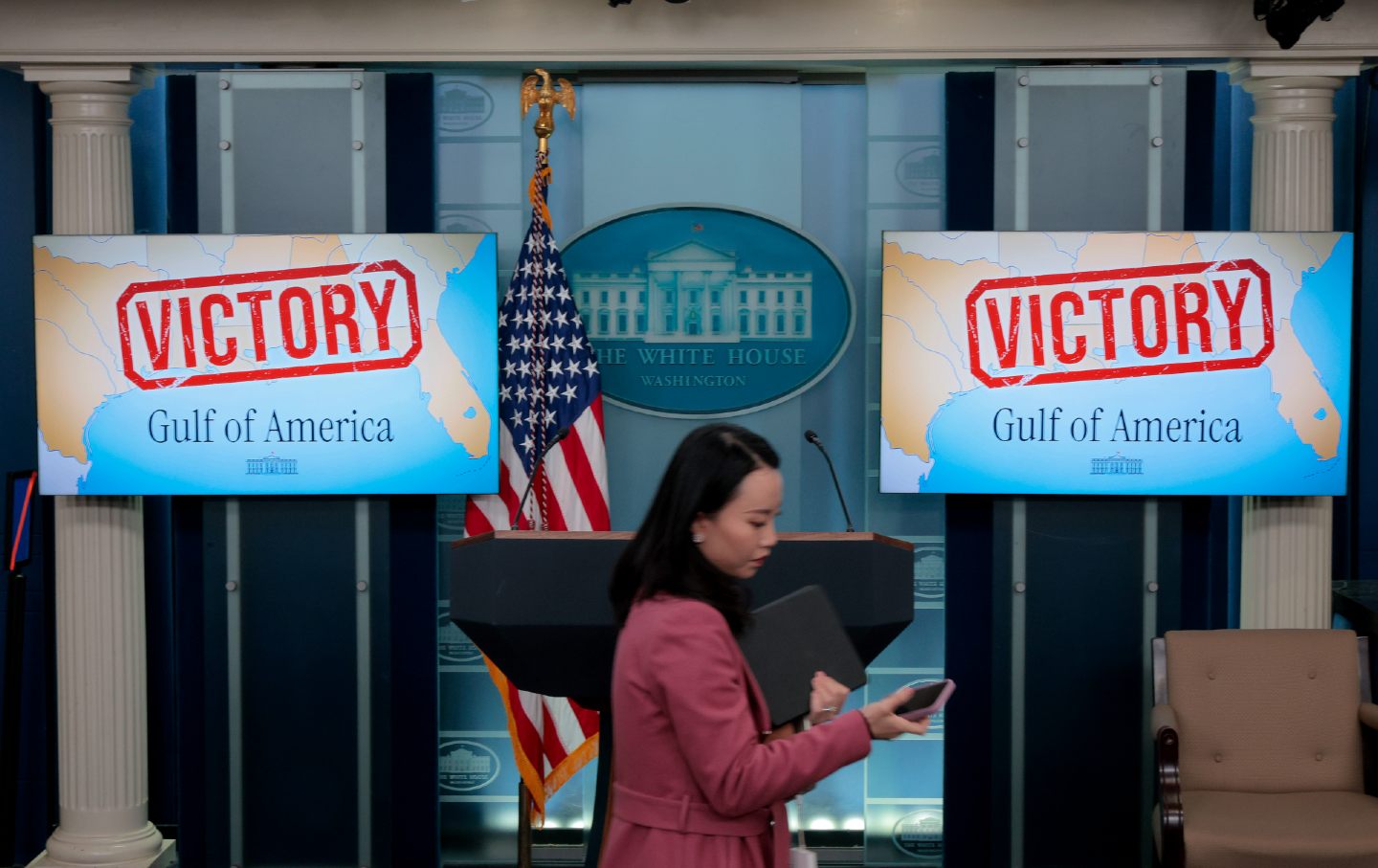
The White House Press Briefing Room on February 24, 2025 in Washington, DC.
(Chip Somodevilla / Getty Images)
“When the other three estates fail, when the judiciary and the executive and the legislative branches fail us, the Fourth Estate has to succeed,” actor George Clooney said last Sunday on CBS’s 60 Minutes, America’s top rated TV news program for 50 years. Clooney was promoting his appearance in the Broadway production of Good Night, and Good Luck, his 2005 movie about Edward R. Murrow, the legendary CBS News broadcaster who, in the 1950s, stood up to the witch hunting of McCarthyism. A lesson from that era applies today as well, Clooney added: “Journalism and telling truth to power has to be waged, like war is waged. It doesn’t just happen accidentally. It takes people saying, ‘We’re going to do these stories and you’re going to have to come after us.’”
Unfortunately, America’s major TV networks sent quite the opposite message in their coverage of stranded NASA astronauts’ return to Earth. Eagle-eyed media writer Oliver Darcy disclosed the details in his Status newsletter, focusing on the refusal of ABC News, CBS News, NBC News, and CNN “to call the body of water [the astronauts] splashed into….the Gulf of Mexico, the water feature’s name since the 16th century.”
“Instead,” Darcy continued, “television news organizations tied themselves in knots, performing linguistic gymnastics to stay out of Donald Trump’s crosshairs, while also tiptoeing around audiences who would have surely been incensed to see them bend the knee and call it the ‘Gulf of America.’”
The corresponding question for climate reporting almost asks itself: Will US broadcasters now be similarly squeamish about stating as fact the long-settled science that climate change is real, extremely dangerous, and caused mainly by burning fossil fuels? Will news organizations perhaps stop using the term “climate change” altogether, now that Trump has had it removed from many government websites? Such self-censorship would not only mislead the public but betray journalism’s civic responsibility to hold power accountable. “Words are the front lines of truth,” Darcy wrote, “and once they’re ceded, it becomes far easier for strongmen like Trump to shape reality.”
The deeper problem is that journalists are under pressure not only from Trump but from their corporate owners. It’s no accident that ABC, CBS, NBC, and CNN all capitulated by employing “off the coast of Florida” or other euphemisms for the Gulf of Mexico, Darcy argued. Broadcast news operations, he noted, have “standards departments” that rule on what their reporters can and cannot say on the air—departments that answer to corporate superiors.
It’s understandable that TV networks want to retain their White House access. But Trump has an insatiable craving for attention and wants TV cameras inside the White House as much as the networks do. Instead of caving to his absurd demands, TV networks and their owners might want to remember a lesson from grade school: Not standing up to a bully only encourages more bullying.
Bear in mind as well the animating fact of Covering Climate Now’s 89 Percent Project: The vast majority of the world’s people—80 to 89 percent, according to recent science—want their governments to take stronger climate action. This overwhelming majority is but one indication among many that Trump’s authoritarianism, like his long-standing climate denial, isn’t popular with the mass public that TV news in particular targets. Leaning into better climate coverage is likelier to appeal to that mass public than bending the knee to a wannabe dictator.