July 17, 2025

Americans Are Concerned About Climate Change—but They Should Be Afraid

Americans still don’t comprehend how imminent, dangerous, and far-reaching the threat is—and journalists are partly to blame.
Mark Hertsgaard
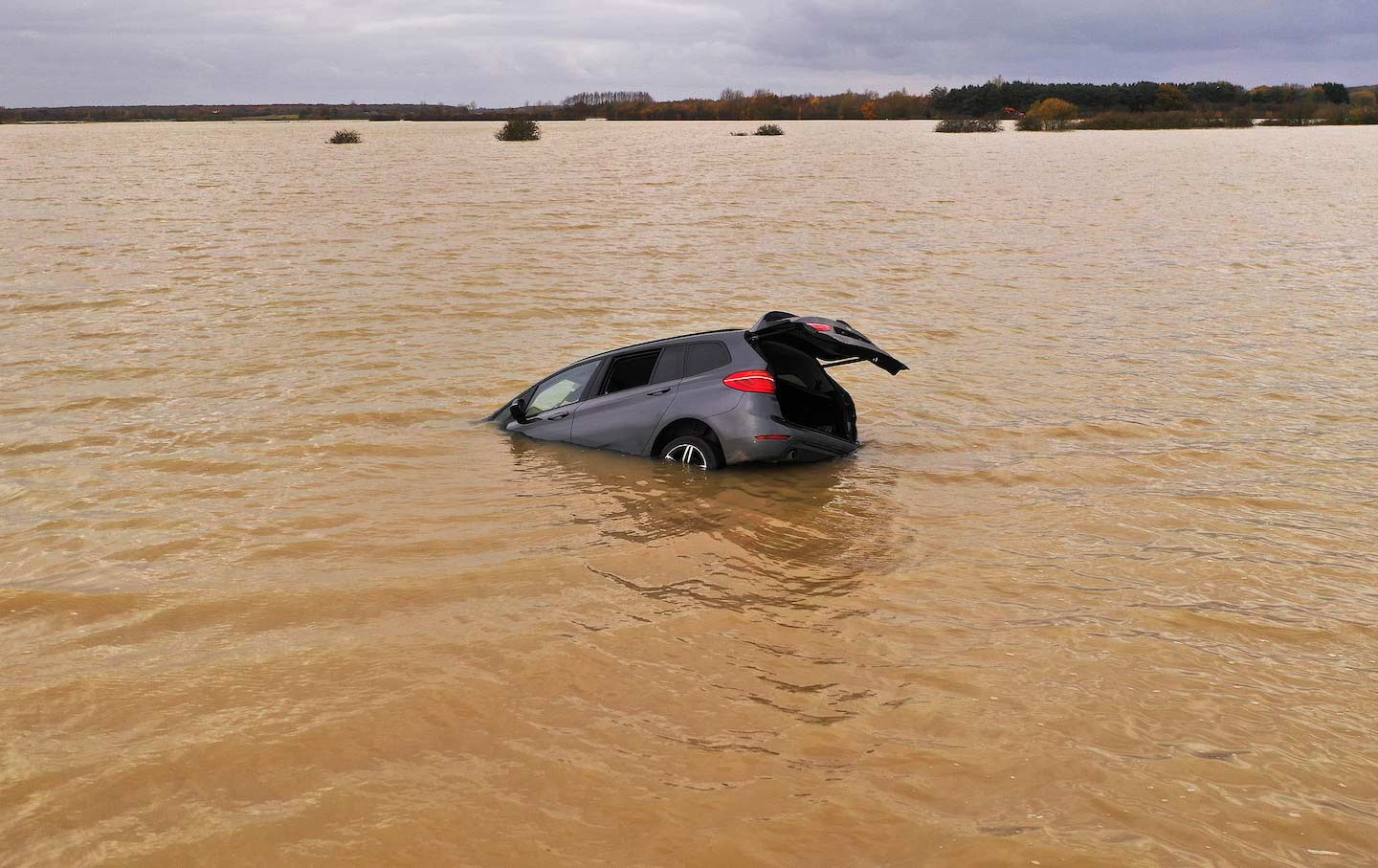
A car is seen part submerged in floodwater in England, 2019.
A car is seen part submerged in floodwater in England, 2019. (Christopher Furlong / Getty Images)

Last Thursday, CNN ran a story that inadvertently underscored the fact that most journalism is still not getting across the full truth about climate change. Harry Enten, CNN’s polling analyst, displayed Gallup data showing that 40 percent of Americans are “greatly worried” about climate change. But this 40 percent is “the exact same percentage as [were worried] back in 2000,” he pointed out, “despite everything we see [today] on our television screens, our computer screens…the hurricanes, the tornados, the flooding.”

“Americans aren’t afraid of climate change,” Enten concluded. “Climate activists have not successfully made the case to the American people.”

Perhaps not, but neither have most journalists. The extreme weather events Enten cited have gotten extensive news coverage, but most of that coverage did not make the climate connection. As we noted last month, “In the summer of 2024, for example, when record high temperatures brutalized outdoor workers, withered crops, and worsened hurricanes, only 12 percent of US national TV news segments mentioned climate change, though its role in driving such extreme heat has long been scientifically indisputable.”

Anthony Leiserowitz, the executive director of the Yale Program on Climate Change Communication, said Yale’s latest survey found that only 29 percent of Americans are “very worried” about climate change—a remarkably low number, considering that climate change is already killing people and devastating communities around the world and threatens much worse if left unchecked.

“I constantly make the point that only 29 percent are very worried, when it should be 100 percent,” Leiserowitz told Covering Climate Now. “This reflects [climate change’s] lack of salience for most Americans. There are many who are not deniers, but do not adequately understand the risks, that the impacts are here and now, and the urgency of action.”

These numbers also shed light on The 89 Percent Project that CCNow and dozens of news outlets have been reporting this year. The project is grounded in a cluster of scientific studies finding that 80 to 89 percent of the world’s people want governments to “do more” about climate change.

Current Issue

Cover of April 2026 Issue

In the United States, the percentage of people supporting stronger climate action is 74 percent. Why, then, are significantly smaller percentages “greatly worried” about climate change?

“There’s a big difference between general support for stronger climate action and prioritizing climate action,” Leiserowitz said. He invoked a concept from political science, the issue public, defined as “a relatively small proportion of the general public that is both passionate about an issue and directly engaged in taking political and personal action.” He added, “While it’s important to have a large majority of the public supporting action (e.g., 89 percent), most issues also need an organized, powerful ‘issue public’ that is loudly demanding policy change and implementing personal change.”

The fact that less than half of the public is “greatly worried” about climate change shows that most Americans still don’t comprehend how imminent, dangerous, and far-reaching the threat is. There is a “critical need for better climate communications,” Leiserowitz said, “especially quality media reporting.”
Support independent journalism that does not fall in line

Even before February 28, the reasons for Donald Trump’s imploding approval rating were abundantly clear: untrammeled corruption and personal enrichment to the tune of billions of dollars during an affordability crisis, a foreign policy guided only by his own derelict sense of morality, and the deployment of a murderous campaign of occupation, detention, and deportation on American streets. 

Now an undeclared, unauthorized, unpopular, and unconstitutional war of aggression against Iran has spread like wildfire through the region and into Europe. A new “forever war”—with an ever-increasing likelihood of American troops on the ground—may very well be upon us.  

As we’ve seen over and over, this administration uses lies, misdirection, and attempts to flood the zone to justify its abuses of power at home and abroad. Just as Trump, Marco Rubio, and Pete Hegseth offer erratic and contradictory rationales for the attacks on Iran, the administration is also spreading the lie that the upcoming midterm elections are under threat from noncitizens on voter rolls. When these lies go unchecked, they become the basis for further authoritarian encroachment and war. 

In these dark times, independent journalism is uniquely able to uncover the falsehoods that threaten our republic—and civilians around the world—and shine a bright light on the truth. 

The Nation’s experienced team of writers, editors, and fact-checkers understands the scale of what we’re up against and the urgency with which we have to act. That’s why we’re publishing critical reporting and analysis of the war on Iran, ICE violence at home, new forms of voter suppression emerging in the courts, and much more. 

But this journalism is possible only with your support.

This March, The Nation needs to raise $50,000 to ensure that we have the resources for reporting and analysis that sets the record straight and empowers people of conscience to organize. Will you donate today?

Mark Hertsgaard

Mark Hertsgaard is the environment correspondent of The Nation and the executive director of the global media collaboration Covering Climate Now. His new book is Big Red’s Mercy:  The Shooting of Deborah Cotton and A Story of Race in America.

More from The Nation

A dark smoke cloud engulfs destroyed vehicles following a US-Israeli airstrike on the Shahran oil refinery in northwestern Tehran on March 8, 2026.

Fortress America Is Now Our Main Climate Policy Fortress America Is Now Our Main Climate Policy

The US spends trillions not to prevent climate catastrophe but to protect the country from climate refugees and resource conflicts.

Sarah Lazare

Trump and his Environmental Protection Agency have made it easier for polluters to profit off our families, our public health, and our planet, writes Representative Lee.

Rep. Summer Lee: The Fight for Environmental Justice Is Far From Over Rep. Summer Lee: The Fight for Environmental Justice Is Far From Over

The Trump administration’s destructive environmental policies will cost us all. But we must not give up.

Summer Lee

Fire breaks out at the Shahran oil depot after US and Israeli attacks in Tehran, Iran, on March 8, 2026.

A World on Fire Needs More Climate Reporting—Not Less A World on Fire Needs More Climate Reporting—Not Less

War is a climate story, but billionaire media owners don’t want to tell it.

Kyle Pope

Natural Man

Natural Man Natural Man

Russ Feingold is on a new mission: preserving nature to save the planet.

Feature / John Nichols

Men watch from a hillside as a plume of smoke rises after an explosion on March 2, 2026, in Tehran, Iran.

The Iran War Is Also a Climate War The Iran War Is Also a Climate War

Climate change is not a peripheral part of what we’re seeing in Iran—it’s structurally embedded in modern warfare.

Mark Hertsgaard and Giles Trendle

US President Donald Trump speaks during a State of the Union address in the House Chamber of the US Capitol in Washington, DC.

The Planet-Sized Hole in Trump’s State of the Union Address The Planet-Sized Hole in Trump’s State of the Union Address

Although climate change received no attention during the president’s speech, Americans must continue to find new ways of making progress against the ongoing environmental crisis.

StudentNation / Ilana Cohen