What’s Next for Covering Climate Now’s 89 Percent Project
An overwhelming global majority supports stronger climate action. Who are the people behind the numbers?
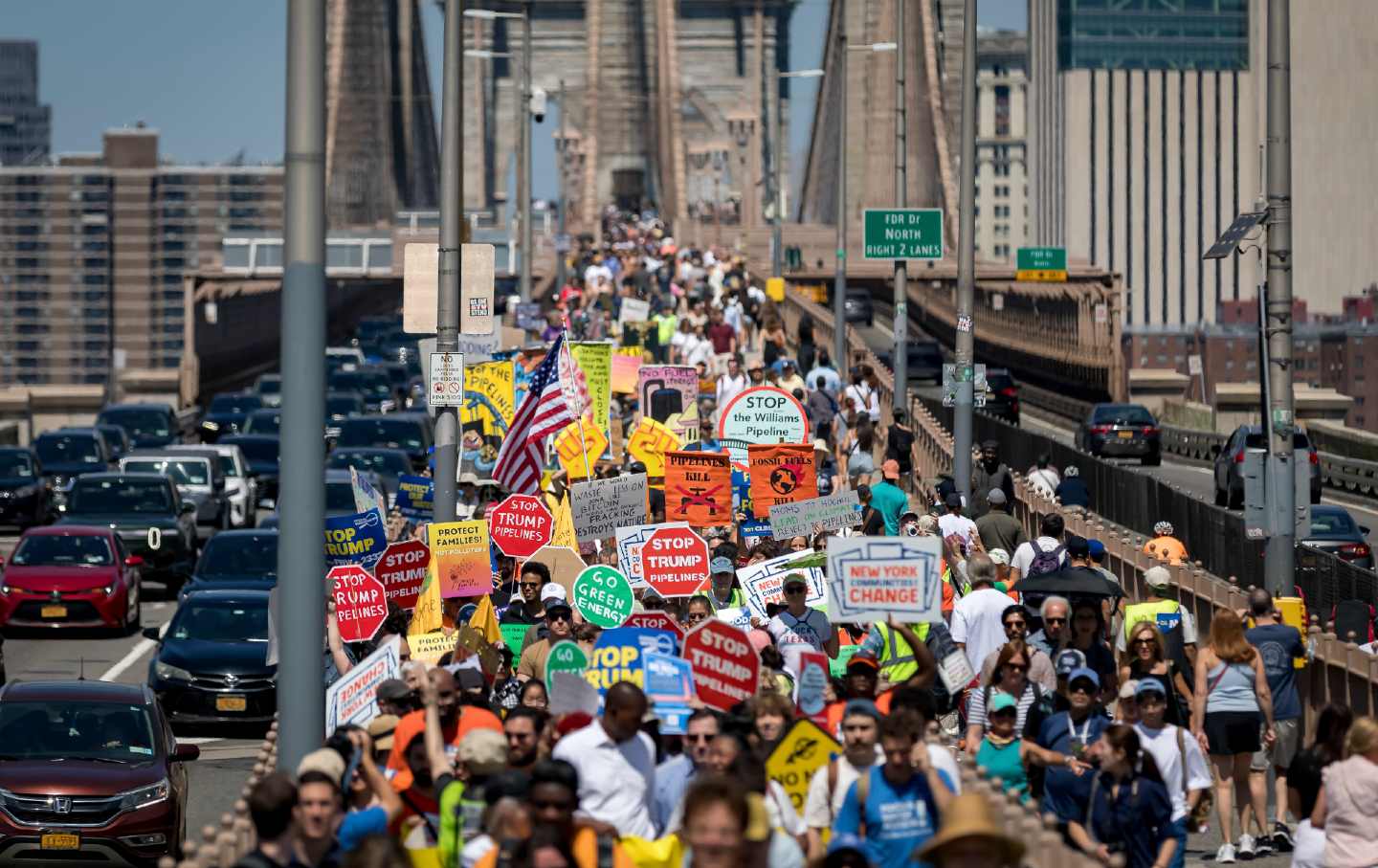
Climate activists march across the Brooklyn Bridge to demand that New York Governor Kathy Hochul stop the construction of the Williams Pipeline in New York City on August 9, 2025.
(Michael Nigro / Pacific Press / LightRocket via Getty Images)When Covering Climate Now launched The 89 Percent Project in April, the goal was to draw attention to the fact that an overwhelming majority of the world’s people—80 to 89 percent, according to scientific studies—want their governments to “do more” about climate change.
Now, in the next phase of the project, it’s time to explore who those people are.
Since The 89 Percent Project began four months ago, additional research—by the European Commission, Dynata, and the Yale Program on Climate Change Communication—has confirmed that roughly eight out of 10 people around the world support stronger climate action. Even in the United States, a leading petro-state where climate disinformation has operated the longest, three out of four people (74 percent) want stronger action.
These figures put the lie to the one-dimensional caricature of people who care about climate change as left-wing or fringe. The sheer size of the climate majority means that it includes almost everyone—across political, economic, generational, racial, and other lines.
Phase 2 of The 89 Percent Project aims to humanize the numbers by reporting on the people making up the climate majority. Who are they, where do they live, what do they do? Why do they care, and what do they want? Are they surprised to learn that they are, in fact, the majority?
The Guardian kicked things off on Tuesday, asking its readers to answer such questions, and CCNow invites journalists and news outlets everywhere to do likewise. Everyone is welcome to draw inspiration from The Guardian’s questions, adapting them for one’s own audience, augmenting them with “person in the street” interviews, and finding new ways to tell these stories through video, audio, and graphics. The Guardian will use the responses it gathers to craft short profiles of individuals who personify the climate majority. Again, fellow journalists and news outlets everywhere are invited to do the same.
In the coming days, CCNow will host a “Talking Shop” webinar to take through how news organizations can report their own “the people behind the numbers” profiles. We invite everyone’s ideas and creativity. The overarching goal of this phase of The 89 Percent Project is to present a vivid, factually grounded portrait of the global climate majority in all its diversity and potential.
Like CCNow itself, this phase of The 89 Percent Project is a collaboration, a way to work together throughout the news industry to reframe the public narrative about the climate crisis and its solutions. For newsrooms, it is also a commercial opportunity. The climate majority represents not merely a sliver but the bulk of the global news audience. Here’s a chance to engage them—to let them see themselves reflected in news coverage and thus be more inclined to read, watch, or listen to that coverage. The next phase of The 89 Percent Project starts now. We can’t wait to see what it produces.