
The “Worst COP” Concludes With a “Heartbreaking” Climate-Finance Deal
Activists say the climate agreement effectively signed away the 1.5-degree Celsius target—”our only real chance to safeguard humanity’s future.”
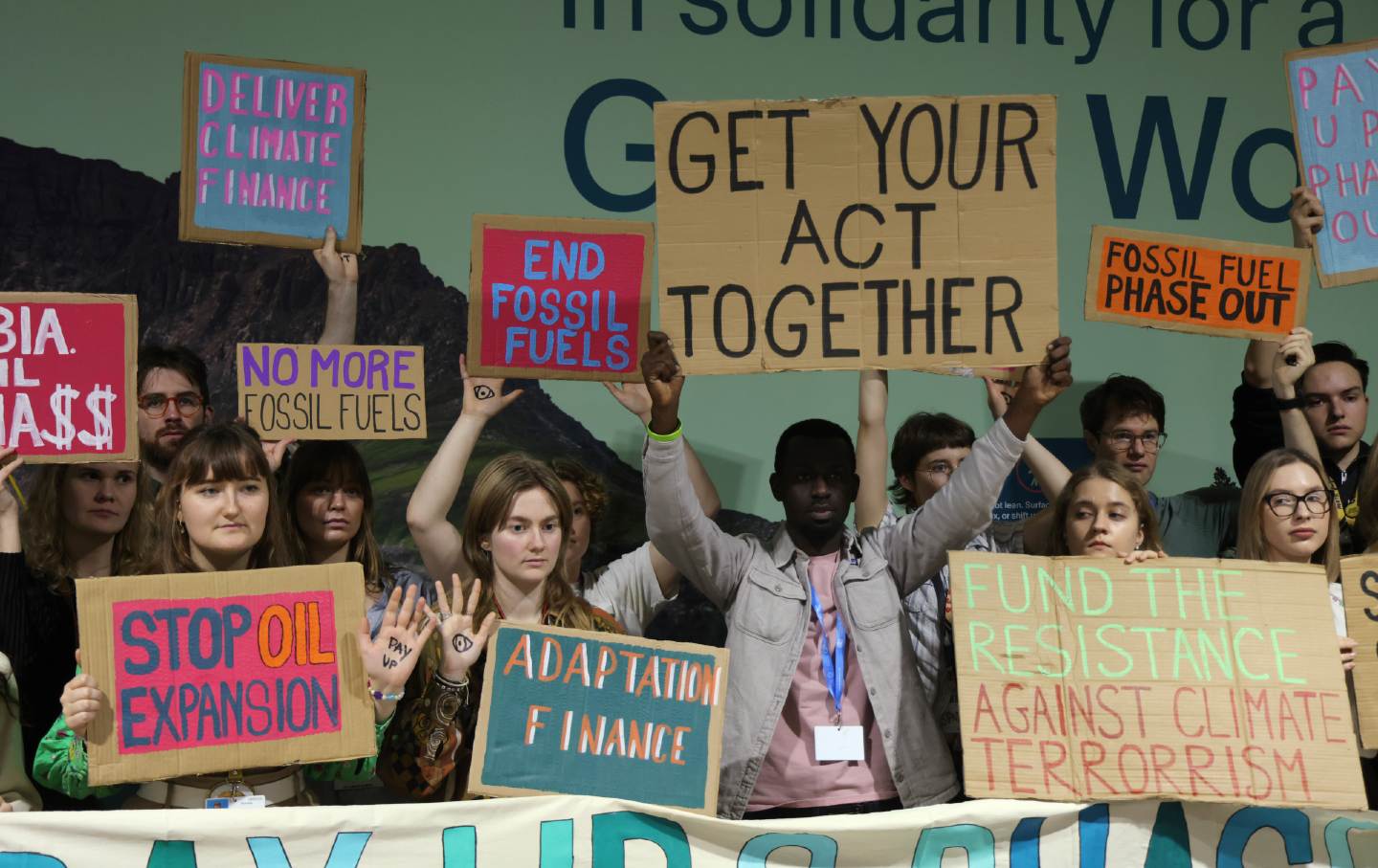
Activists protest against fossil fuels and for climate finance at the COP29 Climate Conference on November 22, 2024, in Baku, Azerbaijan.
(Sean Gallup / Getty Images)
Baku, Azerbaijan—COP29 ended with an agreement that disappointed nearly everyone who wasn’t from a rich country.
The deal created a New Collective Quantified Goal or NCQG, UN-speak for a fixed amount that wealthy nations would pay to poorer ones. The bill for the Global North will come to $300 billion per year by 2035. This is a fraction of the $1.3 trillion in annual grants that developing countries were pushing to begin immediately. It is only a marginal increase from the $250 billion offered in an earlier version of the agreement, released the final scheduled day of the summit. The climate-financing agreement was reached in the early hours of Sunday morning, well after the scheduled end on Friday of the two-week climate summit held in Baku. The deal marked an end to a climate summit marred by chaos and bitterness and which one negotiator called the “worst COP in recent memory.”
Experts estimate that $1.3 trillion a year is what it would cost to avoid surpassing the planet’s 1.5-degree Celsius temperature threshold that was set in the 2015 Paris climate agreements. This level of funding is what’s needed to invest in energy transitions in addition to what is already being spent.
Delegates from across the Global South slammed the final deal. The African Group of Negotiators described the final pledge as “too little, too late.” A delegate from India, Chandni Raina, dismissed the amount as a “paltry sum” and the document as “little more than an optical illusion” designed to appease developing nations but which in reality deflects responsibility away from historical polluters. Developing nations from Asia, the South Pacific, Africa, and South America all echoed these remarks.
“The outcome of COP29 is nothing short of heartbreaking,” said Juan Carlos Monterrey Gomez, Panama’s climate envoy. “It feels as if we have signed away the 1.5-degree target—our only real chance to safeguard humanity’s future.”
This year COP was meant to address perhaps the most important question plaguing the climate-change movement: Who’s going to pay to stop climate change? Billed as the “finance COP,” negotiators were set with a task to clarify the money question. The last agreed number was from COP15 in 2009, where countries agreed to $100 billion paid to developing nations from 2020 to 2025 and which countries failed to honor.
In the meantime, money for climate financing has often been delivered piecemeal to nations with the highest needs. There is widespread acknowledgement that this approach is unsustainable. Domestic political volatility around the world can turn the funding tap on and off. The United States is a perfect example, with the incoming Trump administration likely to obliterate any climate-financing hopes.
The transition to net zero is an enormously expensive global project, which has long stalled due to a lack of financing. At the end of the first week of the two-week climate summit, a report released by economists at COP29 said that the “projected investment requirement for climate action” would be a whopping $6.3–6.7 trillion per year by 2030, divided roughly evenly between “advanced economies,” China, and other nations, and after 2035, that number would jump to $7–8.1 trillion per year. Climate activists throughout the summit had been calling on a deal in which developed countries pay $5 trillion per year, although many admitted that this number would not be achieved this year.
To put that number into perspective: The entire US federal budget for 2024 was $6.75 trillion. Germany, the next-largest Western economy, and the third-largest in the world after the US and China, has a federal budget of just under $0.5 trillion. The GDP of the entire world is estimated at roughly $100 trillion.
The deal crucially does not delineate what amount of funding goes to “mitigation,” i.e., carbon emissions reduction (of which 90 percent of climate financing is currently dedicated to) or what amount goes to “adaptation,” which is the term used to describe building resilient infrastructure to adapt to climate change.
Missing also is a much-requested clarification and expansion of a “loss and damage” fund. Established two years ago at COP27 in Sharm el-Sheik, Egypt, a dozen countries pledged $720 million—a sum that UN Secretary General António Guterres dismissed as inadequate and “roughly the annual salary of the world’s 10 best-paid footballers.” According to World Bank figures, the floods in Pakistan alone in 2022 caused between $30 billion and $40 billion in damage and losses.A review of a mechanism to provide funding for natural disasters came to no conclusion and has been postponed until COP30 next year in Brazil.
Throughout the summit, negotiations focused on who should bear responsibility for climate change, as industrialized nations who have benefited from centuries of colonization have been and continue to be the world’s largest carbon emitters. It is not an uncommon scenario for a developing nation to be inundated with climate-financing debts—taking out loans just to pay back the interest on their original loans. And for countries experiencing massive infrastructure damage from natural disasters, the bureaucracy around a recovery grant could take years to materialize, when the funding for reconstruction or even just disaster alleviation is often urgently needed.
On the last scheduled day, representatives from the 39 aligned countries and territories represented by Alliance of Small Island States (AOSIS) walked out of climate talks after dismissing the original proposed deal of $250 billion annually from developed nations. This was the first time in the 29-year history of COP talks that AOSIS has walked out of negotiations. Michai Roberts, the lead negotiator for AOSIS, reportedly said that the other countries were “laughing at them” for asking for more money to confront the consequences of climate change.
“We came here to this COP for a fair deal,” Cedric Schuster of AOSIS told reporters. “There is a deal to be made, and we are not being consulted.”
In the late hours of the negotiation, US and European leaders worked to secure a deal. “The need is great, the offer on the table from donor countries is high, so hopefully we will pull something together,” John Podesta, the US climate envoy, said. Sue Biniaz, a veteran US climate negotiator, conferred with developing nation leaders and maneuvered a series of changes to appease those most frustrated by the $250 billion number originally proposed. Debt-inducing loans would be discouraged while the deal would be up for review and expansion in 2030.
Popular
“swipe left below to view more authors”Swipe →“COP29 will be remembered as the start of a new era on climate finance. The EU will continue to lead,” EU’s climate envoy Wopke Hoekstra said. “This COP delivered an ambitious and realistic goal and an increased contributor base. With these funds and this structure, we are confident we’ll reach the $1.3 trillion.”
There were a lot of ideas floated to find financing for climate change, but none that were ever likely to be adopted by the end of this COP. Ideas for a “global solidarity levy” were floated by a group headed by Barbados, France, and Kenya, but did not materialize into substantial commitments. Nor did a proposal to tax cryptocurrency or AI, though the carbon emissions of each industry alone could be sufficient to push global warming beyond Paris Agreement goals.
But perhaps the negotiations were doomed from the start. Most government leaders and negotiators were from environmental or climate ministries, not finance or treasury, who are often the real holders of countries’ purse strings. And while the negotiators from Washington tried to find compromises in the depths of Baku Olympic Stadium, there was speculation as to whether President Donald Trump would lead the United States out of the Paris Agreement or out of the UN sector responsible for climate policy altogether. China, the world’s largest foreign-currency holder, has become the leading emitter without participating in the UN’s official climate financing and maintains that it could not and will not fill the gap left by the United States. The Europeans would also not commit to compensating for an absent US. The next EU Commission will probably stay the course on climate protection rather than set new goals, and among its member states, support for an ambitious climate policy is weaker than it was even a few years ago.
Then there has been the ongoing debate over loans versus grants. Developing countries have been consistent in their calls for primarily grant-based funding rather than loans. While developing nations insist that this is not charity, for wealthy nations that’s been a hard sell. The current deal has said that the $1.3 trillion goal may yet be accomplished via an indetermined mix of public and private financing—a far cry from the guarantee of non-debt-inducing funds that developing nations called for.
According to a long-outdated UN classification from 1992, neither the rich producing countries such as the Emirates nor major emitters such as China are considered developed countries and are therefore not asked to pay for the financing.
Controversially, dependence on international carbon markets, centered on the trade of “carbon credits,” seems to have solidified as a solution to climate change. This means that wealthy countries can “offset” their carbon emissions by funding, for example, climate adaptation or renewable energy in less-developed nations, essentially buying their way out of penalties for carbon emissions. During COP29, the last states gave up their resistance to the principles of international carbon markets.
Many dissatisfied participants are now looking forward to the 2025 climate summit planned in Brazil. Home to the Amazon rainforest, Brazil stores as much carbon dioxide as humanity produces in 15 to 20 years. Agnès Pannier-Runacher, the French Minister for Energy and Climate, was the most outspoken on Sunday: “This COP, more broadly, was marked by real disorganization and a lack of leadership from the presidency,” she said. “Our hopes now turn to COP30, which is being led by Brazil.”
More on COP29:
But there seems to be a silver lining: Both Europe and the United States have at least recognized that the Paris Agreement cannot continue under the current global financial structure. The text of the agreement calls on countries to spend more—triple their original $100 billion goal—even if that number is far lower than what developing nations need. Lenders are urged to provide lower-interest loans to the most vulnerable nations, and a “Baku to Bélem road map” promises to explore the kinds of broad taxes laid out by groups calling for global wealth taxes and taxes on polluting tech industries, for example.
The Unites States, China, and Europe have forced these costs on them by heating up the earth with their emissions. The countries of the Global South will not forget that they have hardly taken any responsibility for this. Many feel that the COP29 decision may keep the multilateral system barely afloat, while failing to address the crisis. This does not bode well for the climate conferences to come.
“The lack of ambition and urgency is a betrayal of science, morality, and responsibility,” Monterrey Gomez, the Panamanian climate envoy, said.
“We cannot rely on the goodwill of those who have failed us time and again,” he continued. “This is not a question of convenience; it is a question of survival.”
Support independent journalism that does not fall in line
Even before February 28, the reasons for Donald Trump’s imploding approval rating were abundantly clear: untrammeled corruption and personal enrichment to the tune of billions of dollars during an affordability crisis, a foreign policy guided only by his own derelict sense of morality, and the deployment of a murderous campaign of occupation, detention, and deportation on American streets.
Now an undeclared, unauthorized, unpopular, and unconstitutional war of aggression against Iran has spread like wildfire through the region and into Europe. A new “forever war”—with an ever-increasing likelihood of American troops on the ground—may very well be upon us.
As we’ve seen over and over, this administration uses lies, misdirection, and attempts to flood the zone to justify its abuses of power at home and abroad. Just as Trump, Marco Rubio, and Pete Hegseth offer erratic and contradictory rationales for the attacks on Iran, the administration is also spreading the lie that the upcoming midterm elections are under threat from noncitizens on voter rolls. When these lies go unchecked, they become the basis for further authoritarian encroachment and war.
In these dark times, independent journalism is uniquely able to uncover the falsehoods that threaten our republic—and civilians around the world—and shine a bright light on the truth.
The Nation’s experienced team of writers, editors, and fact-checkers understands the scale of what we’re up against and the urgency with which we have to act. That’s why we’re publishing critical reporting and analysis of the war on Iran, ICE violence at home, new forms of voter suppression emerging in the courts, and much more.
But this journalism is possible only with your support.
This March, The Nation needs to raise $50,000 to ensure that we have the resources for reporting and analysis that sets the record straight and empowers people of conscience to organize. Will you donate today?
More from The Nation
The Iran War Is Also a Climate War The Iran War Is Also a Climate War
Climate change is not a peripheral part of what we’re seeing in Iran—it’s structurally embedded in modern warfare.
The Planet-Sized Hole in Trump’s State of the Union Address The Planet-Sized Hole in Trump’s State of the Union Address
Although climate change received no attention during the president’s speech, Americans must continue to find new ways of making progress against the ongoing environmental crisis.
Japan’s New Climate Bomb—in the US Japan’s New Climate Bomb—in the US
Bloomberg Green reveals the climate costs of the US-Japan trade deal.
Where Climate Coverage Goes to Die Where Climate Coverage Goes to Die
The very notion of public service journalism is under assault at precisely the moment that it’s most needed.
The International Olympics Committee Is Urged to Drop Oil Company Sponsors The International Olympics Committee Is Urged to Drop Oil Company Sponsors
Global warming means the future of Winter Games “is literally melting away.”
Can New York Adapt the Subway for the Climate Crisis? Can New York Adapt the Subway for the Climate Crisis?
As climate change leads to record rainfalls, the city’s 120-year-old subway system is more vulnerable to flooding than ever.

