The Media Is Complicit in the Climate Confusion
The vast majority of people want their governments to take climate action—but most wrongly think they’re in the minority. The media is partly to blame.

A TV reporter braces against the wind as Hurricane Irma approaches in Miami, Florida, on September 10, 2017.
(Marcus Yam / Los Angeles Times via Getty Images)Multiple surveys, polls, and studies conducted over the past five years—from Yale, Gallup, Nature, Oxford, and the European Commission—indicate overwhelming global support for stronger climate action. Roughly 80 to 89 percent of the world’s people want their governments to “do more” to address climate change, and nearly two-thirds are on board with that action costing them a bit. Yet most of the people comprising this overwhelming climate majority think they are the minority, telling pollsters they believe that only around 30 percent of their fellow humans also want stronger climate action. Researchers have defined this kind of systemic misunderstanding of how others think as a perception gap, and one result is that politicians calculate that they can continue to cater to corporate interests and preserve the fossil fuel status quo.
Now new research is highlighting the role the media plays in perpetuating this gap. Yale’s most recent climate opinion poll shows that while more than two-thirds of Americans want stronger climate policy, less than a third of them say they see coverage of the issue in the media at least once a week. That’s unfortunate, according to Max Boykoff, who runs the Media and Climate Change Observatory at University of Colorado, Boulder, because inconsistent coverage of the issue can lead to gaps in the public’s understanding of it. “Climate journalism is prone to an events-based model of reporting that often decontextualizes the climate crisis,” he said. “Extreme heat, floods, and storms tend to be reported as unique events as opposed to part of an unfolding and long-term crisis, which prevents a fuller understanding of the issue.”
That problem and others are explored in research from the Climate Social Science Network, published in October in the book Climate Obstruction: A Global Assessment. The book includes a chapter on the media’s role in perpetuating misleading narratives. Boykoff and Rutgers University researcher Melissa Aronczyk were lead authors on the chapter, which concludes that while false equivalence—the practice of pairing any scientific statement about climate change with a contrarian statement about it—has tapered off, “news media, particularly business presses, continue to legitimize climate denial by allowing fossil fuel companies access to mainstream platforms.”
Moreover, the peer-reviewed research in the book points to the emergence of a new and insidious approach by those who wish to block climate policy. Aronczyk and Boykoff write,”Politicians and influencers associated with the circulation of disinformation attempt to frame as censorship initiatives such as fact-checking, labeling of content, and enforcement of platform policies on content moderation.”
Meanwhile, Content Confusion, a forthcoming book from Boston University researcher Michelle Amazeen unveils how major media outlets are increasingly blurring the line with advertorials. Amazeen’s previous research has shown that at best a little over 30 percent of readers, roughly one in three, can spot the difference between editorial content—a legitimate news article—and advertorial content, a paid advertisement that is designed to look like editorial content. In the study that established that finding, Amazeen used two different advertorials with test subjects. One was for the shoe brand Cole Haan, the other for the oil and gas company Chevron. “Once I realized how difficult it was for people to realize this was commercial content and not genuine news reporting, I got to thinking: How dangerous is it really if a fashion company confuses people in this way, compared to Chevron and other fossil fuel companies leveraging this strategy?” Amazeen said.
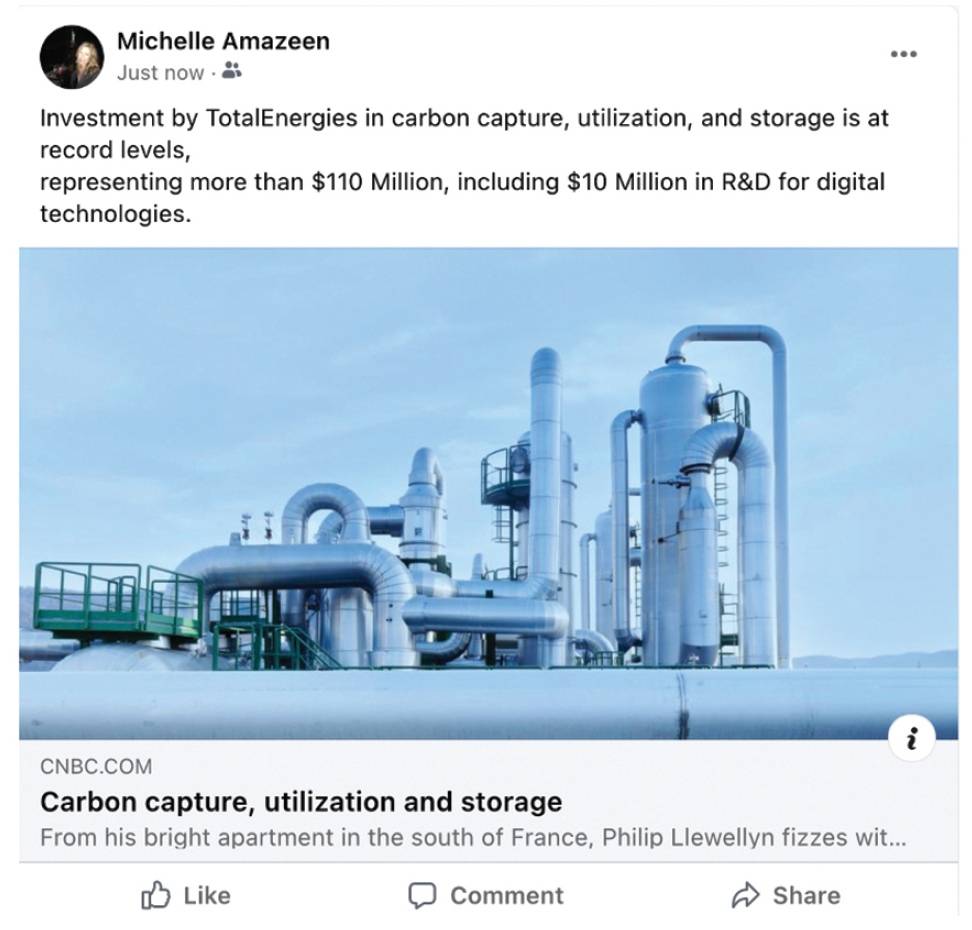
That prompted more experiments, culminating in a book in which Amazeen takes the media to task for allowing this fox into the hen house. In one study, she looked at how native ads get a second life on social media, where outlets are required to share and amplify them, and where “frequently the disclosures that are required by the Federal Trade Commission that distinguish them as commercial content, disappear.” When Amazeen shared a TotalEnergies advertorial from CNBC on Facebook, for example, no “sponsored content” label appeared on the post. So those who clicked on it to read the article might spot the disclosure on the website, but if they skimmed the headline while scrolling their feed, they would assume this was a reported story.
For her book, Amazeen spoke with climate reporters and content marketing staffers at outlets that produce advertorials for fossil fuel companies. “Many of [the reporters] are aghast at what is happening. Some have left their jobs over it,” she said. And while the outlets themselves always maintain that there is a firewall between the internal brand studios and the editorial team, everyone Amazeen spoke with said the boundaries are often blurred.
In her book, Amazeen reports that a native advertising campaign can command anywhere from $200,000 to $750,000, on average, but “that might be a conservative estimate, as we know from a congressional investigation that The New York Times was paid as much as $5 million for one native campaign” that it created for ExxonMobil.
“In some cases, journalists accompany strategists and salespeople on client visits,” Amazeen writes, referring to examples from The Atlantic and The New York Times. “In other cases, journalists write for both the newsroom and the content studio, which is easy to conceal because native ads typically omit the author byline.” In a dystopian twist, Amazeen also found that the preferred candidates for product marketer and strategist roles within media content studios are journalists forced out of the industry by relentless job cuts and plummeting wages.
Meanwhile, advertorials have become increasingly popular with advertisers, in part because—since they blend into the editorial—they can get around ad blockers.
On both advertorials and the persistent embrace of climate denial, the United States is a leader, and the two are not disconnected. While opinion data finds that globally 80 to 89 percent of people want their governments to take stronger climate action, in the United States that number is 74 percent. Still an overwhelming majority, but behind the rest of the world. The media is not entirely to blame, of course, but it has been one of the channels through which climate disinformation has flowed for decades as part of coordinated and well-funded campaigns by the industries, companies, and individuals who would lose the most if the world’s governments regulated emissions.
In their review of the peer-reviewed research on climate and media, Aronczyk and Boykoff found that the US and the UK media were global outliers in their willingness to platform industry talking points and contrarian views on climate. In fact, when researchers have looked at media coverage in Brazil, India, China, France, the United Kingdom, and the United States, they found that “news coverage of [climate] skepticism is largely limited to the latter two countries.” Perhaps unsurprisingly, the research also shows that “nations with the strongest relationships between right-of-center ideology and climate contrarianism tend to be those whose economies are relatively highly reliant on fossil fuel industries.”
Aronczyk says part of the reason US and UK outlets are more open to platforming climate skepticism has to do with “the ownership structure of so many news outlets in the UK and the US, so the question of who owns the media becomes really salient here.” With so many American and British outlets operating as for-profit companies, increasingly dependent on ad revenue and increasingly owned by businessmen or business ventures with their own political preferences—from Jeff Bezos at The Washington Post to Axel Springer at Politico and Politico Europe—stories about the benefits of any sort of regulation may struggle to find a home.
Popular
“swipe left below to view more authors”Swipe →Because so much money has been spent in the United States to seed contrarian talking points, not just in the media but on social media and even in schools, newsrooms often hear more from those who doubt the science, leading many to believe that climate contrarianism is more prevalent than it is.
“Every time I published a climate change story, a chem trails believer would write into the paper and chide me for overlooking the influence of chem trails,” Kit Stolz, a local reporter in Ventura County, California, said. The regular response to his climate stories made it seem like there were “a lot of climate deniers out there, even in liberal California towns,” Stolz said, despite the fact that polling consistently finds that only about 15 percent of Americans are climate deniers.
It’s not a unique experience. Though there is an overwhelming amount of evidence that a supermajority of people in the United States and around the world are deeply climate-concerned, newsrooms often assume, because the contrarians are a vocal minority, that “nobody cares” about climate stories.
Kirsty Johnston, investigative reporter in New Zealand, commented about this recently on BlueSky. “You know, there’s this pervasive view that people don’t care about climate change / are bored of it / find it overwhelming but I wrote this story this week [about the government cutting climate policy] and social media went crazy over it. People care!!!! They really care and they need a way to channel it.”
Fossil fuel companies, meanwhile, are well aware of how much people care about climate change, which is why they spend millions to convince the public they’re acting on the issue. In most fossil-funded advertorials over the past five years, companies have used the space to portray themselves as good guys in the climate fight, promoting technological fixes that independent experts criticize as false solutions.
Some advertorials, for example, overhype the potential of algae biofuels or carbon capture to meaningfully limit global temperature rise. Others make claims that directly contradict a given newspaper’s own reporting, as was the case with an advertorial The Washington Post’s internal studio created for the American Petroleum Institute in 2021, arguing that fossil fuels remain an important source of energy because renewable energy is unreliable since the sun doesn’t always shine or the wind always blow—an assertion the Post’s own climate reporting has repeatedly debunked.
Aronczyk and Boykoff highlight the media’s role in normalizing business-as-usual “solutions” on climate in regular coverage, too. “Big brands and other business groups sidestep their role in contributing to climate change, and they do this by promoting that they’re at the table with us, that they’re collaborators, they’re consensus makers, or that they’re willing to compromise,” Aronczyk said.
”We’ve also seen how oil and gas companies do source-building with journalists to promote their industry point of view and news coverage,” Aronczyk continued. And to make those relationships pay dividends, Aronczyk says fossil fuel companies also work with PR firms to generate credible and seemingly independent reports that help promote their viewpoints to the media. “PR firms will conduct industry friendly research that helps their clients promote their viewpoints in the media. So there’s a massive production of scientific material, legal material, and technical material to circulate in the media.”
All of which creates confusion for the general public, who depend on the media to translate the science around climate change and its solutions, according to Boykoff, the University of Colorado, Boulder, researcher who inserted news-media studies into the Intergovernmental Panel’s sixth assessment mitigation report in 2022 (the first time those gold-standard climate science reports had included such information). “[Ordinary] people don’t pick up peer-reviewed literature, and the general public isn’t reading IPCC reports to learn about climate change,” Boykoff said. ”They rely on news coverage to help make sense of what’s going on around them. And so news becomes this important bridge and this powerful driver of public conversation.”
The media plays an enormous role in shaping public opinion, which in turn influences how much political will there is to act on climate.
In their survey of the research on the media’s role in shaping attitudes on climate, Aronczyk and Boykoff didn’t just find problems; they also encountered potential solutions, particularly the way the concept of “rapid attribution” is being applied to disinformation “events.” By quickly attributing misleading information to industry actors, journalists can help “diminish trust in transgressive sources as well as lower consumption and belief in their news products,” Aronczyk and Boykoff write.
They point to examples of daily advisories, weekly or monthly digests, and explainers and reports on climate disinformation as effective counter measures.
“This has to do with the incredible speed of the news cycle these days, and the fact that our attention is constantly pulled in a million different directions online. And if you contrast that with the academic research and publication cycle, I mean, there’s just no contest,” Aronczyk said. “Our research and publication cycle is incredibly slow. We work in cycles of years, not cycles of, of minutes. So what some researchers are calling for is a monitoring and rapid response service to provide facts, to provide accurate information to the public while they’re thinking about the issue, not a year or two later.”
Getting governments to take the action citizens want on climate requires closing the perception gap, something the media may have helped to create in the first place, but is also uniquely positioned to fix.
Become a Sustaining Donor This September
Between the reemergence of right-wing red-baiting and Donald Trump’s use of the chilling National Security Presidential Memorandum–7 to criminalize left political organizing, we’re seeing McCarthyism reborn before our eyes.
This assault on democracy cannot be ignored or wished away. Resisting it requires bravery in the face of threats and repression, a steadfast commitment to the truth, and the unwavering belief that we can—and will—overcome this darkness.
We must have an independent media that sets the record straight, unearths corruption and abuses of power, and advances a politics of justice and dignity for all if we’re to win this fight.
That’s why I’m writing to you today. This September, The Nation needs to add 100 monthly donors to sustain our progressive journalism. Your contribution makes the next investigative report, the next truth-speaking column, and the next pathbreaking essay all possible.
I hope you’ll support our work with a recurring donation today. If you donate $10 or more a month, we’ll send you a brand new “Hands Off the Free Press!” sticker to recognise your commitment to our cause. Please, donate today.
Onward,
Katrina vanden Heuvel
Editor and Publisher, The Nation