Bill Moyers Helped Break the Media’s Climate Silence
When Bill Moyers helped launch the Covering Climate Now media collaboration, he urged fellow journalists to “tell the story so people get it.”
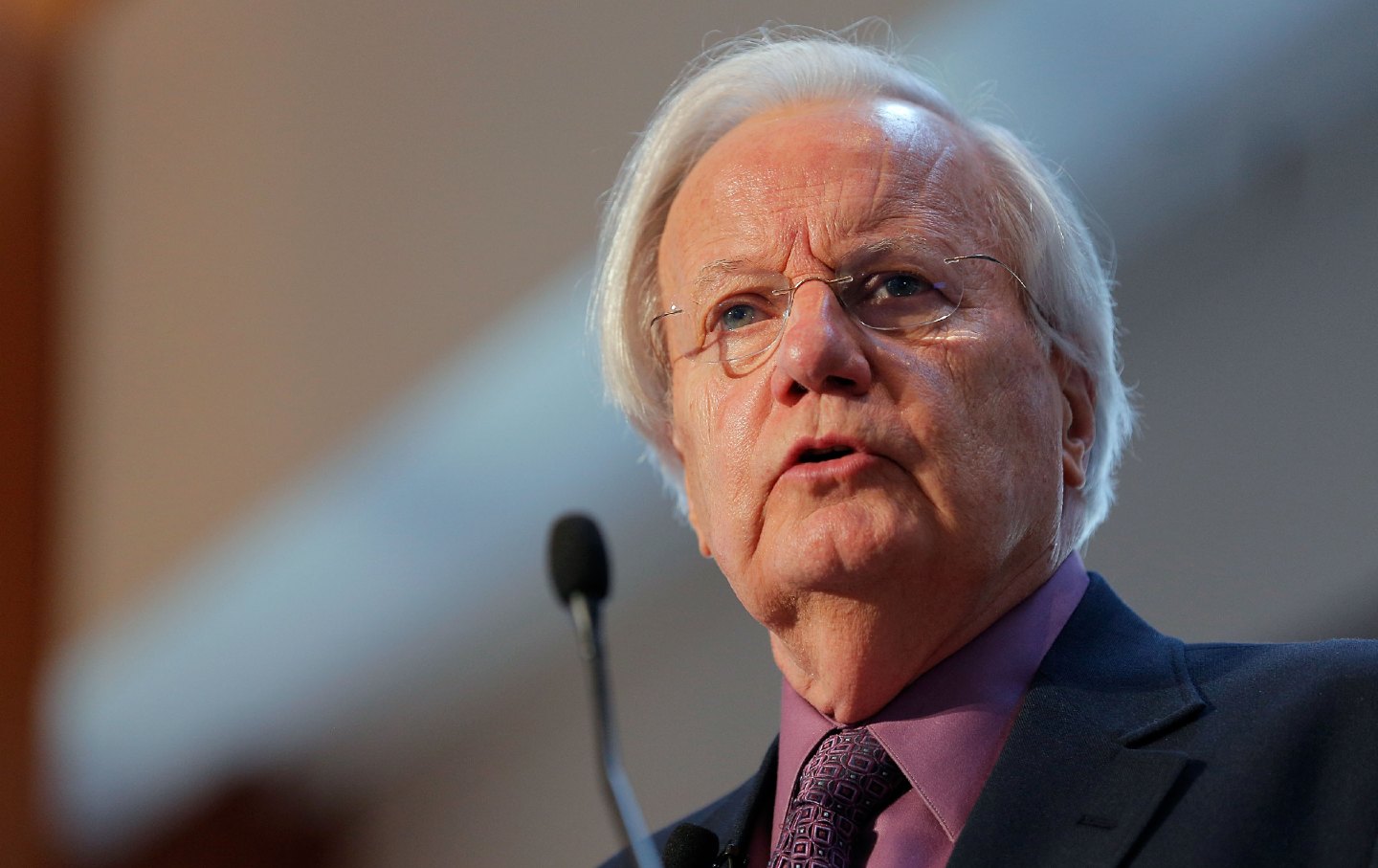
Bill Moyers in 2012.
(Jemal Countess / Getty Images for Time)In recent days, the journalism world has been paying tribute to Bill Moyers, and rightly so. Moyers died last Thursday, June 26, at the age of 91. Obituaries and tributes have cited his work as the White House press secretary to President Lyndon Johnson in the 1960s and his subsequent decades of TV journalism at PBS and CBS, where his eyewitness reports, probing interviews, and incisive commentary on a vast range of subjects were lauded as equaling Edward R. Murrow’s.
To us at Covering Climate Now, Moyers was of course a giant of journalism. But he was also a beloved colleague, mentor, and hero. In fact, without Moyers, there would be no CCNow.
When Mark Hertsgaard and Katrina vanden Heuvel of The Nation and Kyle Pope of the Columbia Journalism Review approached Moyers in early 2019 wanting to break the “climate silence” that had long pervaded the news media, Moyers immediately grasped the urgency of the mission and threw himself into bringing it to life. His keynote speech at a conference at the Columbia School of Journalism that April that would give birth to CCNow managed to be both rousing and funny—not an easy thing when discussing a crisis that “journalists must figure out how to cover as if life on earth depends on it, which it does,” Moyers said.
Urging his fellow journalists to push back against the commercial considerations that can cloud newsroom leaders’ judgment, Moyers invoked Murrow’s battles in 1939 to get his bosses in New York to let him cover Hitler’s impending invasion of Poland rather than the dance contests in London and Paris the bosses wanted. Moyers then challenged journalists today to step up to our historical moment—to break our profession’s silence about the climate crisis and its abundant solutions. “Our responsibility as journalists,” he said, “is to tell the story so people get it.”
Moyers also was instrumental in raising the first $1 million in philanthropic support that launched Covering Climate Now. By that September, CCNow had organized 323 news outlets across the United States and around the world to do one week of dedicated climate reporting. By coincidence, a Swedish teenager named Greta Thunberg inspired an estimated 6 million people to take to the streets around the world that same week demanding climate action. The combination of high-profile news coverage and massive civil-society mobilization triggered a decisive shift. Government leaders could no longer ignore the crisis without political risk. Media leaders began to see that climate change mattered to the public and deserved more news coverage.
“Ideas have power, but ideas need legs,” Moyers once said. “The eight-hour day; the minimum wage; the conservation of natural resources and the protection of our air, water, and land; women’s rights and civil rights; free trade unions; Social Security; and a civil service based on merit—all these were launched as citizen’s movements and won the endorsement of the political class only after long struggles and in the face of bitter opposition and sneering attacks…. What’s right and good doesn’t come naturally. You have to stand up and fight for it—as if the cause depends on you. Because it does.”
Since the launch of CCNow, we had kept Moyers updated on our work and the evolution of climate journalism. He had been gratified at the progress, but also impatient about the scale of the work still to be done.
We know that journalism still has a long way to go before we are fully honoring Bill’s call to tell the climate story “so people get it.” But we at CCNow are more committed than ever to that mission. And Bill’s incomparable example—his towering intellect, unwavering ethics, unfailing generosity, and unshakable belief in the decency and capacity of ordinary people to make a better world—will guide us for as long as we’re privileged to do this work.