The New Labor Militancy of LA’s Hotel Workers
UNITE HERE Local 11 is staggering its strikes across Los Angeles, targeting one out-of-contract hotel one day and another the next.
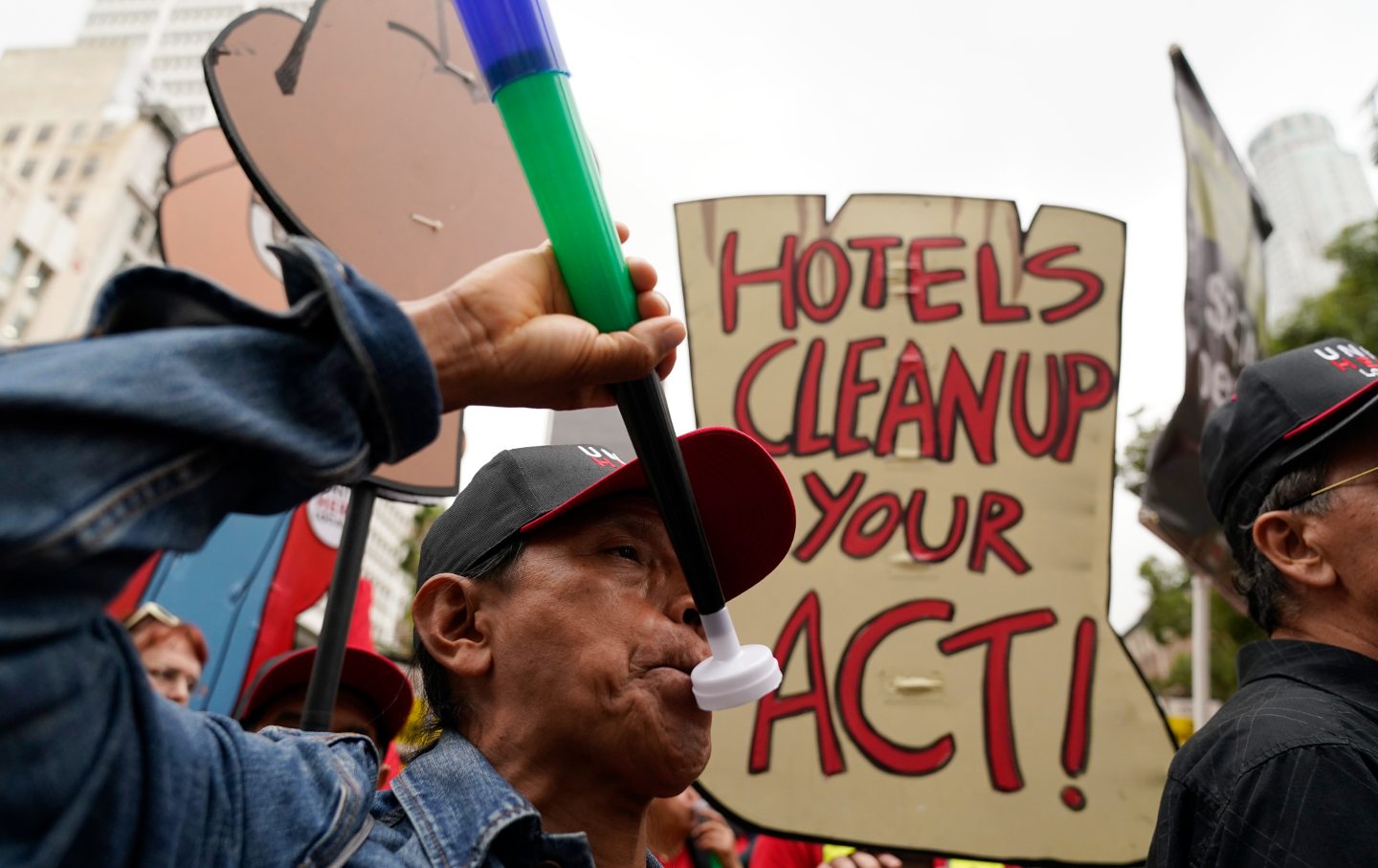
Earlier this week, striking hotel workers in Los Angeles began protesting outside of two LAX airport hotels, the Sheraton Gateway and the Four Points by Sheraton. Hundreds of employees, from the two hotels, as well as from numerous other nearby hotels, arrived on the picket lines. They wore red union T-shirts, and several set up drums outside. A couple dozen planned to sleep overnight in tents that they pitched surrounding the building.
This was the latest installment in one of the most important of California’s numerous strikes this past year. Work stoppages were also underway at the Waldorf Astoria in Beverly Hills, and picketers at Le Meridian Delfina in Santa Monica were noisily singing Christmas carols in the hotel lobby.
“I make $19 an hour,” said 33-year-old Primes Williams, who works at the Gateway fielding guest requests, taking out the trash, and removing dirty linens. In the two years that he has worked there—even as inflation reached levels not seen in decades—his hourly wage hasn’t increased. For more than five months now, Williams has been involved in the strike, taking on Uber jobs on the side to try to cover the shortfall in his income. It’s been difficult, he said; he’s struggling to buy sports supplies for his son, and he and his wife are barely making ends meet. This week, he volunteered to join those camping outside of this place of employment, hoping, in the high-profile action, to finally draw the hotel owners to the bargaining table.
Starting in July, members of UNITE HERE! Local 11 have been involved in a series of rolling strikes at several dozen area hotels, demanding significantly higher wages—$5 per hour raises in year one, increasing wages by $12.50 an hour over four years—better healthcare and pension benefits, and a restoration of staffing levels to pre-pandemic levels. Earlier in the strike, they also demanded that hotels pay into a fund intended to secure additional affordable housing in the area for the workers—though that demand was dropped during negotiations with some of the hotels over the past months.
The union uses tactics similar to those successfully deployed by the United Auto Workers in their recent strike against the Big Three car manufacturers. Instead of simply calling out all hotel employees in the region, it has staggered the strikes, targeting one out-of-contract hotel one day, another the next. As a result, workers have been able to get their arguments across while not forcing their workers into a multi-month stoppage, with all the lost wages that that implies. “In my career I’ve never seen militancy at this level,” said union copresident Kurt Petersen. “Before work, after work, they’re out picketing. Our members are more militant and determined today than they were on July 1 when we started it.”
Picket lines are going from one hotel to the next, so that even in hotels which, on any given day, aren’t officially on strike, guests can see the protesting workers and hear about the labor issues that are in play. Some conference organizers have moved their events out of affected hotels, and some guests, not wanting to cross picket lines, have canceled reservations.
“It’s very difficult to operate a hotel when you have no control over the workers,” Petersen said.
Bill Doak, managing director of hospitality for Stockdale Capital Partners, an investment firm that owns Le Merigot Marriott, which is one of five area hotels to have recently agreed a new four-year contract with the striking workers, agrees. At a certain point, he said, it became clear that the union wasn’t going to budge on its wage demand—and that, given the soaring cost of living in the Los Angeles region, the workers’ wage demands were reasonable. Despite the hotel’s being a Marriott franchise, the hotel’s owners had the right to strike their own deal with the workforce, giving them the flexibility to craft a deal that would get their staff back to work. “These costs are the result of inflationary trends, particularly in a city like LA, where wages haven’t kept up with the cost of living,” Doak told me. “You can offer to pay 20 dollars an hour and post a job, but that doesn’t mean somebody will work for it.”
Le Merigo Marriott, the Laguna Cliffs Marriott, Loews Hollywood, the Bonaventure, and Millennium Biltmore—the latter being one of the most iconic old hotels in town—have all now signed multiyear agreements with UNITE HERE. But dozens of other hotels are standing firm against the strikers. As the holiday season gets underway, the picketers outside the airport hotels are hoping that more owners will break ranks and follow suit by signing contracts that boost pay and benefits. Williams estimates that 85 percent of his coworkers at the Sheraton Gateway are on strike. The union says that, across a dozen hotels, up to 14,000 workers are involved in the strike actions.
The writers’ and the actors’ labor disputes may be over, but the hotel workers’ strike is very much alive. This strike is about human dignity, about low-end workers seeking not to get rich but to earn enough to pay the rent and put food on the table for their kids. That’s hardly too much to ask in Tinseltown, a place where hotels are filled with people from all over the world flocking to spend their tourist dollars.