Mass Deportations Aren’t Just Evil. They’re Also Terrible Economics.
Immigrants don’t steal citizens’ jobs and wages. They grow the economy for all.
President Donald Trump has promised that his administration will conduct deportations on a staggering scale. On the campaign trail, he pledged to remove 15 million people from the country, potentially including legal immigrants and US citizens.
Voters seemed to bristle at higher immigration, in part perhaps because people tend to greatly overestimate how many immigrants are actually in the country. But when Americans cast their votes, they also made clear that the economy was their top concern. Unfortunately for them, if Trump achieves even part of his mass deportation goal, it will almost certainly wreck the economy.
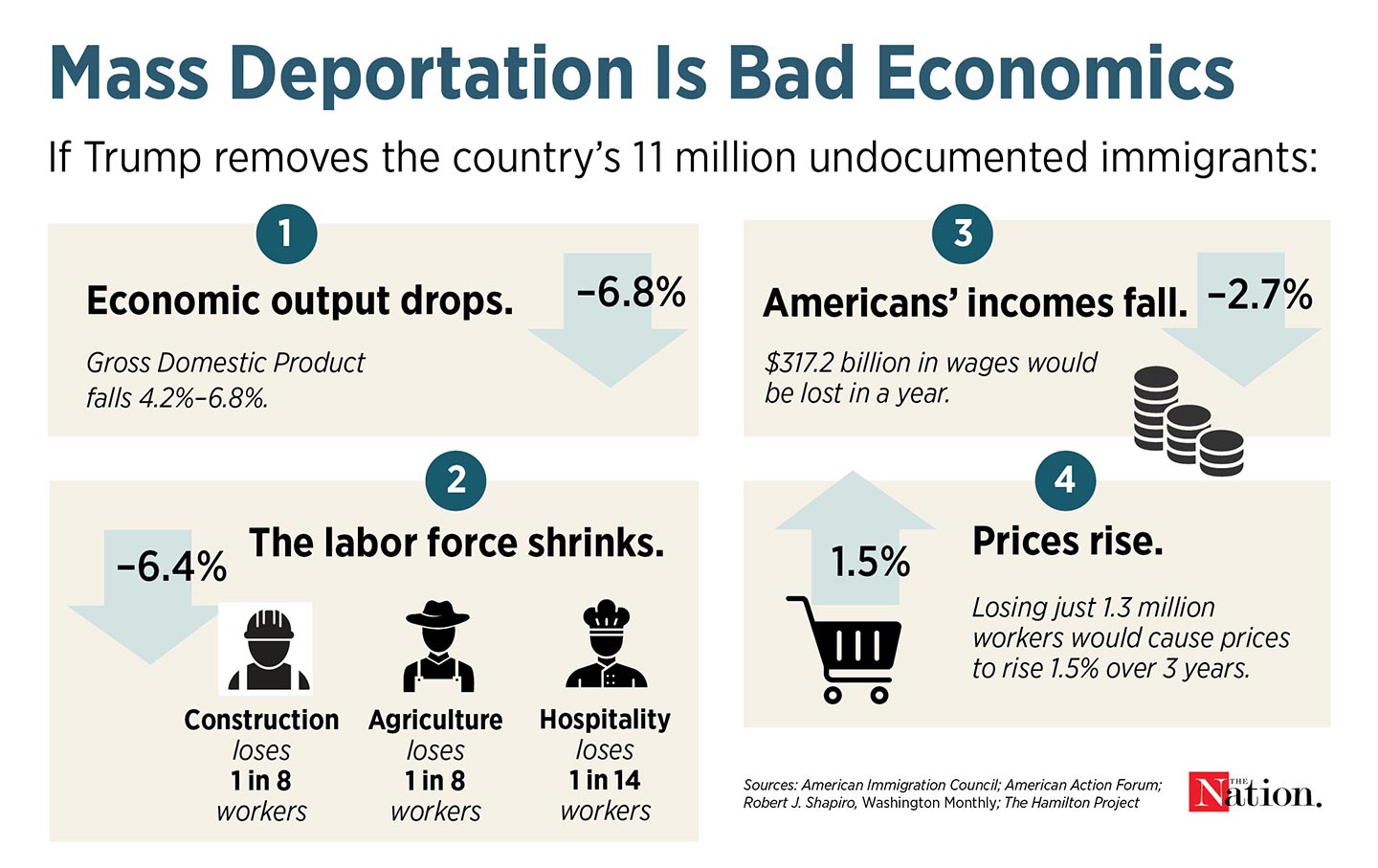
The American Immigration Council simulated what would happen if the government deported the 11 million undocumented immigrants who lived here as of 2022 and found that the gross domestic product would drop by at least 4.2 percent, or over $1 trillion. The American Action Forum came to a similar conclusion, finding that removing all undocumented immigrants would reduce the GDP by 5.7 percent, or $1.6 trillion, and would cut the labor force by 6.4 percent. The Peterson Institute for International Economics determined that it would permanently reduce employment by 0.6 percent.
Research has long found that immigrants don’t steal citizens’ jobs and wages; they help grow the economy for all. Among 27 empirical studies on the consequences of immigration, the vast majority found either no effect or a beneficial one on the wages of native-born workers. Immigrants also create more jobs for the native-born. One study estimated that nearly half of the employment growth between October 2023 and June 2024 can be attributed to the arrival of immigrants.
If Trump enacts his deportation plans, it wouldn’t be the first time the country has restricted immigration and kicked people out. And past examples give us an idea of what’s to come. In 1882, Congress passed the Chinese Exclusion Act, which banned immigration from China and resulted in lower employment among white workers and a reduction in the quality of their jobs. After the US imposed country-specific immigration quotas in the 1920s, earnings fell for native-born workers. The forced deportation of Mexicans in the 1930s, meant to boost jobs for the native-born, reduced employment and increased unemployment. The 1964 restriction on Mexican braceros, also meant to improve wages and employment for Americans, did neither. Secure Communities, a 2008 policy to remove undocumented immigrants, reduced employment for US citizens.
There is also the sheer cost of deporting so many people so quickly. The American Immigration Council found that the price for a onetime removal of all undocumented immigrants in the country would come to at least $315 billion. That doesn’t account for the costs of internment camps to hold people before they’re shipped out, hiring the necessary personnel, or deporting new arrivals. With some of that taken into consideration, the cost balloons to almost $1 trillion over a decade. That kind of money could fund the construction of more than 40,450 schools or 2.9 million homes, or cover in-state college tuition for 8.9 million students.
There is also the loss of tax revenue: Tax payments from undocumented immigrants came to $96.7 billion in 2022.
Then there’s the increase in prices. One analysis found that a deportation plan that reduced the labor force by just 1.3 million workers would raise prices by 1.5 percent over three years. Certain sectors would get hit particularly hard. The American Immigration Council estimated that construction and agriculture would each lose at least one in eight workers, and hospitality would lose about one in 14. Agricultural prices would subsequently jump 1.7 percent by 2028. Past immigration enforcement has increased home prices because of the loss of construction workers.
None of these numbers get at the human toll of ripping people out of their homes and sending them away. A study of the effects of a federal immigration raid in Iowa in 2008—the largest in history at the time—found a spike in low-birth-weight deliveries among Latina mothers in the area: one way of quantifying the disruption and trauma that deportations cause. Undocumented residents make up 3.3 percent of the population, and about 80 percent have lived here for 12 or more years. Abruptly and violently losing these coworkers, friends, neighbors, and classmates will undoubtedly harm those who remain, too.