Great Authors Are Just As Human as the Rest of Us
A new play about Roald Dahl shows the now-controversial children’s writer in his flawed, complicated reality.
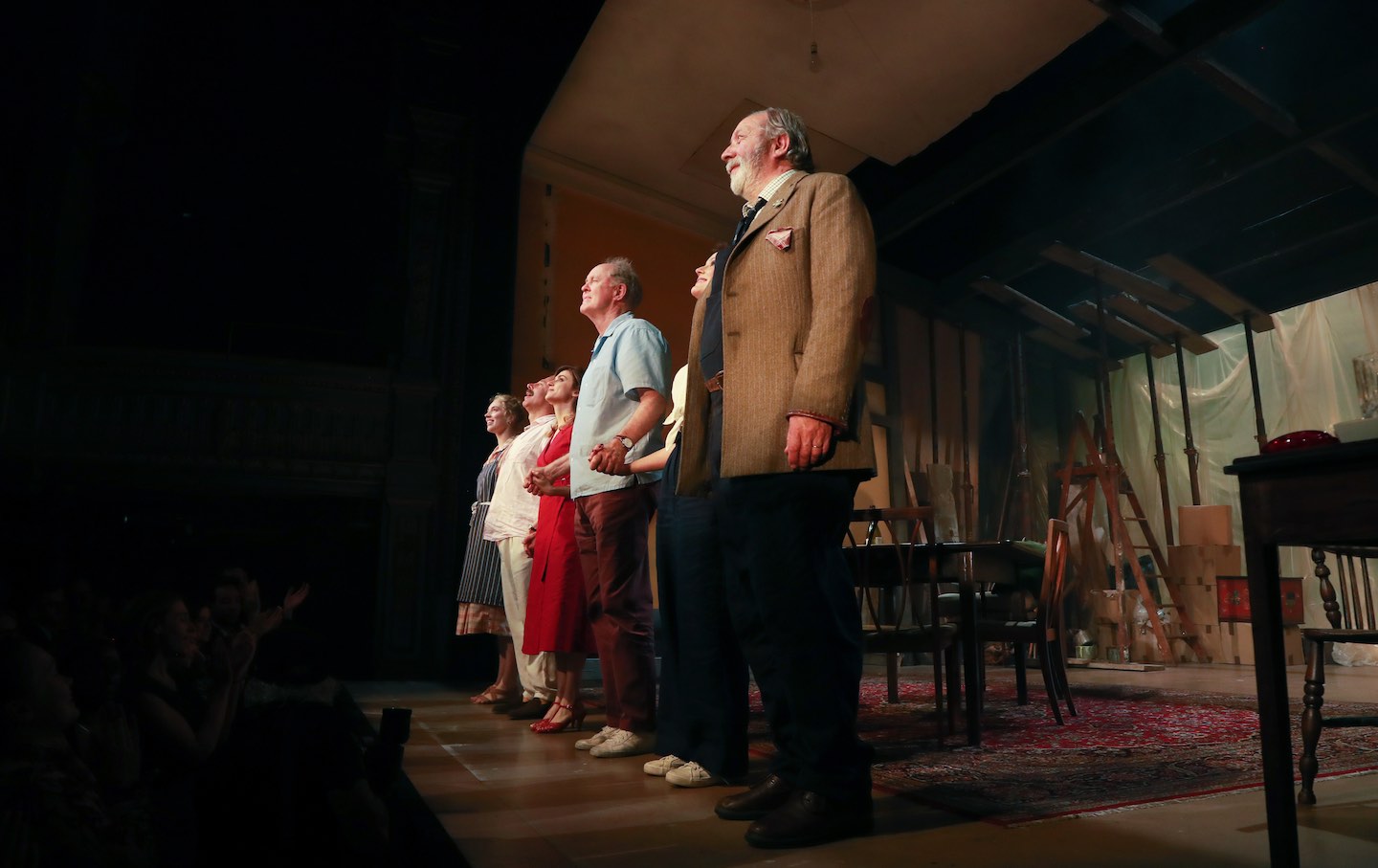
Tessa Bonham Jones, Elliot Levey, Aya Cash, John Lithgow, Rachael Stirling, and Richard Hope bow during the curtain call at the press night performance of Giant at the Harold Pinter Theatre in London, May 1, 2025.
(Dave Benett / Getty Images)There’s a lot to be said for not knowing much about your favorite writers’ actual lives. People being what they are, you’re not likely to come away loving them more. Do you really want to know that Dickens tried to put his perfectly sane wife, a mother of 10, in a mental institution so that he could go off with his much-younger mistress? It sounds like the sort of thing one of his villains would do. But then, if Dickens didn’t have a dark side, could he have invented Uriah Heep or Miss Havisham?
That Roald Dahl would have a dark side is not a surprise. A writer whose mind was all kindness and crumpets would never have had James’s nasty aunts run over by the peach in James and the Giant Peach or sent a terrifying troop of cannibal giants out by night to eat little children in The BFG. His brilliant, hilarious children’s books are full of violence, rage, cruelty, and revenge and have long been indicted for misogyny, racism, mockery of fat and unattractive people, and many other sins.
The new play Giant, by Mark Rosenblatt, currently playing to sold-out audiences in London, reminds us that in addition to his other failings—did I mention that he was unfaithful for years to his first wife, the actress Patricia Neal?—Dahl was also an irascible bully and a huge antisemite. Set in 1983, the play revolves around his just-published review of a book of photographs of Israel’s invasion of Lebanon, in which he compares Israeli leaders to Nazis, conflates Israelis and Jews, and attacks “Jewish financial institutions” and “American Jewish bankers.”
As Dahl frantically corrects page proofs of The Witches, raging at the hefty royalties that are to go to the illustrator, Quentin Blake, his soon-to-be-wife Felicity Crosland and his editor Tom Maschler try to get him to do damage control. Their efforts are complicated by the arrival of Jessie Stone, a sales director sent by his US publisher, Farrar Straus and Giroux. (Jessie is the only significant fictional character in the play.) Dahl quickly establishes that she is Jewish (“Stone? Was that Stein once”?) and it’s all downhill from there. By the end, Dahl is gleefully giving a phone interview to The New Statesman’s Michael Coren in which he claims that Jews didn’t fight in World War II (in fact, Jews volunteered in droves) and that they control the US government and media. Moreover, he added, “There is a trait in the Jewish character that does provoke animosity, maybe it’s a kind of lack of generosity towards non-Jews. I mean Hitler, I mean there’s always a reason why anti-anything crops up anywhere; even a stinker like Hitler didn’t just pick on them for no reason.”
John Lithgow plays Dahl, and he is an astonishing whirlwind of energy—incandescent with wit and rage, by turns nasty and charming, affectionate and manipulative, loving and malevolent. He is all of Dahl’s characters at once. Rosenblatt tries hard to show us Dahl’s more sympathetic side. He still grieves a dead daughter, bonds with Jessie over their shared tragedy of brain-damaged sons, and bravely endures terrible back pain. The damaged-son subplot seemed a bit contrived to me, but it makes the point all good fiction makes: that people are always more complex than the public, bumper-sticker version of themselves.
Dahl never repudiated his views. In fact, he doubled down. In a 1990 interview with The Independent shortly before his death, Dahl openly declared himself an antisemite (“I’ve become anti-Semitic in as much as that you get a Jewish person in another country like England strongly supporting Zionism”). “It’s the same old thing: we all know about Jews and the rest of it,” he said. “There aren’t any non-Jewish publishers anywhere, they control the media—jolly clever thing to do—that’s why the president of the United States has to sell all this stuff to Israel.”
Score one for those who argue that critics of Israel are, at bottom, antisemites. But today, as Israel systematically lays waste to Gaza and slaughters and starves tens of thousands of utterly helpless people, and as the Trump administration uses charges of antisemitism to destroy Columbia, Harvard, and other universities, it’s hard to argue that anyone who protests would only do so out of antisemitism. That would be true even if Jews were not prominently involved in the protests.
But what about the books themselves? My husband and I have been reading them over Facetime with our granddaughter. As it happens, our most recent read-aloud was The Witches—the very book Dahl was about to publish in Giant, and one of his best. Jessie accuses it of veiled antisemitism: After all, it’s about “a secret society of powerful, child-snatching, money-printing devils passing as humans.” Not only that, argues a recent blog post on the Jewish Women’s Archive website, they have big noses and wear wigs, and the Grand High Witch has an Eastern European accent. To me this seems a clear example of reading biographical information into a text. Absent Dahl’s own interviews, would it occur to anyone that the witches are a stand-in for Jews? That their wigs allude to the sheitels of ultra-orthodox Jewish wives? That their noses are meant to remind us of antisemitic caricatures? “Witches have slightly larger nose-holes than ordinary people. The rim of each nose-hole is pink and curvy, like the rim of a certain kind of sea-shell.” Pink, curvy, sea-shell—actually, that sounds rather pretty.
It’s this kind of reading, at once too literal and too fanciful, that has J.K. Rowling’s erstwhile fans hunting through Harry Potter looking for anti-trans subtext no one ever thought was there before. It’s the same mentality that led Dahl’s publisher to issue bowdlerized versions of his books in which hundreds of words and phrases were altered to avoid giving offense. “Fat became “enormous,” “boys and girls” became “children,” and the grandmother in The Witches helpfully explains that all sorts of women wear wigs, not just witches, “and there is certainly nothing wrong with that.” A mighty backlash ensued, with many writers, including Salman Rushdie, a man who knows a thing or two about censorship, rising in protest. (You can read my column on the subject here.) I rushed to buy five boxed sets of the original versions, but fortunately they remain in print and available, suggesting that there is hope for humanity yet.
I’ll give the last word to Tom, Dahl’s editor: “This man, he deserves criticism for what he says sure, but, in his books, he… picks a glorious, playful path through the chaos of childhood. It’s the rarest of gifts. To show its cruelty but take you out the other side. And the more kids feel guided by his books, the more boldly they’ll read as adults, and rise above the narrow crap their parents told them to sit with braver minds in richer worlds.” Through darkness into light: That is what literature, including children’s literature, can do.
Support independent journalism that does not fall in line
Even before February 28, the reasons for Donald Trump’s imploding approval rating were abundantly clear: untrammeled corruption and personal enrichment to the tune of billions of dollars during an affordability crisis, a foreign policy guided only by his own derelict sense of morality, and the deployment of a murderous campaign of occupation, detention, and deportation on American streets.
Now an undeclared, unauthorized, unpopular, and unconstitutional war of aggression against Iran has spread like wildfire through the region and into Europe. A new “forever war”—with an ever-increasing likelihood of American troops on the ground—may very well be upon us.
As we’ve seen over and over, this administration uses lies, misdirection, and attempts to flood the zone to justify its abuses of power at home and abroad. Just as Trump, Marco Rubio, and Pete Hegseth offer erratic and contradictory rationales for the attacks on Iran, the administration is also spreading the lie that the upcoming midterm elections are under threat from noncitizens on voter rolls. When these lies go unchecked, they become the basis for further authoritarian encroachment and war.
In these dark times, independent journalism is uniquely able to uncover the falsehoods that threaten our republic—and civilians around the world—and shine a bright light on the truth.
The Nation’s experienced team of writers, editors, and fact-checkers understands the scale of what we’re up against and the urgency with which we have to act. That’s why we’re publishing critical reporting and analysis of the war on Iran, ICE violence at home, new forms of voter suppression emerging in the courts, and much more.
But this journalism is possible only with your support.
This March, The Nation needs to raise $50,000 to ensure that we have the resources for reporting and analysis that sets the record straight and empowers people of conscience to organize. Will you donate today?