
The Making of Arundhati Roy
In Mother Mary Comes to Me, the icon of Indian letters revisits the time that forged her as a writer.
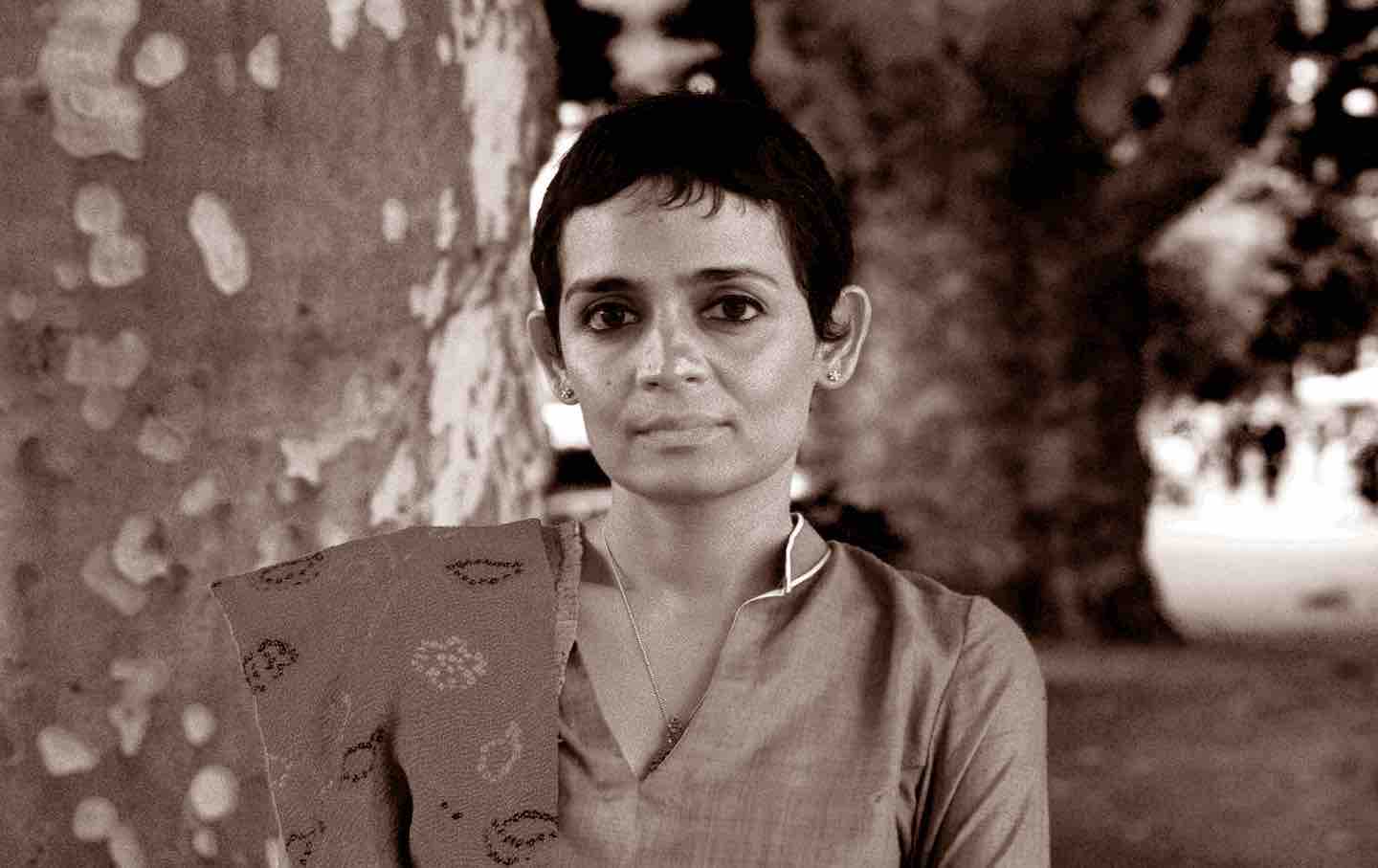
Arundhati Roy, 2002.
(Ricky Flores / Getty Images)
After college, I took a long trip to India. The ostensible reason was to assist with a research project on the country’s vast informal labor sector. But my personal reasons were both urgent and clichéd. Spending time in my parents’ native country would cure me of an encroaching sense of existential displacement. Upon returning home, I would feel connected, confident, perhaps even slightly high on the fumes of India’s glittering BRICS-utopia-to-come. This was the hope, at least.
Books in review
Mother Mary Comes to Me
Buy this bookOver those six months between 2007 and 2008, in every corner of the country, I sensed a rabid hunger to turn the page on decades of deep-rooted corruption, entrenched inequality, maddening underdevelopment, and, perhaps above all else, a history of shame and disgust at what the world’s biggest democracy had become. For many upwardly mobile Indians, the future couldn’t arrive fast enough. And yet, as I pored over Indian media and met housemaids, trash pickers, and labor activists, I came to see how this new world would come at the expense of India’s underclass as well as its ethnic and religious minorities, who often found themselves at the mercy of a still-palpable zeal for violent communal rage. It pains me to recall how much had remained invisible to me. Smoky late-night debates with friends, family, organizers, and academics filled in some of the gaps.
For the rest, there was Arundhati Roy. Reading The Algebra of Infinite Justice and An Ordinary Person’s Guide to Empire, her early collected works of nonfiction, I came to understand the jingoistic politics of India’s nuclear ambitions, the environmental and social calamity wrought by its massive dam projects, the epidemic of suicides among its debt-choked farmers, the human-rights and civil-liberties nightmare in Kashmir, the Naxalite fight against rapacious mining companies, and the story of Narendra Modi’s role in abetting the Godhra pogroms of 2002. India, as Roy saw it, was both every bit the place my mother and father had left decades before, yet also unalterably transformed.
In her new book, Mother Mary Comes to Me, Roy turns to her own mother in order to understand where she came from and why she has devoted her life to advocating on behalf of the dispossessed and the exploited. Mary Roy was a fearsome woman: “As a child I loved her irrationally, helplessly, fearfully, completely, as children do,” she writes. “As an adult I tried to love her coolly, rationally, and from a safe distance. I often failed.” But it was Mrs. Roy—never “Mother” or “Mary” but always “Mrs. Roy”—who also instilled in her a sense that life should be lived independently and humanely, in defiance of the Hindu-nationalist fervor that has overtaken India, a beast that continues to feast on the country’s women and lower classes.
As with most memoirs, Roy seeks to set the record straight and rebut her critics. But there’s a deeper purpose at work here: to consider the profound impact of those we’ve spent a lifetime running away from.
We meet Roy, at the start of the book, upon her return to her childhood home. She’s in mourning: Mrs. Roy has just died. And so Roy decides to write this memoir. “Seeing her through lenses that were not entirely colored by my own experience of her made me value her for the woman she was. It made me a writer. A novelist. Because that’s what novelists are—labyrinths,” she writes. “And now this labyrinth must make sense of its labyrinthine self without her.”
We turn, then, to 1963, the year Roy’s mother decided to leave her husband, the substance-addicted manager of a tea plantation in Assam, taking her children with her to Kerala, her family’s native state in South India. They eventually settled in a Syrian Christan community called Kottayam, where “women were only allowed the option of cloying virtue—or its affectation.” Roy doesn’t tell us why her mother chose this place—it was hostile to her as a single, divorced woman—but Mrs. Roy still found her calling at a school she opened with the mission to turn boys “into considerate, respectful men, the kind the town had rarely seen,” and to give girls “spines” and “wings” that “set them free. She bequeathed her unwavering attention and her stern love on them, and they shone back at her,” Roy writes. From her mother, Roy learned Shakespeare, of the existence of faraway places like Mississippi, and about the ravages of US empire several thousand miles to the east in Vietnam. And outside of school, in the nearby paddy fields and rubber plantations, Roy learned firsthand how the local landowners relied on the labor of the poor and their children.
Life under Mrs. Roy’s roof was never easy. Wracked by asthma, taking various medications, and fulminating under the judgment of their conservative community, she took her fickle rage out on her daughter, sometimes physically. “I had to pick my way through that minefield without a map,” Roy writes. “I was no longer prepared to understand that when she hit me and raged at me, quite often it was because she was angry at someone else who she couldn’t hit or insult in the same way, so I stood in for them.”
As a teenager, Roy encountered Laurie Baker, a visionary English-born architect specializing in sustainability who helped design her mother’s school, and was inspired by him. With her mother’s support, Roy moved to Delhi in the hopes of following in his footsteps. Living in India’s capital and studying architecture, she found herself transformed into a “scrawny bonsai plant” who made “hideous” art and fell in love with a filmmaker. Meanwhile, back in Kottayam, Mrs. Roy had become a protector of the town’s women and children and a crusader against India’s sexist property laws. But Roy no longer fit into the world of her mother: “Quite often I found myself wishing I were her student and not her daughter.” And so Roy returned to Delhi, where, through the early 1990s, she made well-regarded films for Channel 4, the British TV network, with her partner Pradip Krishen.
In 1994, Roy published a scathing two-part essay about a movie that told the story of a woman named Phoolan Devi, who became a legend among the Indians for robbing upper-caste families and for orchestrating of the murder of 22 upper-caste men who had allegedly gang-raped her some years before. The film, Roy writes, convinced her that “no one should have the right to restage the rape of a living woman without her consent.” While the essay effectively ended her relationship with Channel 4, which had produced the film, she was now free to satisfy her burning desire “to write the opposite of a screenplay.” And so, over the next several years, she wrote “a stubbornly visual but unfilmable…book” inspired by the images of her childhood that would become The God of Small Things, her aching, poignant debut novel about a pair of fraternal twins in South India grappling with caste, religion, class, and tragedy. Soon after its publication in 1997, Roy became an overnight global literary sensation, but living in “a country of desperately poor people,” she grew uneasy with her acclaim.
Roy’s meteoric rise coincided with a pair of portentous, twinned events in 1998 that would cast a shadow over India for the next two and a half decades. First came the victory in March by a coalition of parties led by the Bharatiya Janata Party (BJP), its first-ever national triumph after its founding in 1980. Then in May came the detonation of three nuclear weapons in the deserts of Rajasthan, a pointed threat to neighboring Pakistan. In conjunction, the two events unleashed a new national politics “couched in the language of masculinity and virility.” Roy set out to write about the darkness taking over India, publishing excoriating essays about its jingoistic mania, its destructive, development-at-any-cost agenda, its immiserated underclass, and its anti-capitalist insurgents. The very elites that had only just embraced Roy now branded her as a traitor to the nation. Yet Roy found herself feeling more Indian than ever: “Where else could I be the hooligan that I was becoming? Where else would I find co-hooligans I so admired?”
Popular
“swipe left below to view more authors”Swipe →Before long, her work brought her into confrontation with the horrors of Hindu nationalism. The anti-Muslim pogrom in the city of Godhra in 2002, revenge for the killing of a group of Hindu pilgrims, came “straight out of Hindu nationalism’s ideological playbook,” she writes. In Kashmir, where Indian security forces have waged a decades-long campaign against Pakistan-backed militants, she discovered barbaric cruelty: “A brother could be arrested or killed in place of another. A father could be tortured till he gave up his son.” It was an unsettling finding that made her reconsider the power of familial love. Suddenly, she began to wonder: In living life on her own terms, what had she given up or lost along the way?
If there’s a central mystery animating the memoir, it is Roy’s exhaustingly complex relationship with her mother. Perhaps the enmity between them sprang from a sense of competitiveness, or from envy of her daughter’s ability to escape, or from Roy simply having been too much for her mother: too liberated, too vocal, too romantically and sexually adventurous. We begin to understand that Roy’s life and political project—of provoking, truth-telling, and enemy-making—represents, for her, the apotheosis of her mother’s life. “She taught me to be free and raged against my freedom,” Roy writes. “She taught me to write and resented the author I became.” But through the ups and downs, Mrs. Roy remained in her daughter’s corner, offering barbed but loving encouragement.
Near the end of the book, Roy shares a surprising piece of history: Her mother had considered ending the pregnancy that produced her, a revelation Roy seems to have processed with empathy. “I imagine her alone and ill, isolated on an inaccessible tea estate with a drunk husband, a small baby, and another on its way,” she writes. Looking back, Roy realized that her mother wanted only to caution her against falling into domesticity without thinking through whether it was what she truly wanted.
Ultimately, Roy arrived at a sort of peace with her mother. “I watched her unleash all of herself—her genius, her eccentricity, her radical kindness, her militant courage, her ruthlessness, her generosity, her cruelty, her bullying, her head for business, and her wild, unpredictable temper—with complete abandon on our tiny, insular Syrian Christian society,” she realizes. This “was nothing short of a miracle—a terror and wonder to behold.”
Roy’s journey has come at some cost: contempt notices from India’s Supreme Court for alleging corruption in military contracting; sedition charges in connection with her writing on Kashmir; trouble stemming from her writing about the Narmada dam and her support for the Naxalites; legal standoffs arising from her novels’ depictions of caste, class, and sex; the near-constant harassment from the Rashtriya Swayamsevak Sangh, a right-wing paramilitary group, and the BJP, which has been in power since 2014.
Those who dish it out on the regular must, of course, be ready to have it dished out to them. Samanth Subramanian, in a largely sympathetic article from 2019, observed Roy’s tendency toward “convenient moral elisions” and her “habit of decrying capitalism, even as some market reforms lifted Indian people out of poverty.” Others, such as the prominent Indian historian Ramachandra Guha, have called her writing on the dams “arguments…served up in a jumble of images and exclamations with the odd number thrown in.” But it’s Roy’s willingness to fling herself headlong into the unknown, her habit of making the right enemies, and her conviction in her own purpose, that give her work its meaning.
Perhaps this comes with the territory of the “writer-activist,” an appellation often ascribed to Roy but one that she seems to find absurd. “My commitment was to writing. To being a writer, not a leader or an activist…. I had to have the right to be unpopular. I had to have the choice of probing the boundaries of acceptability, of not fitting in, of standing alone.” While she considers Gandhi a “visionary in some ways,” she does not identify as a Gandhian: “I was a critic. A skeptic. To put it mildly.”
Decades of fierce skepticism and confrontation, however, tend to force some degree of reflection. Even as history has largely moved in the directions Roy warned about—authoritarianism ascendant, free speech stifled, class disparity entrenched, religious and ethnic repression rampant, communal violence fully unleashed—one wonders: Was her choice to commit herself to this life worth it? What did it cost? And, perhaps more hauntingly, what did it achieve? These questions feel present, if not fully answered, on every page.
Last October, Roy accepted the PEN Pinter Prize, awarded to writers whose work helps “define the real truth of our lives and our societies.” Not long before the ceremony, PEN had been pressured by pro-Palestine activists to acknowledge the war in Gaza, an admission that Roy did not allow to go unmentioned in her acceptance speech.
In her remarks, she congratulated her cowinner, the imprisoned (and recently pardoned) Egyptian writer Alaa Abd El-Fattah, and acknowledged several imprisoned Indian activists, before pivoting to Israel’s genocidal campaign in Gaza and America’s ongoing support for the slaughter. “A whole population is being starved—their history is sought to be erased,” she said. As for the pledges from US lawmakers in support of a ceasefire, she viewed them with contempt. “A party to the genocide cannot be a mediator. Not all the power and money, not all the weapons and propaganda on earth can any longer hide the wound that is Palestine. The wound through which the whole world, including Israel, bleeds.” Then she added, with a note of measured optimism: “The war that has now begun will be terrible. But it will eventually dismantle Israeli Apartheid. The whole world will be far safer for everyone—including for Jewish people—and far more just. It will be like pulling an arrow from our wounded heart.”
The tension between rage and hope—in community, in the possibility of a more just future, in defiance of a horrific present—is a constant in her work. For Roy herself, though, the only choice appears to be to go on.
Support independent journalism that does not fall in line
Even before February 28, the reasons for Donald Trump’s imploding approval rating were abundantly clear: untrammeled corruption and personal enrichment to the tune of billions of dollars during an affordability crisis, a foreign policy guided only by his own derelict sense of morality, and the deployment of a murderous campaign of occupation, detention, and deportation on American streets.
Now an undeclared, unauthorized, unpopular, and unconstitutional war of aggression against Iran has spread like wildfire through the region and into Europe. A new “forever war”—with an ever-increasing likelihood of American troops on the ground—may very well be upon us.
As we’ve seen over and over, this administration uses lies, misdirection, and attempts to flood the zone to justify its abuses of power at home and abroad. Just as Trump, Marco Rubio, and Pete Hegseth offer erratic and contradictory rationales for the attacks on Iran, the administration is also spreading the lie that the upcoming midterm elections are under threat from noncitizens on voter rolls. When these lies go unchecked, they become the basis for further authoritarian encroachment and war.
In these dark times, independent journalism is uniquely able to uncover the falsehoods that threaten our republic—and civilians around the world—and shine a bright light on the truth.
The Nation’s experienced team of writers, editors, and fact-checkers understands the scale of what we’re up against and the urgency with which we have to act. That’s why we’re publishing critical reporting and analysis of the war on Iran, ICE violence at home, new forms of voter suppression emerging in the courts, and much more.
But this journalism is possible only with your support.
This March, The Nation needs to raise $50,000 to ensure that we have the resources for reporting and analysis that sets the record straight and empowers people of conscience to organize. Will you donate today?
More from The Nation
George Packer’s Liberal Imagination George Packer’s Liberal Imagination
What happens when liberalism’s crisis is made into a fable?
The Greatest Love Is Grieving The Greatest Love Is Grieving
I spent years as a labor organizer. Marguerite Duras’s war novel taught me that the strongest fighters are always the women hurting the most.

The Neoliberalism of Robert A.M. Stern The Neoliberalism of Robert A.M. Stern
The passing of postmodern architecture’s last living holdout marks the end of an era—and reminds us that we’re in a new, worse one.
The Cinema of Societal Collapse The Cinema of Societal Collapse
This year’s Oscar-nominated international feature films—especially The Secret Agent and Sirāt—tackle what it means to live and die under tyranny.
Can the Dictionary Keep Up? Can the Dictionary Keep Up?
In Stefan Fatsis’s capacious, and at times score-settling, personal history of the reference book, he reveals what the dictionary can still tell us about language in modern life

