Macklemore Dares Others to Stand Up for Palestine
With “Hind’s Hall,” the rapper is telling artists and other culture workers, “The students are risking it all. Where are you?”
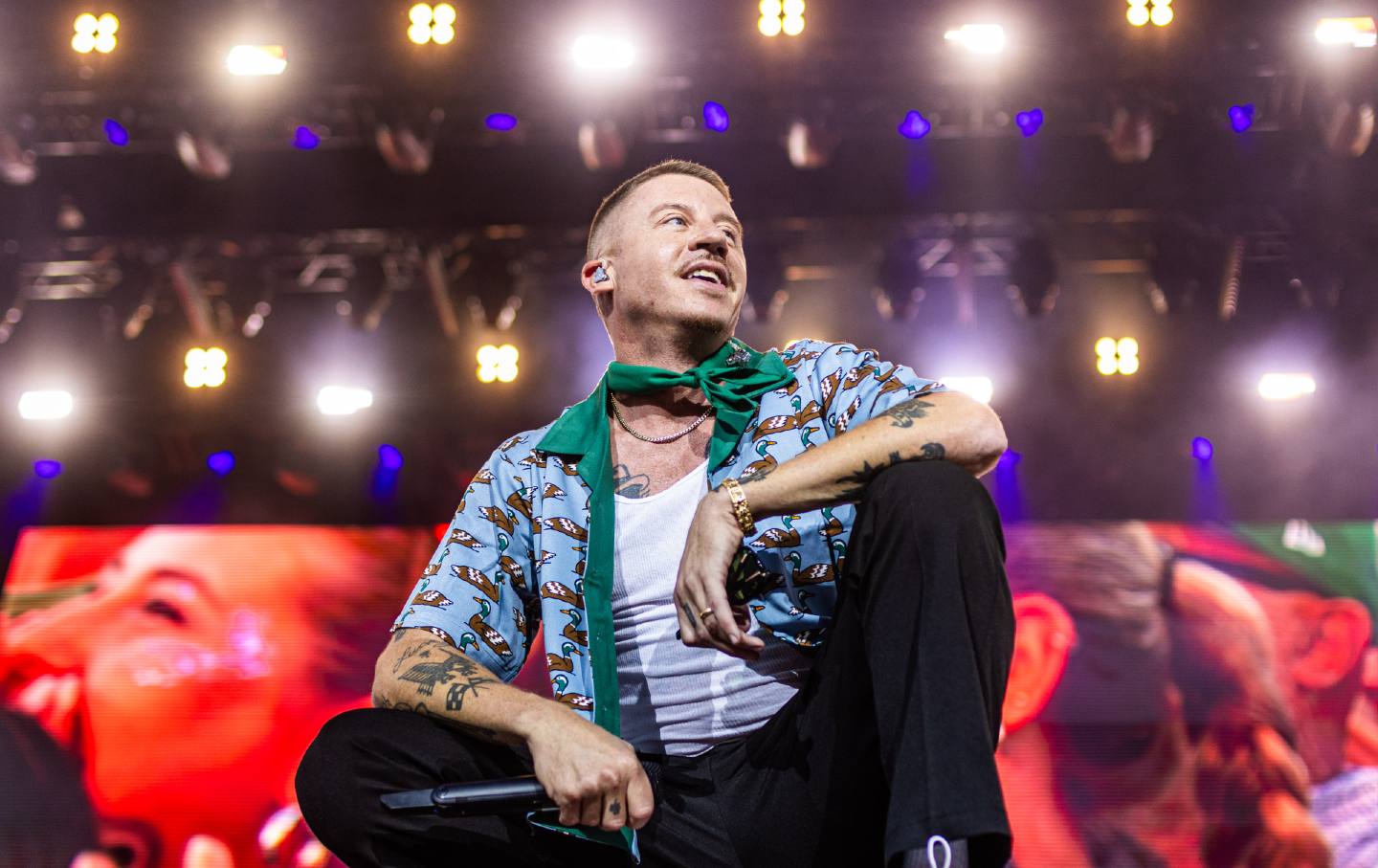
Macklemore performs live at Lollapalooza Berlin 2023 on September 10.
(Gina Wetzler / Redferns via Getty)The foremost authority on the revolutionary rock/rap band Rage Against the Machine, their own guitarist Tom Morello, tweeted this. Rage Against the Machine filled stadiums in the 1990s with its brand of radical, political fire. Now Macklemore is carrying the flame.
For those who haven’t heard it, “Hind’s Hall”—named after Columbia’s renamed building that students occupied—is a beautiful, incendiary new track about Palestine and the student movement by Seattle rap artist Macklemore. With its panoply of up-to-date reference, the lyrics seem as if they were written immediately before the song dropped. Macklemore raps about the student occupations, violent police staring down peaceful resistance, the silence of the music industry in the face of genocide, the efforts to ban TikTok, the proud Jewish role in this struggle, and the great lie that anti-Zionism and antisemitism are in any way the same thing.
In this track, Macklemore, born Ben Haggerty, recenters the discussion not on the encampments but the reason they exist: the carnage in Gaza. He rhymes, “The people, they won’t leave / What is threatenin’ about divesting and wantin’ peace? / The problem isn’t the protests, it’s what they’re protesting / It goes against what our country is funding/ (Hey) Block the barricade until Palestine is free / (Hey) Block the barricade until Palestine is free.”
Macklemore also treads on the third rail of the moment: Biden’s complicity in Israel’s war on the people of Gaza and the 2024 elections. He raps, “The blood is on your hands, Biden, we can see it all, And fuck no, I’m not votin’ for you in the fall (Woo) Undecided. You can’t twist the truth, the people out here united / Never be defeated when freedom’s on the horizon.”
In releasing “Hind’s Hall,” which has already gone viral, Macklemore is doing more than just asserting his solidarity. He says he will send all streaming proceeds to the United Nations Relief and Works Agency for Palestine Refugees in the Near East. He is also breaking a silence that has spread to nearly every aspect of our culture. The music industry has been silent on Palestine. Star athletes, so central to the Black Lives Matter movement, have largely been too scared to speak. Most of Hollywood has kept quiet. I know artists and athletes who want to speak up for Palestine but are correctly concerned that they would be putting their careers in danger. With “Hind’s Hall,” Macklemore is breaking the glass and inviting, even daring, other people to walk through the shards, breathe the air, and make their voices heard. He is staring at the artistic world saying, “The students are risking it all. Where are you?”
The release of “Hind’s Hall” is reminiscent of when the first people in the movie industry began to hire blacklisted writers in the 1950s or that moment when Paul Robeson, facing the House of Un-American Activities Committee, was told to go back to Russia (really telling him to go back to Africa), and he refused, saying, “Because my father was a slave, and my people died to build this country, and I am going to stay here, and have a part of it just like you. And no Fascist-minded people will drive me from it. Is that clear?” These acts produced the oxygen of freedom where none existed before. “Hind’s Hall” is now part of that tradition.
To be clear: Macklemore is standing up because the students are standing up on campuses across the country. He is drawing inspiration from the young people risking their safety and their futures by denouncing a genocide funded by our tax dollars. Instead of being cowed by his industry’s silence, Macklemore is raising the volume. Instead of slouching through this crisis with tired battle rhymes, he is raising the stakes: telling people to use their skills to look beyond themselves.
As he writes in “Hind’s Hall”:
What you willin’ to risk? What you willin’ to give?
What if you were in Gaza? What if those were your kids?
If the West was pretendin’ that you didn’t exist
You’d want the world to stand up and the students finally did,
let’s get it.