The Crisis of Shelter in the United States
Housing is one the building blocks of human life. Why is it so scarce in this country?
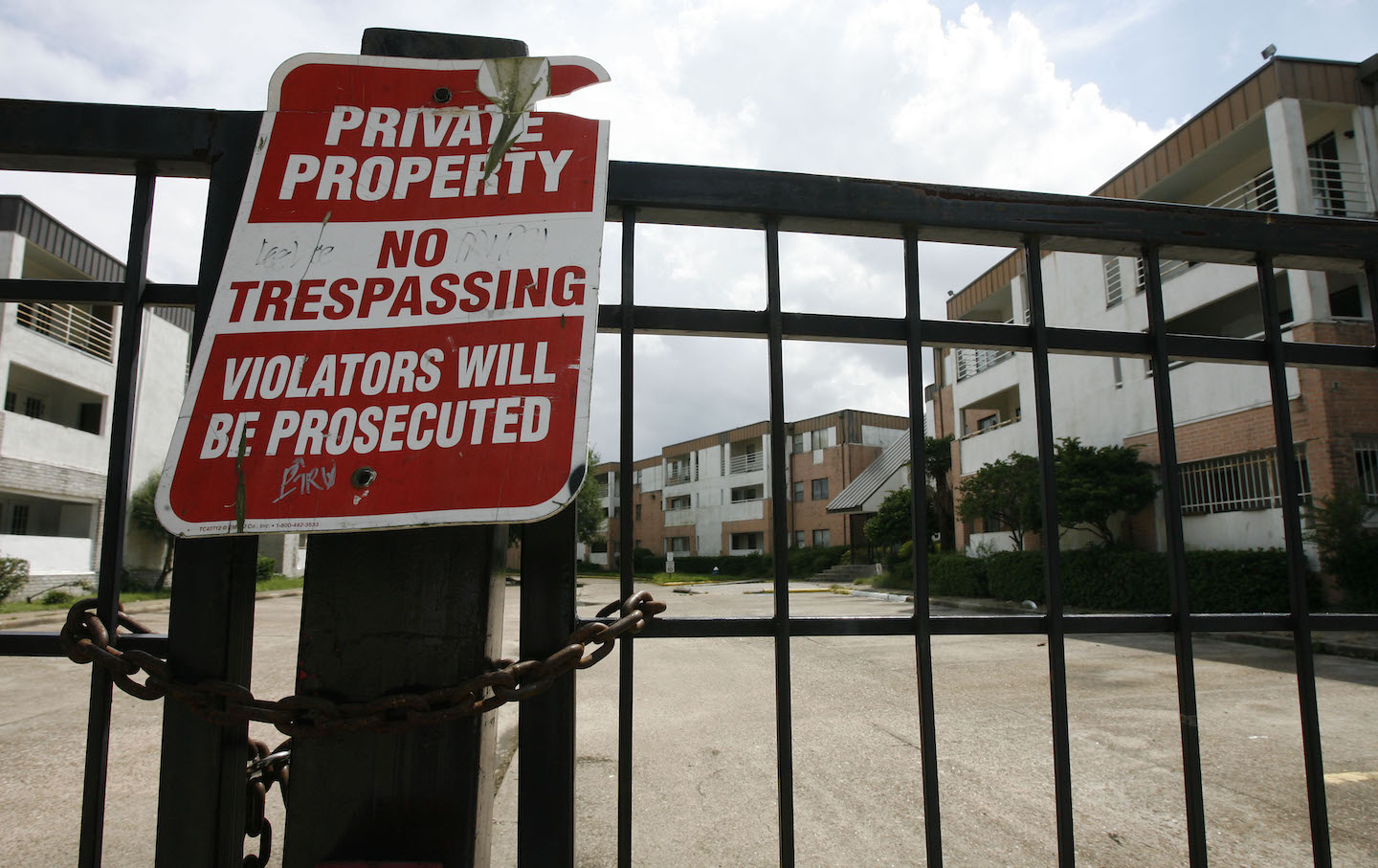
Condemned condominiums in Houston, 2007.
(Photo by James Nielsen / Houston Chronicle via Getty Images)The summer before seventh grade, my mother and I began a nomadic journey across the Metroplex, the geography-laden name for the city of Dallas and its surrounding suburbs. My mom had filed for bankruptcy in 1982 and could never catch up. We moved from our house in the lush Oak Cliff neighborhood, where the waxy green leaves of magnolia trees and sturdy pecan trees were fed by Five Mile Creek, to a condominium complex several miles away that sat on the edge of a freeway. The next year we moved again, this time into my uncle’s three-bedroom ranch house in a completely different part of Dallas. Brown carpet and endless wood panel, but with a cold, white-tiled bathroom and a bedroom a quarter of the size of my previous one. We lied about our address so that I could stay at my junior high school. After eighth grade, we moved again. We were in a new neighborhood, blocks away from the movie theater on Jefferson Avenue where Lee Harvey Oswald huddled after he assassinated President John F. Kennedy. This time, we shoved our steadily dwindling belongings into the shell of a house that my mother imagined could be remade into a windfall.
By that point, my mother had taken up part-time work as a home appraiser, feeding a delusion that investment into real estate could transform debt into prosperity. She hired a contractor who was mostly skilled at draining her bank account. We were left with a hulking structure that had no hot water, no heat, and a kitchen infested with nutria, rodents that look like gigantic rats that made their home on the exposed pipes where the kitchen walls should have been. We ceded the kitchen to the nutria and plugged in a hot plate in another room that was used for heating up water for baths.
This during my first year of high school, when anxiety and anticipation were already cranked high. Texas winters were mild, but without heat or hot water, my morning routine—heating up small pots of water to dump into a bathtub—became interminable. After a year of living in a house that barely constituted shelter, my grandmother moved from Nashville, Tennessee, to live with us. Her income, combined with my mother’s, was enough for us to rent a house in the suburbs of Dallas. We were on the move again.
There are a handful of necessities that define what it means to be human, binding our vastly disparate experiences into one. We need some combination of food, water, air, and shelter. Of course, there are other things that may constitute a better or worse life, but these four are a baseline for human survival. And yet, in the United States, whose leaders like to imagine this nation as the absolute pinnacle of human achievement, none of these are readily available to all who need them.
I share my own story to communicate the universality of housing instability, housing insecurity, and housing precarity in the United States. This can be measured in the more than three million people formally designated as homeless or living in shelters, while millions more languish in what social scientists describe as “housing insecurity,” which is measured by unpredictable housing costs and threats to habitability, quality, and continued access. This crisis of shelter in the United States has been a feature of our society for the duration of the twentieth century and now in the twenty-first.
If crisis indicates a periodic rupture in the otherwise routine occurrence of daily events, then what we are actually experiencing, in the words of Ruth Wilson Gilmore, is the “organized abandonment” of the human and social obligation to shelter our species. This abandonment is abetted by gender and racial discrimination that has left Black women, in particular, facing eviction, homelessness, and the attendant social catastrophes that come when your housing is fleeting.
The deep roots to our housing disaster lie in the market economy that has historically regarded housing as a commodity and not a right. This process has worked to drive the price of rent well beyond the rate of wages and salaries earned by ordinary workers. From 2021 to 2022, rents across the United States for both one-bedroom and two-bedroom apartments increased by 24 percent. It has been long established that the paltry national minimum wage of $7.25 is not enough to cover the rent for a two-bedroom apartment in any state in this country. This has translated into an astonishing 51 percent of American households being “rent burdened” or spending more than 30 percent of their income on rent.
The enduring character of the organized abandonment of housing means that it’s very easy for housing insecurity to look normal. But the pandemic brought this instability to the surface. Individuals and families on the brink of eviction or foreclosure were able to see each other as mutual victims of corporate, landlord greed. Their collective endeavor might one day cohere around a different kind of consciousness of resistance.
Many stories of housing insecurity center or describe the fear and personal insecurity that gestate when it’s unclear where or what home is. This does not have to be the case. Housing should be treated as the human right it is, along with the other things like food and water which actually constitute the building blocks of human life.
Support independent journalism that does not fall in line
Even before February 28, the reasons for Donald Trump’s imploding approval rating were abundantly clear: untrammeled corruption and personal enrichment to the tune of billions of dollars during an affordability crisis, a foreign policy guided only by his own derelict sense of morality, and the deployment of a murderous campaign of occupation, detention, and deportation on American streets.
Now an undeclared, unauthorized, unpopular, and unconstitutional war of aggression against Iran has spread like wildfire through the region and into Europe. A new “forever war”—with an ever-increasing likelihood of American troops on the ground—may very well be upon us.
As we’ve seen over and over, this administration uses lies, misdirection, and attempts to flood the zone to justify its abuses of power at home and abroad. Just as Trump, Marco Rubio, and Pete Hegseth offer erratic and contradictory rationales for the attacks on Iran, the administration is also spreading the lie that the upcoming midterm elections are under threat from noncitizens on voter rolls. When these lies go unchecked, they become the basis for further authoritarian encroachment and war.
In these dark times, independent journalism is uniquely able to uncover the falsehoods that threaten our republic—and civilians around the world—and shine a bright light on the truth.
The Nation’s experienced team of writers, editors, and fact-checkers understands the scale of what we’re up against and the urgency with which we have to act. That’s why we’re publishing critical reporting and analysis of the war on Iran, ICE violence at home, new forms of voter suppression emerging in the courts, and much more.
But this journalism is possible only with your support.
This March, The Nation needs to raise $50,000 to ensure that we have the resources for reporting and analysis that sets the record straight and empowers people of conscience to organize. Will you donate today?