CNN Surrenders to Trump
The corporate media’s commitment to fighting autocracy proves fickle.
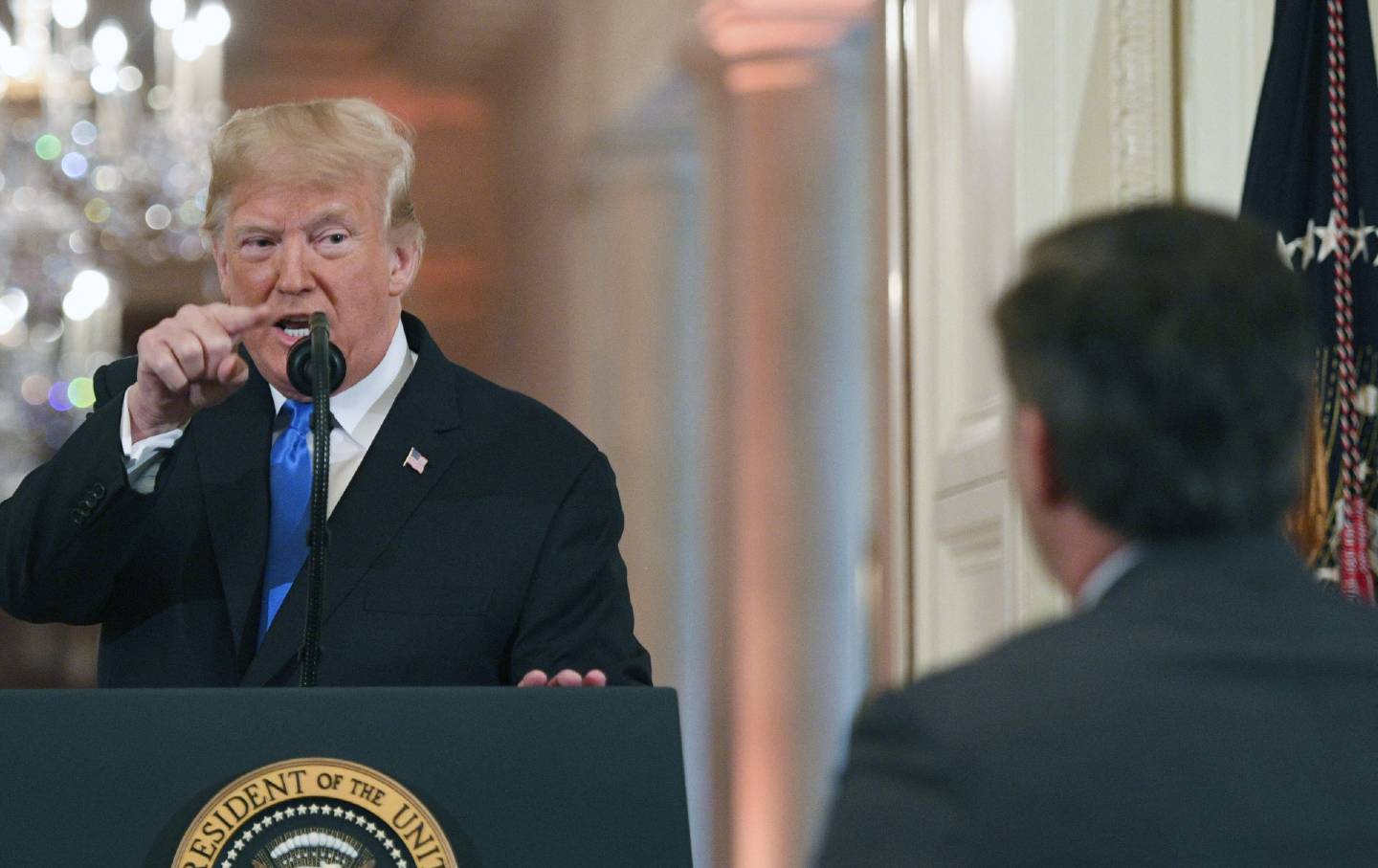
CNN anchor Jim Acosta is fated to be a barometer of his network’s relationship with Donald Trump. During Trump’s first term, Acosta’s tough questioning at press conferences gave CNN credibility as a news outlet uncowed by the president’s bullying and willing to uphold the principle of accountability. In 2018, Trump denounced Acosta as a “rude, terrible person” and the White House revoked Acosta’s press pass. CNN sued Trump and his top aides on behalf of Acosta, successfully forcing the White House to give the reporter back his press pass.
If Acosta’s jousting with Trump was once celebrated by CNN, it has now become a source of shame. With Trump winning not just a second term but also having, for the first time, a popular vote victory (however narrow), CNN and other corporate media outlets have been thoroughly cowed. Last Thursday in the newsletter Status, Oliver Darcy, a former CNN journalist, reported that CNN CEO Mark Thompson had phoned Acosta and “delivered the veteran journalist a sudden and strange proposal: Move your show to midnight and anchor it until 2am ET.” Acosta currently has a morning show that runs at 10 am ET. A media executive told Darcy, “They want to get rid of Acosta to throw a bone to Trump. Midnight is not a serious offer when his ratings are among the best on the network.”
Mediaite followed up Darcy’s reporting with other quotes from current and former CNN employees, who were nearly unanimous in being shocked by the network’s behavior. One staffer said, “Jim made a career and name for himself by asking tough questions and holding power to account. That included Trump. So it will be interesting to see if this kind of move has some sort of chilling effect or sends a message to other shows and EPs about how the network wants to engage with this new administration.” Another interviewee described the staff as “baffled” by the proposed sidelining of Acosta, noting, “It seems like an attempt to appease Trump, who is never appeased by anything.”
On Tuesday, Darcy reported that the day before Trump’s inauguration Thompson held a virtual editorial meeting where he
offered guidance about how he wanted to see the network cover Inauguration Day. Thompson indicated to attendees, I’m told, that he wanted his journalists to be forward-thinking and to avoid pre-judging Trump. He cautioned against expressing any outrage of their own, as many of the anchors who make up CNN’s roster of journalists had previously done with regularity during Trump’s first term.
CNN’s shift mirrors a larger transformation in the corporate media. During Trump’s first term, many outlets found it profitable to cater to popular liberal outrage over Trump. Under the umbrella label of “resistance liberalism” emerged a genuine mass movement that sought to fight Trumpism through protests and electoral organizing. Resistance liberalism had its share of faults—notably a propensity for conspiracy theories evident in the wilder speculations about Trump’s possible ties to Russian President Vladimir Putin—but it was also a salutary popular engagement with democracy.
The mainstream media, sometimes cynically but also with genuine investigative reporting, tried to harness the new audience of resistance liberals. In 2017, The Washington Post adopted the slogan “Democracy Dies in Darkness.” But even before Trump won his second term, the fighting spirit of resistance liberalism had waned, weakened by years of defending the often out-of-touch Biden administration. It’s notable that in 2024, roughly 75 percent of the nation’s largest newspapers—including The Washington Post, USA Today, and the Los Angeles Times—refused to endorse any candidate for president. Earlier this month, the Post adopted a new mission statement: “Riveting Storytelling for All of America.” While “Democracy Dies in Darkness” can be criticized for being melodramatic and self-important, the new credo suggests a newspaper not committed to journalism at all but devoted instead to simple entertainment.
The retreat from an adversarial relationship to Trump is undoubtedly rooted in economic self-interest. As corporate consolidation of the media intensifies, news outlets are increasingly beholden to leviathan parent entities that are deeply entangled with affairs of the state. This is especially the case since Donald Trump has not been shy about threatening to use his presidential power against business leaders who defy him. Last fall, Trump threatened Meta CEO Mark Zuckerberg with life in prison. Not surprisingly, Zuckerberg has swiftly moved to appease Trump by making changes at Facebook that suit the president—notably the site’s recent severe curtailing of fact-checking.
The New York Post reports that “CNN’s corporate parent, Warner Bros. Discovery, has made it clear it wants the network to adopt a more neutral tone in its dealings with Trump.” The Washington Post, of course, is owned by Jeff Bezos, one of the world’s richest men, whose extensive business interests, notably at Amazon, require him to keep on the good side of Trump.
The abject submission of outlets such as CNN and The Washington Post is not just a lesson in the dangers of corporate control of the media but also a reminder of the value of independent media. The alliance between the mainstream media and resistance liberalism was always precarious and dubious. Even when CNN was more critical of Trump than they are now, it was on grounds friendlier to a safe centrism than any progressive politics: hence CNN’s onetime promotion of Russiagate and incessant elevation of Never Trump Republicans. The lesson progressives should take is that corporate media is never friendly terrain and to build a lasting opposition you need independent outlets such as Democracy Now!, ProPublica, and, dare we say it, The Nation.
Become a Sustaining Donor This September
Between the reemergence of right-wing red-baiting and Donald Trump’s use of the chilling National Security Presidential Memorandum–7 to criminalize left political organizing, we’re seeing McCarthyism reborn before our eyes.
This assault on democracy cannot be ignored or wished away. Resisting it requires bravery in the face of threats and repression, a steadfast commitment to the truth, and the unwavering belief that we can—and will—overcome this darkness.
We must have an independent media that sets the record straight, unearths corruption and abuses of power, and advances a politics of justice and dignity for all if we’re to win this fight.
That’s why I’m writing to you today. This September, The Nation needs to add 100 monthly donors to sustain our progressive journalism. Your contribution makes the next investigative report, the next truth-speaking column, and the next pathbreaking essay all possible.
I hope you’ll support our work with a recurring donation today. If you donate $10 or more a month, we’ll send you a brand new “Hands Off the Free Press!” sticker to recognise your commitment to our cause. Please, donate today.
Onward,
Katrina vanden Heuvel
Editor and Publisher, The Nation