
A Sweeping History of the Black Working Class
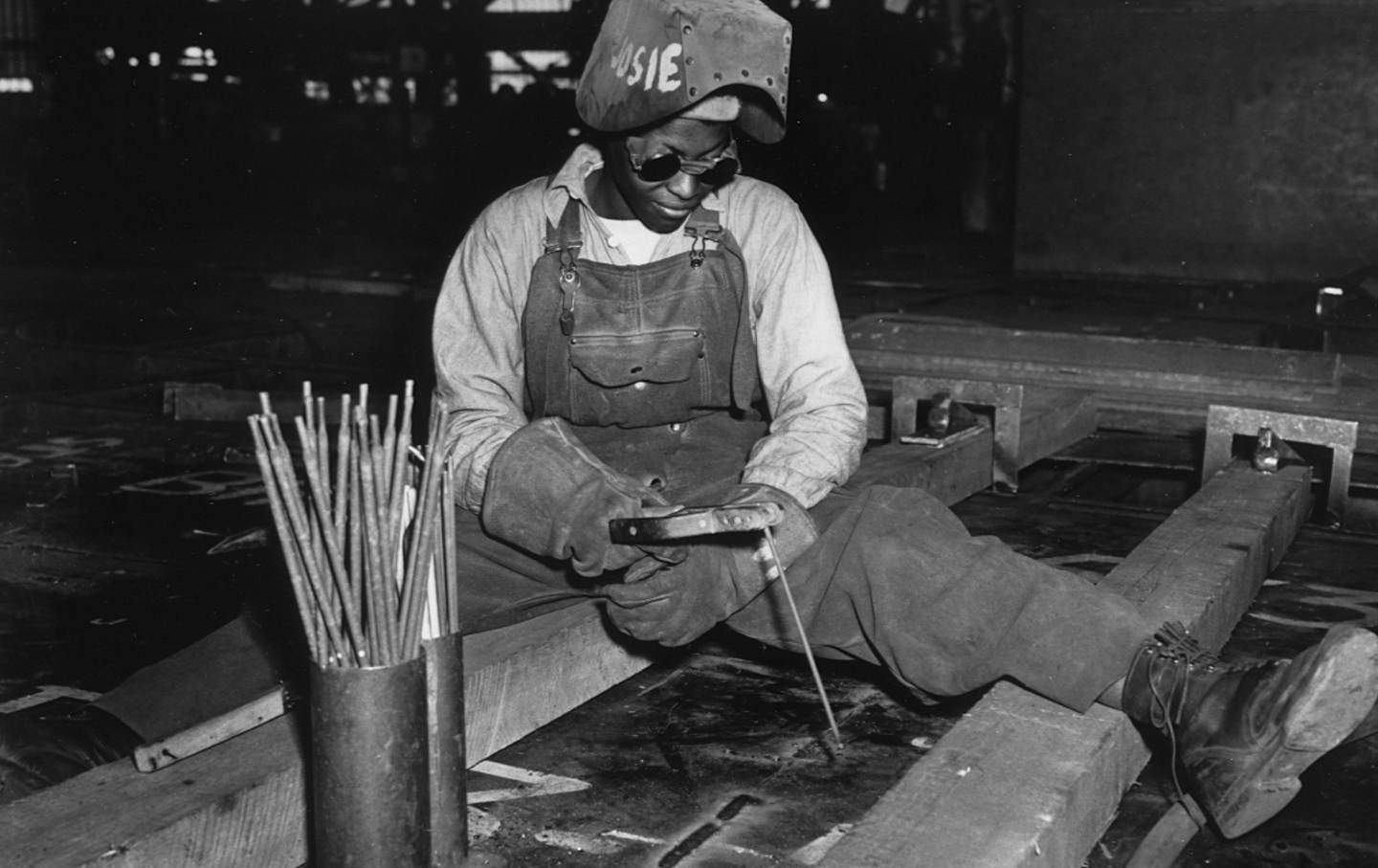
By focusing on the Black working class and its long history, Blair LM Kelley’s book, Black Folk, helps tell the larger story of American democracy over the past two and a half centuries.
The famous “I Have a Dream” speech, arguably the best-known public statement by Martin Luther King Jr., was given at the 1963 March on Washington for Jobs and Freedom. In it, King urged the nation on in tackling segregation and political inequality, but he also talked about economic injustice: How, he asked, could Black Americans continue to live “on a lonely island of poverty in the midst of a vast ocean of material prosperity”?
King was not alone in highlighting the economic disparities ravaging Black America on that day. The March on Washington, after all, was about jobs as well as freedom, and one of the themes that connected the plethora of speeches given by the leaders of the burgeoning civil rights movement was a concern about economic inequality and the desire to realize freedom in all the domains of life—not just politics and civil society. “Yes, we want a Fair Employment Practice Act,” thundered A. Philip Randolph, “but what good will it do if profit-geared automation destroys the jobs of millions of workers black and white?”
A socialist, Randolph always thought deeply about the relationship between race, labor, and class in American society. This—as well as how they relate to gender—sits at the heart of Blair LM Kelley’s book, Black Folk: The Roots of the Black Working Class. In this masterful analysis of US history, Kelley offers a new and refreshing perspective: While focused on the history of the Black working class in particular, she at the same time captures truths about the American past writ large: How the racialization of minority groups is intertwined with class; how capitalism extracts profits from labor; how the politics of race and class can clash within Black America; and even how the latest outbreak of the culture wars in the United States—over how to teach American history—is a dire threat to understanding this rich and variegated legacy. By focusing on the Black working class and its long history, Kelly helps tell the larger story of American democracy over the past two and a half centuries.
Kelley, who is currently the director of the Center for the Study of the American South at the University of North Carolina, has focused on Black and Southern history throughout her career. Her first book, Right to Ride: Streetcar Boycotts and African American Citizenship, discussed how the tactic of boycotting public transportation by Black Americans did not begin in Montgomery, Alabama. Instead, Kelley showed, the first campaigns started with streetcars in the 1890s and early 1900s and led to the Supreme Court taking up the Plessy v. Ferguson case of 1896.
Like Right to Ride, Black Folk offers a unique take on a familiar history, in part because it includes the personal narratives of members of Kelley’s own family tree. Beginning with a chapter on an enslaved ancestor named Henry, a blacksmith, she then tells us about her great-grandfather, Solicitor Duncan, and her grandfather, John Dee. Through their stories, Kelley personalizes the history of three generations of Black working-class men as they went from slavery and sharecropping in the Deep South to trying to make a living in World War II–era Philadelphia. From Reconstruction to Jim Crow, the Great Migration, and the Depression and New Deal era, Kelley details what remained continuous within Black working-class history and what did not.
Black history, Kelley notes, has not always been told as a story of the working class, but by doing so she reminds us of the centrality of labor to all of Black history. Charting the transition from slavery to freedom at the end of the Civil War and the formation of new labor regimes during the Reconstruction, Jim Crow, and New Deal periods, she also examines the ways in which the freedom to choose how and where one works was a central concern for Black Americans. While we tend to emphasize, in histories of the Reconstruction era, the political and social travails involved in extending voting rights to Black men, as well as the rise of Black politicians and the violent counterrevolution of the 1870s, Kelley also stresses that, on the ground across the South, the freedom most dear to Black Americans was the freedom to choose how to live their new lives—and that included how to make a living, too.
To understand Black religion, politics, and cultural creativity in the Reconstruction era, Kelley notes, one has to understand this struggle to find dignity and create the foundations of emancipation as one that was often centered on the labor Black Americans performed. No longer forced to work as slave labor for someone else, they now had to decide who they would work for—and how. That so many Black Americans saw their struggle for this more expansive understanding of freedom weakened—though not destroyed—by the rise of sharecropping helps explains why it remained such a defining issue for members of the Black working class.
As Kelley shows, Black working-class organizers and agitators, from railroad workers to those organizing within the US Postal Service, were on the front lines, pursuing not just higher wages or better working conditions but also civil rights reform. The rise of the Brotherhood of Sleeping Car Porters as an engine of social change is one of Kelley’s key examples. Formed by A. Philip Randolph in 1925, the union soon became a critical part of the Black struggle for civil and political rights in the 20th century, serving not only as the labor organization for railroad-car porters—one of the few decent-paying jobs available to Black men in the early to mid-20th century—but also a conduit connecting Black Americans north and south, east and west, via America’s rail lines to advance a general program of emancipation and racial equality.
Not all of Black America agreed with the union’s radical bent. Kelley describes attempts by The Chicago Defender, the famed Black-run newspaper that spurred many Black Americans to join the Great Migration north, to weaken the brotherhood due to the paper’s skepticism toward labor organizing. Randolph and the working-class members of the brotherhood, however, could give as well as they got: Randolph would sometimes refer acidly to the Defender as “the Surrender.”
Alongside Kelley’s discussions of work, she also offers a careful reading of the important role that gender plays in the history of the Black working class. Telling the story of washerwomen like Sarah during the Great Depression, she puts Black women at the center of her history and, in this way, joins the illustrious company of historians like Tera Hunter, the author of To ’Joy My Freedom, who wrote about Black women’s lives in the Deep South in the post-Reconstruction era and offered a study of how race, gender, and labor intersected in ways that many Americans have never learned about.
Hunter was interested in how Black working-class women—often erased from the broader narratives of gender and labor in American history—found ways to organize in order to create an economic and social space in which they could survive and even thrive. Expanding on Hunter’s work, Kelley examines how Black working-class women, from Rosa Parks to Fannie Lou Hamer, not only sought to transform their workplaces but also became an integral part—if not sometimes the integral part—of the larger struggles of Black Americans during the civil rights era.
Connecting the struggle of working-class women to the history of those struggling for Black freedom, Kelley also makes it clear that it was often not the “talented tenth” of Black middle-class intellectuals and activists who helped break the grip of segregation over the South, but rather working-class Black Americans. The reader of Black Folk can only be humbled by the hard work of washerwomen in the South in the late 19th century—and domestic servants throughout the country in the 20th century—in their efforts to secure their own economic rights in spite of tremendous pressure not to do so. And that reader will also begin to see how these working-class actions established a pattern for the civil rights movement in the 1950s and ’60s. The working-class women that Kelley chronicles in this book did more than just make “space for their families,” she explains; they also pursued a political struggle “for their rights, for their dignity, and for one another.”
Such working-class solidarity repeatedly showed itself throughout the second half of the 20th century. When Randolph and King led the call for a Freedom Budget in 1966 to address the plight of the poor, they sought a solution that would benefit not just Black Americans but all members of the working class, regardless of race. “The tragedy,” Randolph wrote in his introduction to the budget, “is that groups only one generation removed from poverty themselves, haunted by the memory of scarcity and fearful of slipping back, step on the fingers of those struggling up the ladder.” Randolph acknowledged that many in the working class—especially, but not only, the Black working class—knew that they were one financial disaster away from being poor themselves.
As Kelley points out in her conclusion, what these activists had long recognized was that the plight of the Black working class was often shared by the working class as a whole. This simple truth was made plain during the early days of the Covid-19 pandemic and Donald Trump’s administration. Yet, as Kelley also notes in the final pages of her book: “The Trump-caused obsession with the white working class…has obscured the reality that the most active, most engaged, most informed, and most impassioned working class in America is the Black working class.” It is this element of the American body politic that has, in the past, tended to offer the most hope in trying times. As the son of Black working-class people, I can say that this is true today too.
Support independent journalism that does not fall in line
Even before February 28, the reasons for Donald Trump’s imploding approval rating were abundantly clear: untrammeled corruption and personal enrichment to the tune of billions of dollars during an affordability crisis, a foreign policy guided only by his own derelict sense of morality, and the deployment of a murderous campaign of occupation, detention, and deportation on American streets.
Now an undeclared, unauthorized, unpopular, and unconstitutional war of aggression against Iran has spread like wildfire through the region and into Europe. A new “forever war”—with an ever-increasing likelihood of American troops on the ground—may very well be upon us.
As we’ve seen over and over, this administration uses lies, misdirection, and attempts to flood the zone to justify its abuses of power at home and abroad. Just as Trump, Marco Rubio, and Pete Hegseth offer erratic and contradictory rationales for the attacks on Iran, the administration is also spreading the lie that the upcoming midterm elections are under threat from noncitizens on voter rolls. When these lies go unchecked, they become the basis for further authoritarian encroachment and war.
In these dark times, independent journalism is uniquely able to uncover the falsehoods that threaten our republic—and civilians around the world—and shine a bright light on the truth.
The Nation’s experienced team of writers, editors, and fact-checkers understands the scale of what we’re up against and the urgency with which we have to act. That’s why we’re publishing critical reporting and analysis of the war on Iran, ICE violence at home, new forms of voter suppression emerging in the courts, and much more.
But this journalism is possible only with your support.
This March, The Nation needs to raise $50,000 to ensure that we have the resources for reporting and analysis that sets the record straight and empowers people of conscience to organize. Will you donate today?
More from The Nation

The Neoliberalism of Robert A.M. Stern The Neoliberalism of Robert A.M. Stern
The passing of postmodern architecture’s last living holdout marks the end of an era—and reminds us that we’re in a new, worse one.

The Cinema of Societal Collapse The Cinema of Societal Collapse
This year’s Oscar-nominated international feature films—especially The Secret Agent and Sirāt—tackle what it means to live and die under tyranny.
Can the Dictionary Keep Up? Can the Dictionary Keep Up?
In Stefan Fatsis’s capacious, and at times score-settling, personal history of the reference book, he reveals what the dictionary can still tell us about language in modern life

Why We Misunderstand the Chinese Internet Why We Misunderstand the Chinese Internet
Journalist Yi-Ling Liu’s The Wall Dancers traces how the Internet affected daily life in China, showing how similar this corner of the Web is to the one experienced in the West.
The Bad Vibes of “Wuthering Heights” The Bad Vibes of “Wuthering Heights”
Keeping its distance from the novel, Emerald Fennell’s film ends up offering us a mirror of our own times.
Has Contemporary Fiction Ignored the Working Class? Has Contemporary Fiction Ignored the Working Class?
Claire Baglin’s bracing On the Clock gives its readers a close look at work behind the fry station, and in the process asks what experiences are missing from mainstream letters.

