
The Gaza Protests Were a Mask-Off Moment for American Universities
The brutal crackdown on the divestment encampments exposed a stark truth: The modern university cannot function without the support of the military-industrial complex.
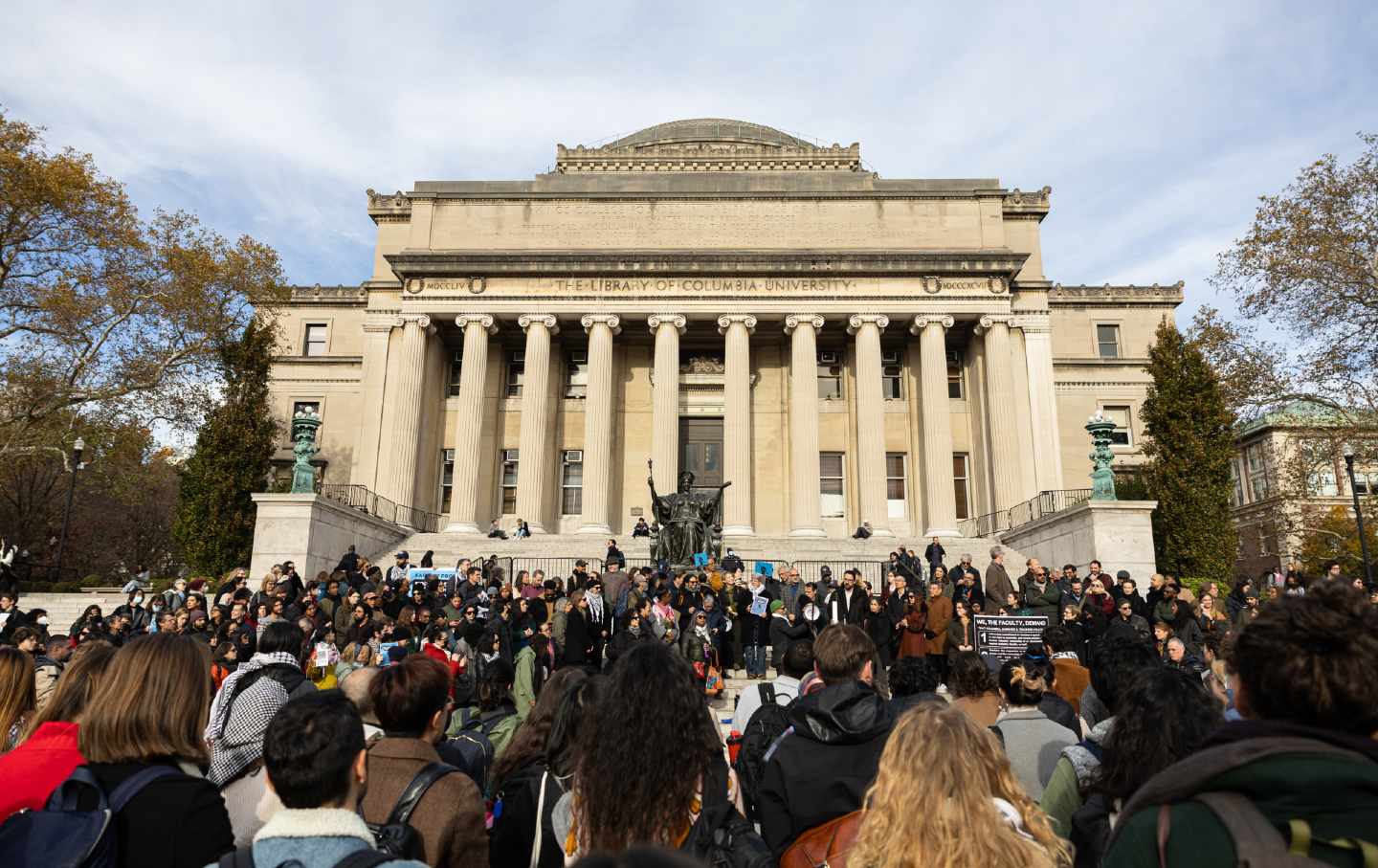
The university presidents who have sicced riot police on students demanding divestment from Israel want you to know something: Violent repression is in the best interest of their schools. University of Chicago President Paul Alivisatos wrote that a police sweep was necessary because the protest “disrupts the functioning of the university.” At UCLA, the site of both pro-Israeli vigilante violence and a brutal police crackdown, Chancellor Dean Block wrote that the Gaza solidarity encampment “damaged our ability to carry out our mission.”
These statements have been mocked as cynical excuses for authoritarian repression. Really, though, they should be viewed as honest—perhaps unintentionally honest—admissions of the threat that divestment poses to the modern university.
The administrators are correct: Their institutions do function in concert with the war machine powering Israel’s genocidal war; their mission does depend on maintaining this alliance, even at the cost of brutalizing their students; and it is this material reality, more than anything else, that explains the ferocity of their response to the Gaza solidarity encampments.
The US military-industrial complex—which forms the industrial base for the world’s largest military and exports nearly half of all weapons sold on the global market—could not function without American universities. It needs college-educated engineers and scientists. It relies on thousands of research projects, funded by the Pentagon and carried out by academics around the country. The atrocities we witness every day in Gaza—including the abject horror that Israel unleashed on Rafah this past weekend—are carried out with American-made bombs, dropped from American-made jets, guided by sophisticated military technologies; all researched, designed and built with the full-throated participation of the academy.
Just as the university provides blood and oxygen to the US war machine, the scale of research funding and jobs offered by the industry lend it a tremendous amount of influence on campus. A recent report showed that Johns Hopkins University received more than twice as much money from defense contracts over the past decade than from tuition. Pentagon funding alone accounts for almost a quarter of the university’s total revenue.
This effect is compounded by decades of austerity (accelerated at public research universities in the past 15 years), which has plunged both students and non-tenured faculty into a permanent state of precarity.
Precarity fosters dependency—on the Department of Defense’s profligate research spending, and on weapons manufacturers, ever eager to employ debt-ridden graduates. The carrot of military funding and the stick of austerity have pushed the academy and the war industry into an intractable embrace.
War is not a side project that academia can cast off or divest from. For many schools—particularly large research universities—to divest from war would be to commit institutional suicide.
In the Cold War frenzy following World War II, the university developed into a critical node of the emergent military-industrial complex. C. Wright Mills wrote in 1956 that “the general direction of pure scientific research has been set by military considerations, its major finances are from military funds, and very few of those engaged in basic scientific research are not working under military direction.”
Ties between the military and the university waned in the 1970s under pressure from the anti-war movement. But powered by the neoliberal turn and the rabid post-9/11 expansion of the national security state, the war industry re-cemented its dominating role.
Since 9/11, the US government has consistently allotted between 45 and 60 percent of its multibillion-dollar R&D budget to “defense” research. In 2023, 46 percent of the federal research budget went to the Pentagon, far more than to any other government agency. Hundreds of schools conduct Pentagon-funded research, and this funding makes up a significant portion of many university budgets, especially at large research universities.
Research powerhouses like MIT (over $1 billion a year in defense contracts for the Lincoln Laboratory), Penn State (recently awarded a $2 billion contract from the US Navy), Carnegie Mellon University ($2.7 billion contract with the DoD), University of Texas, Austin ($1.1 billion contract with the DoD) or Georgia Tech ($2.35 billion from the US Army) lean heavily on federally funded war research to balance their books.
Schools are further beholden to the Pentagon through their general reliance on public research funds. The federal government supports over half of all research conducted at universities—and therefore, the implicit threat of the state rescinding all research funds hangs over the question of divestment. In 2002, for instance, the federal government threatened to withdraw hundreds of millions in grants if the Harvard Law School did not allow military recruiters back on campus. Harvard caved. The dean of the law school laid it out quite plainly: “Most of us reluctantly accept the reality that this university cannot accept the loss of federal funds.”
The DoD is just one part of the picture. Private weapons manufacturers also partner with schools to conduct research and secure access to the next generation of workers. The University of Arizona, for example, houses a major Raytheon facility and provides the war industry giant with a steady stream of trained workers. Lockheed Martin has partnerships—which entail both research funding and employee pipelines—with at least 100 universities in the United States. At least a dozen universities celebrate “Lockheed Martin Day,” where company recruiters swarm campuses to show off their shiny new toys and entice undergraduates with financial aid and internships. At some schools, Lockheed asserts its dominance by landing a helicopter in the middle of the campus.
These companies are crucial engines of Israel’s genocidal assault on Gaza. Raytheon sells Israel jets, drones, and cluster bombs, which have been used to murder thousands; Lockheed Martin provides attack helicopters and missiles like the one used to assassinate a Palestinian journalist in November; General Dynamics makes the 2000-pound “bunker buster” bombs that Israel has dropped indiscriminately on Gaza, including in an attack on the Jabalia refugee camp that killed over 100 Palestinians; Boeing manufactures the F-15 jets that comprise most of the Israeli Air Force and the “precision” GBU-39 missiles that were used to commit the Rafah tent massacre.
The outsize role of war-making in the economy incentivizes universities to train workers for the industry. In a state like Connecticut, for instance, weapons manufacturers like Raytheon, Electric Boat, and Sikorsky constitute 12.5 percent of the state’s total GDP, and are the core of the state’s industrial (and tax) base. They wield tremendous influence within the state: In 2014, Connecticut granted $400 million in tax breaks to United Technologies (now merged with Raytheon to form RTX) after the company threatened to relocate.
It’s no surprise, then, that the state’s flagship university—the University of Connecticut—is deeply involved in both war research and developing students into war industry workers. Companies like Pratt & Whitney and Raytheon, along with the US Air Force, fund millions of dollars of research—into missiles, submarines, and fighter jets—at UConn. The top employers of recent graduates from the Engineering School are companies like Lockheed Martin and Electric Boat.
Popular
“swipe left below to view more authors”Swipe →UConn is not unique. It is common practice for universities to forge corporate partnerships to funnel students from their schools directly into the arms of companies like General Dynamics and Raytheon. Weapons manufacturers take advantage of students, who—in an era of mass debt and soaring tuition—are easily wooed by scholarships, well-paid internships and post-grad job opportunities.
As faculty from California State Long Beach recently elucidated in detail, Boeing—one of the IDF’s longtime partners—has taken over the university. Driven by the twin pressures of austerity and militarization, professors wrote, “the College of Engineering and College of Business has quite literally transformed into Boeing’s labor-supply mill.”
As a result, Boeing employs more CSULB graduates than any other company. And that’s just Boeing—the College of Engineering’s advisory council “currently has three members from Boeing, two members from Raytheon, and two members from Northrop Grumman.”
You can find similar anecdotes at schools across the country. As Indigo Olivier wrote in a 2022 exposé on Lockheed Martin’s campus recruiting, “A student might work on Lockheed-sponsored research as part of their course load, then intern over the summer at Lockheed, be officially recruited by Lockheed upon graduation and start working there immediately, with defense clearances already in place—sometimes continuing the same work.”
Some schools are veritable factories for war industry workers. The University of Central Florida, for instance, brags on its website that it is the top supplier of graduates to the defense and aerospace industries, producing nearly a third of local Lockheed Martin employees.
Beyond what we think of as the traditional academy, there are dozens of universities that specialize in training students for military or intelligence service. An ecosystem of online war industry degrees has also emerged in recent years, sometimes funded directly by the DoD or the industry. For-profit “diploma mills” like the University of Phoenix are particularly prolific. Traditional universities have reoriented academic programs to serve the war industry as well.
Behind these efforts are deeply connected and deep-pocketed trustees and administrators. The University of Maryland, for instance, boasts on its website that at least five former Lockheed Martin executives have served in board positions at the school. The former CEO of Northrop Grumman sits on MIT’s board of trustees. Boards are littered with hedge fund managers, real estate moguls, industrial titans—all people with a vested interest in the maintenance of the status quo. These boards form an entrenched base of power, which is unsurprisingly used to direct brutal repression against the anti-imperialist student movement.
Taken together, this web of entanglements sutures the interests of students and professors to not just the genocide in Gaza but also the entirety of the US empire—and renders any attempt to weaken these ties radioactive to university leaders.
The scale of repression that the movement for Palestine has experienced is a reflection of the threat that it poses to the university. Institutions only resort to this level of violence when their ideological barriers are breached and they are left naked, vulnerable to an attack on their material foundations. The mask that the university dons to portray itself as a bastion of critical thinking and free expression has slipped, revealing an unwavering allegiance to empire.
Though designed to demobilize us and sap us of our energy, the violence has instead seared a lesson into our consciousness: The imperial university cannot be reasoned with. Universities won’t be convinced to betray their own interests. Administrators and trustees—their allegiances inseparable from the interests of the US war machine—are not susceptible to moral appeals.
Instead of seriously entertaining students’ demands, what they can and will do is trot out time-honored techniques of counterinsurgency: committees and task forces to “evaluate” the issue, hysterical warnings about “outside agitators,” symbolic concessions, and hollow promises that trustees will consider divestment.
Activists should not mistake these two-faced moves for earnest engagement. This is how institutions deal with existential threats: first, the baton and the bullet; then, the technologies of co-option.
Because of the threat that we represent, the university has marked us as its enemy; it’s time to reciprocate the gesture.
Support independent journalism that does not fall in line
Even before February 28, the reasons for Donald Trump’s imploding approval rating were abundantly clear: untrammeled corruption and personal enrichment to the tune of billions of dollars during an affordability crisis, a foreign policy guided only by his own derelict sense of morality, and the deployment of a murderous campaign of occupation, detention, and deportation on American streets.
Now an undeclared, unauthorized, unpopular, and unconstitutional war of aggression against Iran has spread like wildfire through the region and into Europe. A new “forever war”—with an ever-increasing likelihood of American troops on the ground—may very well be upon us.
As we’ve seen over and over, this administration uses lies, misdirection, and attempts to flood the zone to justify its abuses of power at home and abroad. Just as Trump, Marco Rubio, and Pete Hegseth offer erratic and contradictory rationales for the attacks on Iran, the administration is also spreading the lie that the upcoming midterm elections are under threat from noncitizens on voter rolls. When these lies go unchecked, they become the basis for further authoritarian encroachment and war.
In these dark times, independent journalism is uniquely able to uncover the falsehoods that threaten our republic—and civilians around the world—and shine a bright light on the truth.
The Nation’s experienced team of writers, editors, and fact-checkers understands the scale of what we’re up against and the urgency with which we have to act. That’s why we’re publishing critical reporting and analysis of the war on Iran, ICE violence at home, new forms of voter suppression emerging in the courts, and much more.
But this journalism is possible only with your support.
This March, The Nation needs to raise $50,000 to ensure that we have the resources for reporting and analysis that sets the record straight and empowers people of conscience to organize. Will you donate today?
More from The Nation
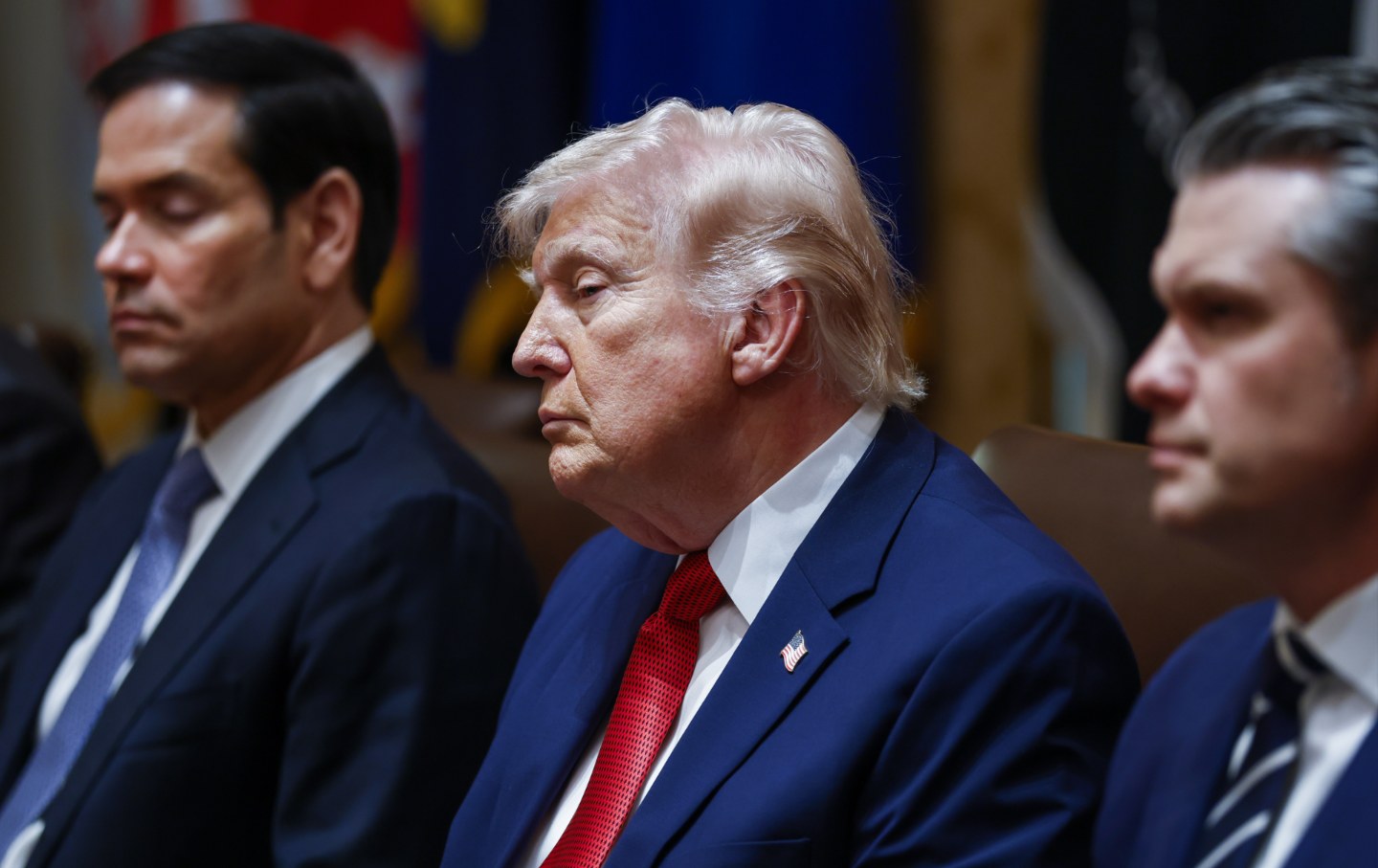
Trump’s TV-Warped Brain Is Putting the World in Danger Trump’s TV-Warped Brain Is Putting the World in Danger
The president is experiencing the Iran War almost entirely through misleading video clips—and that’s very bad news for all of us.
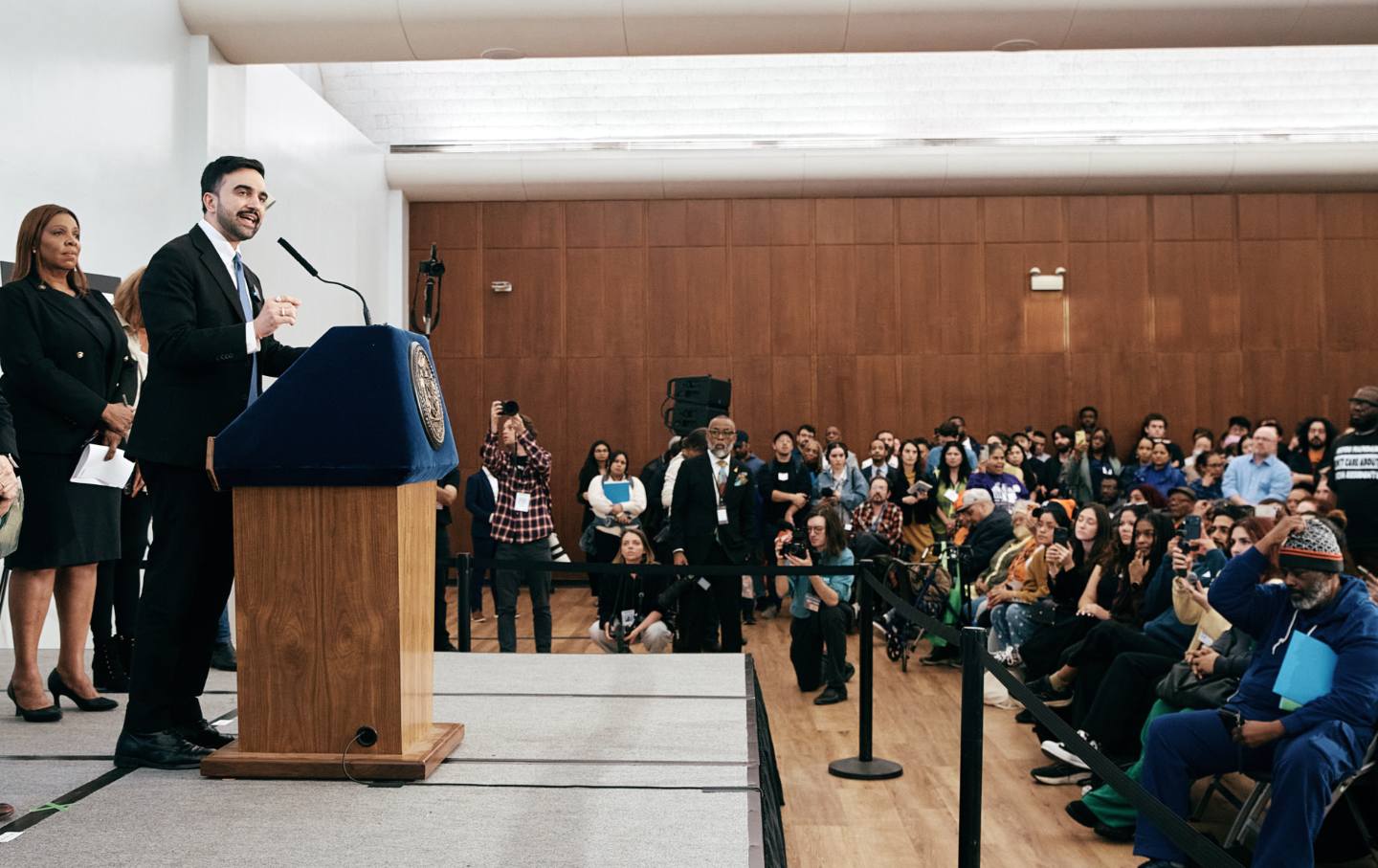
Mamdani Asked Tenants to Tell Him Their Problems. Hundreds Did. Mamdani Asked Tenants to Tell Him Their Problems. Hundreds Did.
What it's like at one of the mayor's "Rental Ripoff" hearings.


The Data Center Revolt The Data Center Revolt
Laura Flanders speaks with Faiz Shakir and John Cassidy on the grassroots fight against the AI oligarchs.

Hawaii’s Storm Damage Is Deeply Rooted in the State’s Plantation Past Hawaii’s Storm Damage Is Deeply Rooted in the State’s Plantation Past
The latest wave of storm devastation closely tracks the regional neglect of infrastructure instituted by the state’s first modern agricultural barons

Are Plastics Poisoning Us? Are Plastics Poisoning Us?
A Netflix documentary exposes plastic’s health harms but misses its climate connection.

