
The New York Times Site Could Be Shuttered on Election Day—Blame Bosses
The “New York Times” Site Could Be Shuttered on Election Day—Blame Bosses
The Tech Guild has waited over two years for a contract. Its workers will go on strike this Tuesday if management doesn’t agree to key demands.

For Benjamin Harnett, a principal engineer at The New York Times, it’s the busiest time of the year—election season. In his more than 12 years at the Times, he’s seen “a lot of changes, a lot of elections.” Tuesday will mark his fourth presidential one.
But, in all likelihood, Tuesday will also bring a first for Harnett and the more than 600 other members of the New York Times Tech Guild, a union made up of the company’s software engineers, data analysts, product managers, and designers. Despite the months they’ve spent readying every nook and cranny of the Times website and apps to handle far greater traffic than usual on Election Day, these workers won’t be there.
Because—unless a change comes between now and Tuesday—they’ll be on strike.
“We don’t want to be on strike,” Harnett, who serves on the union’s elected council, said. “We want to support the site on Election Day. We’ve worked hard on these systems for years. We care about the business. But [Times management] would rather have ultimate power over us than have a good election night.”
Should the Election Day strike go through, what the New York Times website will look like that day is anyone’s guess. Of course, the famous election night needle, which provides live results forecasts, could malfunction—as it did briefly during the 2022 midterms—leaving readers without a vague barometer to exert their anxiety upon. The union says roughly half of their members are directly involved in crucial election programs like this, potentially leaving the Times’ coverage on Tuesday down hundreds of hands in crucial areas. The New York Times boasts one of the largest digital media sites in the world: There’s data that needs to be updated, push notifications to be programmed, credit cards to process for incoming subscriptions, live blogs to produce, a homepage to fill with breaking news. In other words, a tech team striking on Election Day would be a big disruption—and that’s the point.
The Tech Guild won its unionization vote in March of 2022, but has yet to agree upon a final contract with management. In September of this year, the Guild voted to authorize a strike with an overwhelming 95 percent (or over 500 members) in favor. The vote marked two and a half years of bargaining with no result. As Harnett puts it, “At some point, you need a deadline.”
“There’s a point where it’s not acceptable for us to still not have a contract,” Harnett said. “Election Day seemed like a really good deadline. We have a lot of other deadlines that correspond with that day. I don’t think anybody reasonably thought that they would be willing to risk a strike on Election Day. I’m shocked the company is taking the gamble.”’
Over the course of the contract negotiations, the union has refused to concede to management on three key demands that Kait Hoehne, another of the Guild’s shop stewards, calls “labor basics.” The first key demand is a protection that Times editorial staff already have: just-cause job protections, which would ensure that members cannot be fired without good reason and due process. The editorial staff won this protection in their 2023 News Guild contract, and just weeks ago, 750 Times journalists penned a letter to management urging them to reach a contract with the Tech Guild before Election day.
The second demand stems from a pay study the union released in June of this year, which found numerous pay discrepancies for women and people of color. According to the study, Black tech workers at the newspaper make 26 percent less than white workers. The study also found that women, who make up over 40 percent of the Tech Guild, earn 12 percent less on average than men, while Black and Hispanic or Latina women earn 33 percent less than white men. For Hoehne, learning about these iniquities and comparing notes with her colleagues were a primary driver in her decision to join the union. “That’s how I found out I was underpaid,” she said. “I’ve had to reckon with the fact that we still work within a capitalistic system. For much of my life, I trusted the powers that be and structures in place. Now, I find myself much more willing to trust my coworkers.”
Management at the Times has disputed the methodology of the study, claiming that the union did not appropriately compare the salaries of employees doing the same kind of work. In doing so, they are overtly challenging the work of the Times’ own data analysts, who are members of the Tech Guild. The newspaper’s editorial staff has called out and published an analysis on discrepancies between treatment of white and non-white employees in their contract campaign as well. (The Guild is also calling for higher pay across the board, citing the fact that publisher A.G. Sulzberger saw a 50 percent increase in total compensation in 2023 alone.)
The third demand in dispute is a frequent source of anxiety for Hoehne in particular: return to office. Currently, many in the Tech Guild work remotely full-time.“[Management] could technically, with no notice, say: ‘Sorry, you’ve got to come into the office,’” Hoehne said. A senior software engineer who worked on the Games team for four years before recently switching to help produce tools for Times visual journalists, Hoehne has been living and working remotely three hours away from the Times office, in upstate New York, since the pandemic began. “I would lose my job. I can’t sell my house. My kid is in daycare. I can’t. All we’re asking is for them to put in writing that we won’t do that to you.”
As Election Day looms, the union is emphasizing that its campaign for these demands has been met with bad faith and sluggish negotiations since the union won its 2022 election, with the Times adopting a strong anti-union stance from the outset. In a staff memo from January of 2022 titled “Why a Tech Union Isn’t Right for Us,” prior to the Tech Guild’s unionization vote, CEO Meredith Kopit Levien wrote: “In short, we don’t believe unionizing…is the right move. But that’s not because I’m anti-union.” In 2021, Times management hired the law firm Proskauer Rose, known for its Labor Management Relations Group, to manage the emerging unionization effort. The firm promises that “for employers with partially unionized or non-union workforces, we are there to advise on preventative labor relations.” And as The Daily Beast reported in 2021, the firm accidentally sent a private strategy memo to a union representative, revealing that the newspaper’s strategy at the time was the path that the firm had labeled as the most “aggressive” option.
“The company’s talking points have literally been Xeroxed from history,” Harnett told me. In late 2021, the National Labor Relations Board filed a complaint against the Times alleging the company had been “interfering with, restraining, and coercing employees” against unionizing. “They could have been published by the Pinkertons in 1890.”
Tensions have only risen the closer the parties get to Election Day. After the union’s strike authorization vote in September, a spokesperson for the Guild told The Nation that the Times has pulled at least 20 members into one-on-one “interrogation meetings” to “ask if they supported a strike,” and that in these meetings, management promised that members who chose to work during the strike anyway “would be connected with HR for a sign-up form to keep working in a discreet fashion.” This, in simple terms, is scabbing, which management can use to undermine the effectiveness of a strike.
In response, the Guild has filed an Unfair Labor Practice with the National Labor Relations Board, accusing the Times of violating the National Labor Relations Act. A Times spokesperson told Axios that the filing is “devoid of any facts or details.”
In a memo sent to the Tech Guild on October 18, however, Times management makes many of the same arguments the Guild has accused them of making in the alleged one-on-one meetings. Titled “Clarifying Information about a Potential Strike,” the memo emphasizes that employees “are not required to strike,” argues that “a public fundraising campaign is highly unlikely to cover the cost of the strike,” and threatens that a strike will not change the outcome of contract negotiations.“If the Tech Guild goes on strike, we will ensure that anyone who chooses to work can do so remotely if they choose,” the memo reads. “In the event of a strike, we will be sharing more information about how to let us know you are working.”
Even as the temperature of the messaging has risen, October proved to be the most fruitful month of bargaining thus far, the union said. Hoehne said the parties have reached tentative agreements on 10 proposals this month alone, but that there are still no agreements on the Guild’s three key demands, without movement on which there is little hope of avoiding a strike.
Popular
“swipe left below to view more authors”Swipe →But both Hoehne and Harnett don’t think management’s reluctance to settle these demands stems from the particulars of any of the demands themselves; none of them would spark radical changes. The negotiation process has lagged for years, which Times editorial staff experienced en route to their contract as well. Rather, Hoehne said, staring down the barrel of the Election Day strike, management’s immovability feels like it’s more about preventing the union from stabilizing at all.
“I think because The New York Times is owned by a family, they love control and they view this as their company, their baby,” Hoehne said. (The Ochs-Sulzberger family has owned the company since the 1800s.) “They are the ones who get to say how everything works. It’s very much a philosophical issue for them. But we’re at the point where we can’t give anymore.”
Harnett’s analysis is more cutting, centering on the fact that the Times is not just a newspaper but a digital media corporation too. Their fight’s implications are not just limited to the journalism industry, because the Tech Guild is currently the largest tech union in the country that has won collective bargaining rights.
“I think our executives want to be seen as part of tech culture,” Harnett said. “The technology we’ve put in place, this Silicon Valley model, has really contributed to [the Times’] success. And if you look at what happens in Silicon Valley, there is a really hard push against unions. That’s what juices the stock prices and gets investors excited. NYT leadership sees themselves as part of that club. They want the plaudits of having crushed the largest tech union with bargaining rights.”
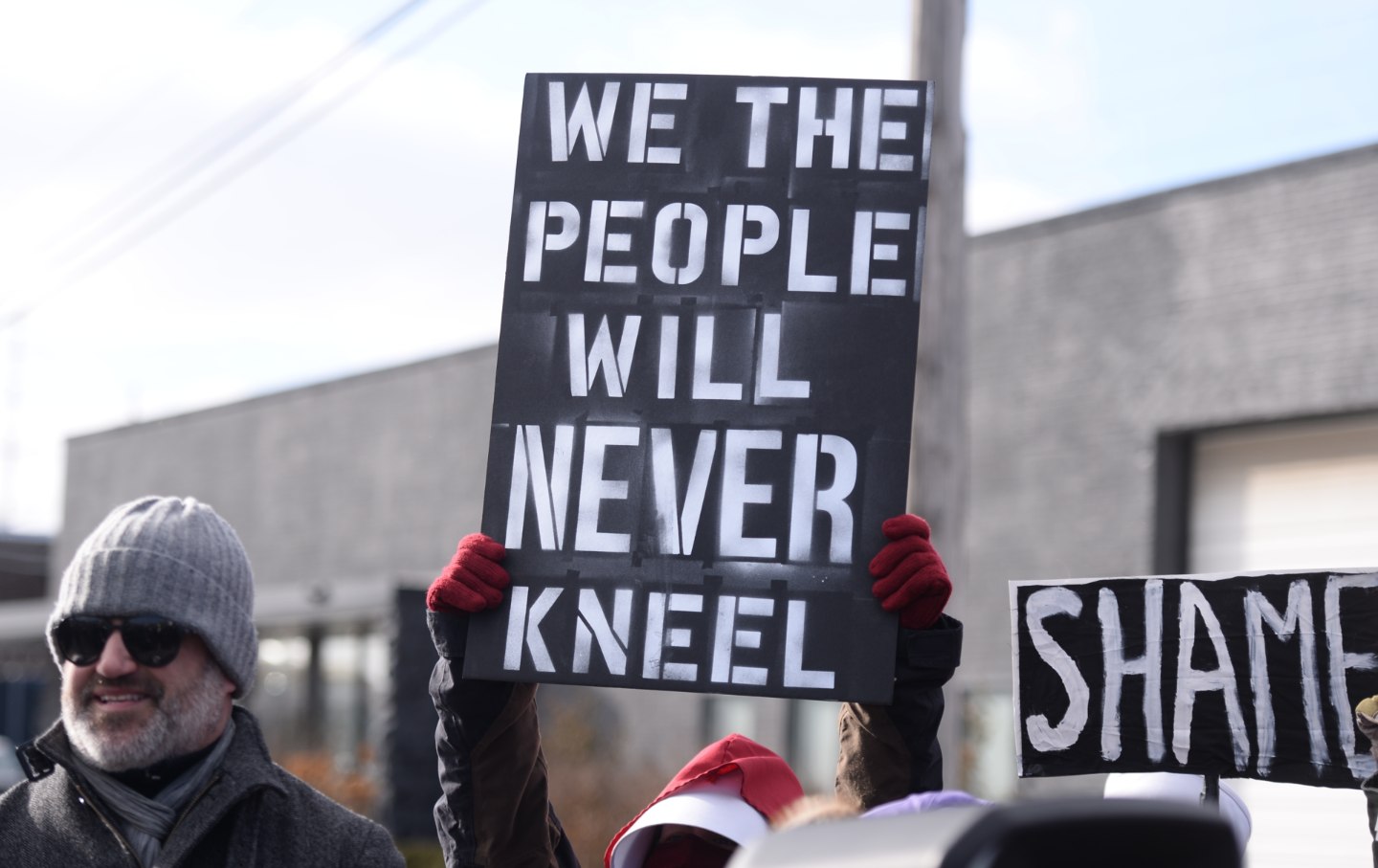
But on the Wednesday prior to Election Day, the Tech Guild looked far from crushed. The union staged a walkout and picket outside the Times’ Eighth Avenue office, eventually drawing a crowd of hundreds. The picket line stretched far enough down the block that the Guild’s distributed systems engineers were enlisted to help coordinate chants.
On social media, the Tech Guild marketed the walkout as “just practicing.” As of Friday morning, the real thing seemed all but inevitable. Meaning that if the Times wants to offer its readers what they expect on Election Day, the ball is in their court.
“They could easily end all of this with a single phone call or e-mail,” Harnett said. “But they’re making the decision not to. Maybe they don’t believe that we are resolved [to strike]. I don’t know how else to convince them.”
Support independent journalism that does not fall in line
Even before February 28, the reasons for Donald Trump’s imploding approval rating were abundantly clear: untrammeled corruption and personal enrichment to the tune of billions of dollars during an affordability crisis, a foreign policy guided only by his own derelict sense of morality, and the deployment of a murderous campaign of occupation, detention, and deportation on American streets.
Now an undeclared, unauthorized, unpopular, and unconstitutional war of aggression against Iran has spread like wildfire through the region and into Europe. A new “forever war”—with an ever-increasing likelihood of American troops on the ground—may very well be upon us.
As we’ve seen over and over, this administration uses lies, misdirection, and attempts to flood the zone to justify its abuses of power at home and abroad. Just as Trump, Marco Rubio, and Pete Hegseth offer erratic and contradictory rationales for the attacks on Iran, the administration is also spreading the lie that the upcoming midterm elections are under threat from noncitizens on voter rolls. When these lies go unchecked, they become the basis for further authoritarian encroachment and war.
In these dark times, independent journalism is uniquely able to uncover the falsehoods that threaten our republic—and civilians around the world—and shine a bright light on the truth.
The Nation’s experienced team of writers, editors, and fact-checkers understands the scale of what we’re up against and the urgency with which we have to act. That’s why we’re publishing critical reporting and analysis of the war on Iran, ICE violence at home, new forms of voter suppression emerging in the courts, and much more.
But this journalism is possible only with your support.
This March, The Nation needs to raise $50,000 to ensure that we have the resources for reporting and analysis that sets the record straight and empowers people of conscience to organize. Will you donate today?
More from The Nation
No Kings! No Wars! No Kings! No Wars!
The founders of the United States feared monarchically inclined presidents who could wage wars of whim.

What We Must Learn From the Revelations About Cesar Chavez What We Must Learn From the Revelations About Cesar Chavez
The sexual predations of the late labor leader follow a depressingly familiar pattern in left organizing circles.

Dolores Huerta: “My Silence Ends Here” Dolores Huerta: “My Silence Ends Here”
The labor movement icon speaks out after revealing that she was sexually assaulted by Cesar Chavez.

Trump Wants to Criminalize Dissent. This Texas Case Could Help Him Do It. Trump Wants to Criminalize Dissent. This Texas Case Could Help Him Do It.
The Prairieland Defendants are on trial in a case that could set a chilling precedent for the right to protest in the United States.

A Motto for All Health Workers: Resist, Resist, Resist A Motto for All Health Workers: Resist, Resist, Resist
Doing our work and keeping our heads down isn’t a victory. We need to fight this regime every day, in every way.

