
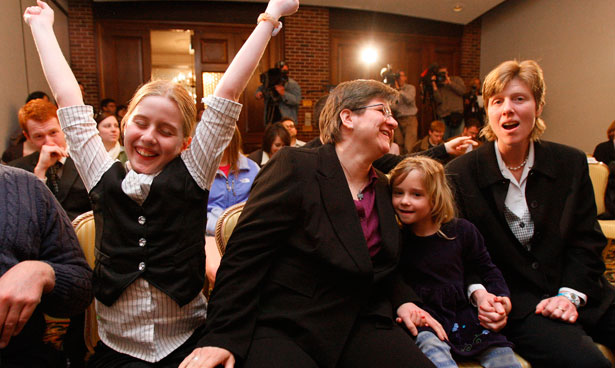
A family celebrates as the Iowa Supreme Court rules in favor of legalizing gay marriage, April 3, 2009. (AP Photo/The Des Moines Register, Christopher Gannon)
It’s inevitable. I’m thinking about marriage.
Not only because of what’s been happening down in Washington, where the Supreme Court’s been hearing arguments on two marriage related cases. I’m thinking about marriage from up closer.
A month ago, a couple close to my partner and me, asked us to serve as witnesses to their marriage down at City Hall in Manhattan. The news came as a surprise. By any possible definition, our friends are radical lesbian feminists, public critics of marriage. We all are. Our two long-term relationships add up to almost fifty years of partnering with no marriage in sight, until now. With just a few hours to think and many questions unasked, we headed down to City Hall with love on our minds, a taxi cab full of contradictions.
Not sure what else to do, I brought a bucket of roses.
Two hours later, there we were at the Manhattan marriage bureau, waiting for the cheeriest public worker I’ve ever seen, James Mitchell, to conduct the ceremony,
Waiting outside the chapel, we took lots of pictures and handed out roses. Our friends, it turns out, thought the red and white buds were just too cheesy to hold, so mostly we gave them away, to the clerks, the cops, the guards, the clean up crews, to the other couples. By the time Clerk Mitchell showed up to officiate, he had a rose of his own, as did just about every one else walking around the marriage bureau.
Mitchell began: “Do you take… to be your spouse?”
Even as my mind chewed over my usual critique, my eyes teared up. Mind is thinking: “marriage is a patriarchal plot, a way to replicate the capitalist status quo, an institution deeply rooted in creepy conservative values and an obsession with control and property…” But my eyes are becoming teary.
Two minutes later, it was over. Our friends “took” one another. They said “I do.” We handed over the rings. They kissed. We witnessed. We all stood there, happy, bemused and misty. Ever since, I’ve been thinking, what is it exactly that’s so moving about a marriage?
Just for the record, I’m for equality of marriage and everything else. Rights are rights and equal protection is in the Constitution, right there in the Fourteenth Amendment. I’m for everyone having free and equal choices and chances and taxes and health benefits, regardless of marital status.
So I’m for marriage equality and I also still think marriage is a patriarchal plot, a way to replicate the capitalist status quo, deeply rooted in creepy conservative values and an obsession with control and property…
Popular
"swipe left below to view more authors"Swipe →
It doesn’t help that I’ve been reading about early socialism. At City Hall, I had Robert Owen’s words running through my mind. An early critic of capitalism dating back to the start of the 1800s, Owen added marriage to religion and private property in his trinity of “monstrous evils” driving our competitive capitalist society. After marriage he said,
With these persons it is my house, my wife, my estate, my children, my husband, my property. No arrangement could be better calculated to produce division and disunion in society.*
Owen believed in cooperation over competition and created experimental communities here and in the UK. As one of his followers wrote, the problem with capitalism is that “the present system of competition is founded upon the predominance of the selfish principles of our nature; each is left to take care of himself and if he cannot do that then the world has no place for him.”
Sound familiar? Owen was prescient about many things. He had a word or two to say about women too: in marriage, suffice to say, he thought they were “property in bondage.”
Fast forward, and my friends are hardly property in bondage to one another. (Although if they’re into that sort of thing, that’s their business.) Many things have changed. Two hundred years on, Owen’s communities are long gone; capitalism has yet to croak and marriage is all the rage among men and men and women and women and all the other variations. Who knows what Owen would make of it all?
I’m still trying to figure out what, to a critic of marriage, makes the ceremony itself tear-worthy. Part of it was all the love at City Hall: our dear friends’ love for each other, our love for them, and ours for each other, and all the other couples waiting to wed: old, young, gay straight, immigrant, affluent and the opposite. The place was brimming with emotion.
But a handful of words were what turned on my tears. In the short civil ceremony they went something like this: “Do you… take… to be your lawfully wedded spouse, to love, honor, comfort and cherish, from this day forward for as long as you both shall live?”
It seems to me it’s the pledging that’s powerful. Pledging faith to someone else. That being the case, maybe selfish isn’t the only possible principle of our human nature.
Thinking about it now, I can hear Robert Owen’s ghost: if we care so much about loving and honoring and comforting and cherishing someone else, what if, as a society, we took that oath to one another?
“I take you neighbor, in sickness and in health, for as long as we both shall live…?”
It sure felt good to stand there with our friends. And just as good to hand out those roses—to everybody.
As the Supreme Court takes up marriage equality for the first time, read Nan Hunter's coverage.
___
*Robert Owen, Lectures on the Marriages of the Priesthood in the Old Immoral World, quoted in Barbara Taylor’s “Eve and The New Jerusalem, Socialism and Feminism in the Nineteenth Century, ” Virago Press, 1983, London.

