
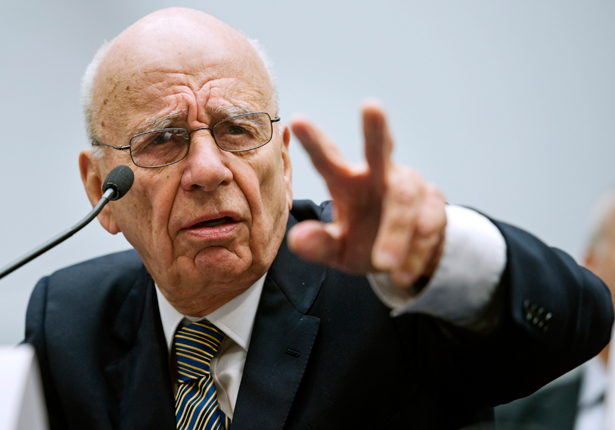
News Corporation Chairman and CEO Rupert Murdoch. (AP Photo/Cliff Owen)
Although he successfully runs one of the largest media empires in the world, Rupert Murdoch has more detractors than fans. His persona and appearance so evoke the archetype of a villain (rich, ruthless) that some James Bond enthusiasts believe he inspired the evil character Elliot Carver, who tries to provoke a war to gain broadcasting rights in China in the film Tomorrow Never Dies. If any Bond film can be said to have an overarching principle (beyond the sexy cars, guns, girls and exploding objects), the message here is this: he who controls the media can influence the fate of the world.
In the United States, Murdoch’s most controversial media network is, of course, Fox News. But his company, News Corp, also owns numerous television stations, the book publisher HarperCollins, and such iconic publications as The Wall Street Journal. The Guardian has called Fox a “major driving force behind global warming denial,” citing a recent study that said Fox viewers were more likely to distrust scientists and disbelieve the evidence that climate change is happening.
But there is a parallel universe in which Murdoch has even more power over information—the faraway country where the media mogul was born, Australia. There, Murdoch controls Australia’s most influential newspapers (accounting for nearly 60 percent of daily newspaper sales), fourteen of the country’s twenty-one metro daily and Sunday newspapers, and 50 percent of the company Foxtel, which holds a near-monopoly on pay television. Murdoch’s News Limited and rival company Fairfax Media (whose largest shareholder is mining magnate and avid climate-denialist Gina Rinehart) together accounted for 86 percent of Aussie newspaper sales as of 2011.
I recently spent three months in Australia, and at the risk of oversimplifying the country’s politics, I will say that the dance between Murdoch media and politicians seemed operatic—or worthy perhaps of a James Bond film.
In many ways, Australia’s politics are far more progressive than ours. The country’s minimum-wage fast-food workers earn more than many entry-level professionals here. Its political leaders are elected via an instant runoff voting system that has allowed third parties (like the Green Party) to survive and sometimes hold an important role in negotiating alliances and power balance in parliament. In 2010, the country got its first female prime minister, Julia Gillard, who accomplished what US federal politicians could not—a carbon pricing system, passed in 2011, to regulate the emissions that cause climate change.
Popular
"swipe left below to view more authors"Swipe →
Rupert Murdoch has always been a political agnostic, whose opinions change the moment politics intersect with his profit-earning potential. His personal position on climate change is ambiguous. Several of his media networks consistently bash climate science, while News Corp has gone carbon-neutral. In Australia, between February and July 2011, more than 80 percent of the carbon-policy stories published in News Limited newspapers were negative, says an analysis by the Australian Centre for Independent Journalism. Many stories harped on past claims Gillard made—she had said that she would not pass a tax but seek different means for regulating carbon. It was political hair-splitting—technically the policy was not legislated as a tax, and it is supposed to morph into an emissions trading system, like the one Europe has, by 2015. But over and over, Australian media called her a liar (“Ju-liar,” quipped one radio shock jock).
Murdoch’s personal reasons for disliking Gillard may have had more to do with the Labor Party’s plans for the country’s national broadband network. The network will make high-speed Internet more accessible across Australia, which would open doors for competitors to Foxtel. But climate policy was one of several convenient wedge issues. More generally, he and his company may have used News Limited coverage to undercut Gillard. The progressive journal Independent Australia claims (by way of an anonymous media executive) that Murdoch had private luncheons with conservative politician Tony Abbott, who has been campaigning to become Australia’s next prime minister. The source said News Limited media have deliberately undermined Gillard’s government and seized any opportunity to claim there was disunity the Labor Party. When I arrived in Australia this past May, Gillard was unpopular with the Australian public. In June, the Labor Party ousted her and reinstalled as prime minister her predecessor, a man named Kevin Rudd.
But what was most alarming to me was the way such politics have seemed to pollute the national dialog on environmental issues. When Bill McKibben appeared on Australian television in May, I was surprised to hear an interviewer on the Australian Broadcasting Corporation (the analog of PBS) lob climate denialist arguments at him without irony. (Picture Jim Lehrer insisting to Al Gore that the planet is cooling.) In the United States, it has become less common for respected, non–Fox News reporters to take climate-change denial seriously. In Australia, it seemed rather normal. The national newspaper, The Australian, was one of the worst offenders. Political scientist Robert Manne writes, “In the real world, scientists accepting the climate consensus view outnumber denialists by more than 99 to one. In the Alice in Wonderland world of [The] Australian, their contributions were outnumbered 10 to one.”
Such coverage has likely taken its toll on political support for environmental policy in Australia. Australians will cast their votes for parliament on September 7. ABC’s environment editor Sara Phillips yesterday called it “the election that forgot the environment”: “Salinity, forestry, water, marine parks and pollution are simply not politically hot enough to get a look in this year.” Instead, the Labor Party is promising the get rid of the so-called carbon tax and convert it, earlier than originally planned, into carbon trading. Neglect of environmental policy is sobering in a water-stressed nation that is, consequently, profoundly vulnerable to climate change.
It is also a troubling tale for anyone watching the shakeups in media ownership elsewhere in the world. As of 2011, just six US corporations controlled 90 percent of the media market here, down from 50 companies in 1983. The business of journalism is increasingly vulnerable to villains—by which I mean individuals whose power and personal agendas, whether benign or devious, can dictate how information is produced by the companies they own or run. Editor Paul Ingrassia’s ambivalence about climate change has disrupted environmental coverage at Reuters. Charles and David Koch, who funded the Tea Party, are still thinking about buying the Los Angeles Times and the Tribune Company. (Murdoch has also expressed interest in recent past in buying this company.) The Washington Post’s new owner, Amazon CEO Jeff Bezos, could turn out to be a benevolent despot, although his political views and editorial policies are still a mystery: Might his presence at the helm skew the venerable newspaper’s coverage of some issues?
Of course, it’s no secret that big newspapers are in decline, and the Internet has both opened spaces for myriad small, independent blogs and publications and ravaged journalism’s business models. Still, when a few people control major media companies, it doesn’t bode well for our ability, as a democracy, to have conversations about politically complex issues, especially when they are as unwieldy as climate change.
Yes, this weather is crazy. And yes, it is our fault.

