
Mamdani’s Master Class in Impression Management
New York’s mayor continues to showcase his command of political symbolism as he prepares to reckon with some difficult real-world choices
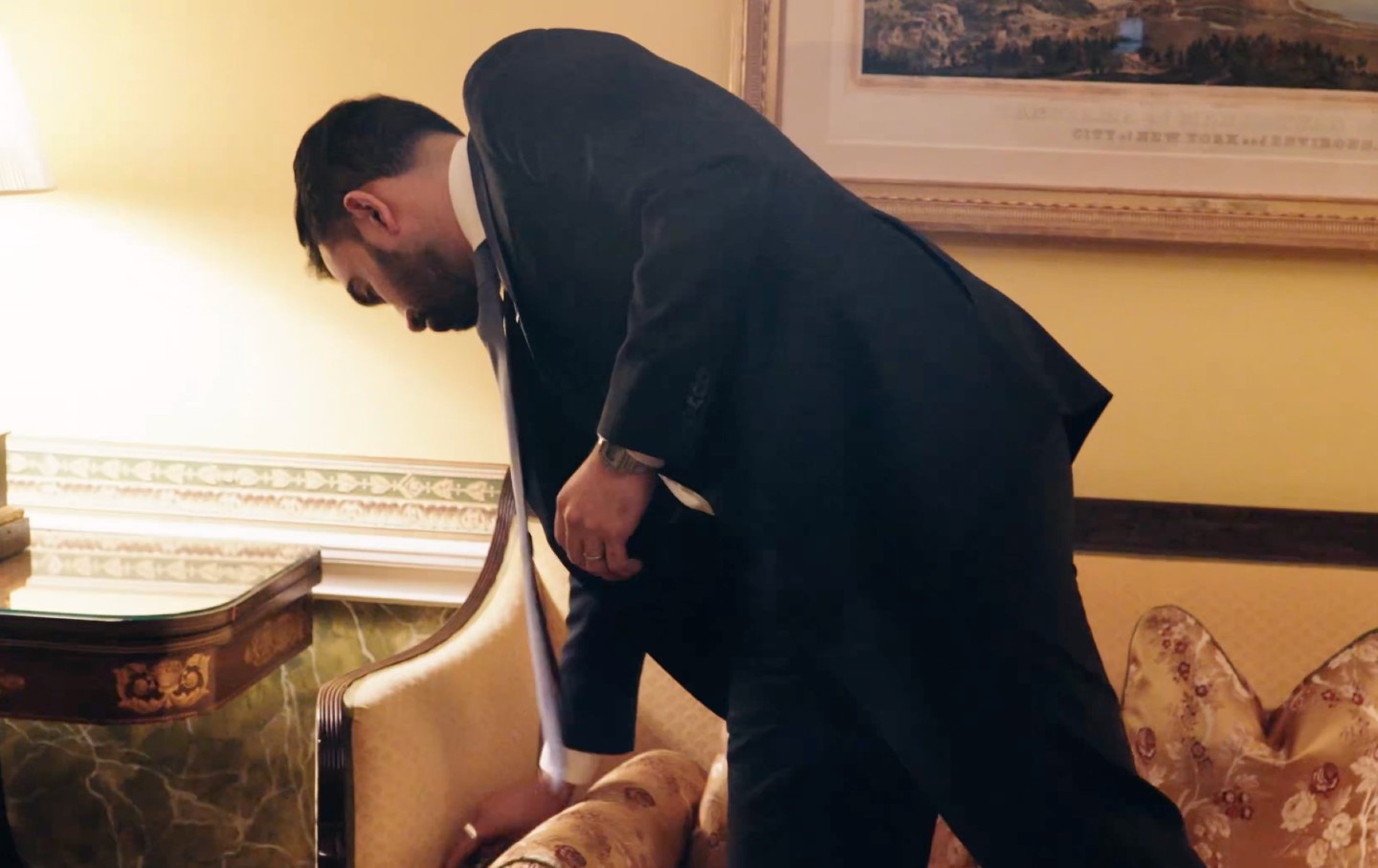
Zohran Mamdani finds money under the sofa cushions.
(Screengrab from the mayor's X account)
“He’s here! He’s here!”
At Field 8A in Prospect Park last Friday morning, the row of little boys sitting in front of me waiting for New York’s first Muslim mayor to arrive and pray with them were having a hard time containing their excitement.
It was Eid-al-Fitr, the end of the holy month of Ramadan, and Mamdani had already stopped at mosques in Jamaica and East New York. But this was the only public observance on the mayor’s schedule that day, with hundreds of Muslims—along with a few dozen members of the press—streaming into the southwest corner of the park. Security at the event seemed low key: no checkpoints or metal detectors, no bag searches—nothing, in short, to detract from the celebratory mood of the crowd.
When the mayor, who’d been delayed on the Brooklyn-Queens Expressway, finally did arrive, he was greeted by loud cheers that brought many celebrants to their feet. The display prompted Maruf Maruf, one of the clergymen leading the prayers, to repeat a plea he’d been making for the past half hour.
“Can I ask the brothers standing up in front to please sit down?”
Eventually they did, and, before the mayor joined them in prayer, he hailed “the breadth of Muslim life in this city, the different languages that we speak, the foods that we eat, the customs that we practice.”
“Soon,” Mamdani continued, “we will return to the normal rhythms of our lives. Morning iced coffees, sips long past sunrise, water drunk freely throughout the day, meals eaten on the run, [and] Maghrib prayers offered alone. Often the solidarity and the connection we feel during the month of Ramadan fade as the time passes. And yet what I have seen over the course of this past month across our city has been too powerful and too precious to leave behind.”
It was an idyllic scene, on a gorgeous early-spring morning, and a vivid reminder of just how much any vision of politics which confines itself to economics alone is in danger of missing. Representation matters—that was obvious from the pride on the faces of the Bangladeshi taxi drivers and their families seated around me as they welcomed a nonbeliever into their midst.
Symbolism matters, too. Anyone doubting the mayor’s awareness of that fact should watch the video his office posted on Wednesday illustrating the results of Executive Order 12, issued back in January, requiring each city agency to appoint a “Chief Savings Officer” to look for possible cuts to the city’s overstretched budget. At the time, many scoffed at this attempt to do a local version of DOGE, employing a scalpel rather than a meat axe. And if you look at the numbers on Wednesday’s press release, some of them are very small-ball indeed. The city’s Department of Emergency Management will save $60,000 by insourcing a software maintenance contract, and another $70,000 by moving some programs “to a more cost-effective platform.” The Taxi and Limousine Commission will “cancel its Slack subscription, saving nearly $20,000.” All told, the savings identified so far add up to $1.7 billion—but as Politico’s Chris Sommerfeldt points out, since the preliminary budget already accounted for $1.77 billion of projected savings, none of these measures address the city’s underlying $5.4 billion budget gap.
Indeed, the savings announced this week only amount to about $245 million—with the one really big ticket item being a projected $100 million reduction to come from kicking ineligible dependants off city employees’ health coverage. As for the rest, you might say that in a $120 billion-plus city budget they’re the equivalent of looking for money under the sofa cushions or in the bottom of the drawers. Which is exactly what the mayor’s office video depicts him doing.
The mayor’s preternatural media savvy may not usher in democratic socialism in our time. But it certainly helps him keep his coalition together. And in our current media environment, that is no small achievement.
To get a better sense of just how deeply the lines running through this city can cut, I spent part of an afternoon this week at the IFC Center watching Scenes from the Divide, director Alison Klayman’s half-hour documentary on the way Jewish New Yorkers of varying political and religious beliefs responded to the Mamdani campaign. Distributed by Jewish Currents, the film definitely has a point of view—and a star in Nicole Krishtul, the 29-year-old Mamdani volunteer first pictured tutoring her fellow canvassers in saying “Зоран не антисемит” (“Zohran is not an antisemite” in Russian).
Though Krishtul, born in the United States and a native New Yorker, is all in for Zohran, her parents, who emigrated from the Soviet Union, are deeply suspicious. But what lifts the film above mere propaganda is the way that, with the possible exception of Elisha Wiesel, who smugly compares “Jews for Zohran” to “turkeys for Christmas,” every single person is shown sympathetically. We see Brad Lander, Zohran’s erstwhile rival—and co-endorser—for the Democratic mayoral nomination (interviewed beside his daughter in their Brooklyn kitchen, Lander jokes about opening a therapy practice for Jewish parents whose children took their talk about social justice seriously and are now opposed to Zionism). And we see Mamdani critic Ramon Maislen, an Israeli-American real estate developer and anti-BDS activist leading a protest outside the Park Slope synagogue that invited Mamdani to speak during the campaign.
Popular
“swipe left below to view more authors”Swipe →For many of those pictured, this is a deeply painful topic. At one point, after a heated argument over the way their family’s experiences during the Holocaust influence their interpretation of events in Gaza and Israel, Nicole’s father, Leon Kirshtul, suggests, almost wistfully, that they return to an earlier line of argument: “Let’s go back to socialism.” It was hard not to agree with him.
Yet as I watched Nicole’s heroic patience in the face of her parents’ fears and her elderly neighbors’ derision, and her joyous celebration on election night, I was reminded again of how much symbolic weight this mayor is carrying on his slender shoulders. That he continues to bear it, and our hopes that he can lead us to a better place, with such persistent good humor is also surely cause for celebration.
Become a Sustaining Donor This September
Between the reemergence of right-wing red-baiting and Donald Trump’s use of the chilling National Security Presidential Memorandum–7 to criminalize left political organizing, we’re seeing McCarthyism reborn before our eyes.
This assault on democracy cannot be ignored or wished away. Resisting it requires bravery in the face of threats and repression, a steadfast commitment to the truth, and the unwavering belief that we can—and will—overcome this darkness.
We must have an independent media that sets the record straight, unearths corruption and abuses of power, and advances a politics of justice and dignity for all if we’re to win this fight.
That’s why I’m writing to you today. This September, The Nation needs to add 100 monthly donors to sustain our progressive journalism. Your contribution makes the next investigative report, the next truth-speaking column, and the next pathbreaking essay all possible.
I hope you’ll support our work with a recurring donation today. If you donate $10 or more a month, we’ll send you a brand new “Hands Off the Free Press!” sticker to recognise your commitment to our cause. Please, donate today.
Onward,
Katrina vanden Heuvel
Editor and Publisher, The Nation
More from The Nation

Clavicular’s Charges Are One Thing. Rape Culture Is Another. Clavicular’s Charges Are One Thing. Rape Culture Is Another.
Braden Peters consistently acts as though the autonomy of women is a maladaptive trait, and dogmatically dismisses any claim to female equality as an outlying aberration.
Kimberly Guilfoyle Is a Master of Mafia Diplomacy Kimberly Guilfoyle Is a Master of Mafia Diplomacy
The US Ambassador to Greece is making suspicious deals for her buddies.
Missing Guardrails for AI Missing Guardrails for AI
Trump ignores the threat of extinction.
The First Amendment Lives for Another News Cycle—Maybe The First Amendment Lives for Another News Cycle—Maybe
In this week’s Elie v. U.S., our justice correspondent parses Trump’s attacks on CNN, MS NOW, and Politico. Plus: it’s time to impeach the judges!

