
Next month, the Paris climate agreement will enter into force. Major greenhouse-gas emitters, including the United States, China, Brazil, and India, have approved it; the European Union became the latest to do so last week, pushing the pact over the participation threshold needed for it to take effect. The main goal of the agreement is to keep global warming “well below” a 2 degree Celsius increase from preindustrial levels, and, because many scientists believe that upper limit is still too dangerous, to try to keep warming to less than 1.5 degrees.
To have a chance of meeting either of those targets, there is one thing every single country must do: stop drilling and digging for new oil, gas, and coal—right now. That’s the conclusion of a recent analysis from the think tank Oil Change International. Using investment-grade data from a Norwegian firm that tracks fossil-fuel reserves, OCI calculated two global “carbon budgets”—in other words, two scenarios that show how much of our fossil-fuel reserves we can tap into before the resulting greenhouse-gas emissions cause catastrophic warming. One scenario gives us a “likely,” or 66 percent, chance of keeping overall warming below 2 degrees C, and the other provides a 50 percent likelihood of staying below 1.5 degrees.
What they found is that the oil and gas fields already in production alone are enough to raise global temperatures by more than 1.5 degrees C. Add in the coal stocks currently being mined, and we’ll blow past 2 degrees. To be clear, those are the oil and gas wells and coal mines that are already in operation or under construction (called “developed reserves”). Exploiting new fossil-fuel reserves, those that are considered recoverable but haven’t yet been tapped into, “would either commit the world to exceeding 2°C of warming, and/or require an abrupt end to fossil-fuel production and use at a later date,” the report states. In order to meet the Paris goals, even some currently operating fields and mines will probably have to be closed before they’ve been fully exploited.
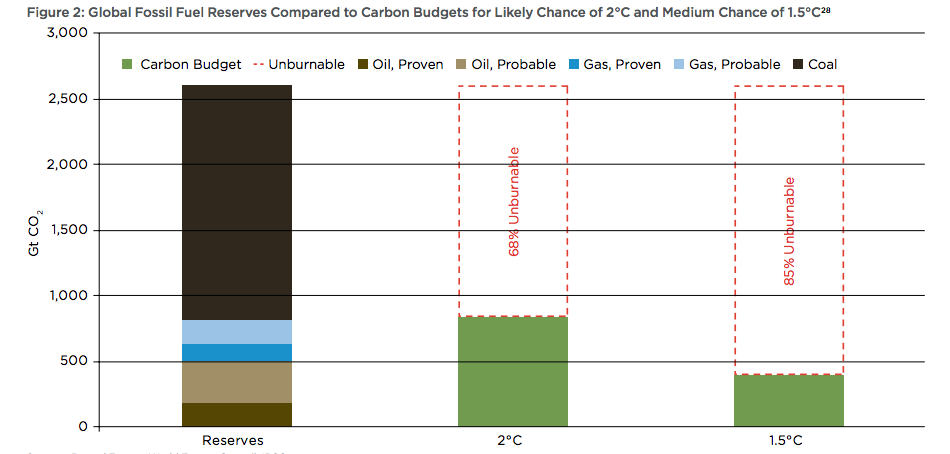
Source: Oil Change International
“At this point we should be looking to manage a decline in the fossil-fuel industry as soon as possible,” said Stephen Kretzmann, the executive director of OCI. Otherwise, the consequences could be financial, as well as environmental. OCI calculates projected investment in new wells, mines, and related infrastructure in the next two decades to be $14 trillion—either “a vast waste of money or a lethal capital injection,” according to the report. “Ongoing, unchecked expansion of the fossil-fuel industry leads inexorably to climate chaos, or to massive stranding of assets and major issues not only for investors but also for communities and fossil-fuel workers,” Kretzmann said.
Popular
"swipe left below to view more authors"Swipe →
Kretzmann anticipates energy interests will say, “Oh my God, you’re going to turn off the gas overnight and people are going to freeze in the dark.” But by “managed decline,” he doesn’t mean stop using fossil fuels tomorrow. Currently operating oil and gas wells will be in production for at least another 30 years, Krezmann estimates. That gives us three decades to ramp up renewable-energy capacity to fill the gap left by gradually depleted wells. As OCI’s report argues, this is technically possible, but requires political will and “robust” planning, particularly to ensure a just transition for workers in the fossil-fuel industry.
The big problem is that“nobody’s doing this math internationally,” Kretzmann said. OCI points to a few bright spots where countries halted the development of some new fossil-fuel reserves: China and Indonesia put a moratorium on new coal mines, and the US government has done so on federal lands. But no government has addressed the need to stop energy companies from looking for and extracting new sources of oil and gas. Instead, the Paris goals are based on the assumption that by midcentury we’ll be able to suck carbon back out of the atmosphere on a massive scale—a seriously risky bet. Last week, in a blog post related to a new discussion paper, climate scientist James Hansen noted, “Proposed methods of extraction such as bioenergy with carbon capture and storage (BECCS) or air capture of CO2 imply minimal estimated costs of $104-570 trillion this century, with large risks and uncertain feasibility.” Even if carbon capture technology were to be available at scale, OCI estimates that it would extend the carbon budget only by an estimated 12-14 percent by 2050.
If we don’t want to stake the future on a “carbon-sucking fairy godmother,” as one leading climate scientist puts it, then OCI’s calculations demand no new drilling, no new fracking, and definitely no new coal mines. It also means no new pipelines or other construction to facilitate fossil-fuel production, beyond repairing old, faulty infrastructure. It’s a conclusion at odds not only with energy interests, who have a lot to lose, but also with the policies of mainstream Democrats who claim to support the targets set in Paris. (Hillary Clinton, for one, reiterated her support for continued natural-gas production during Sunday’s debate.) Calls to keep fossil fuels in the ground are often derided by these serious people as “unrealistic“—but unless that happens, it’s the Paris agreement that’s implausible.

