
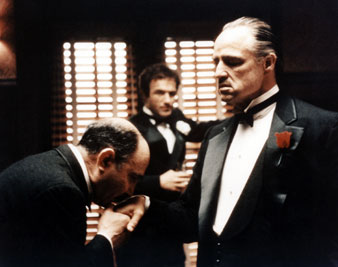
 Everett CollectionSalvatore Corsitto, James Caan, Marlon Brando in The Godfather, 1972.
If one Paramount exec had his way, Don Corleone would have been played by Danny Thomas. Fortunately, Francis Coppola had no interest in turning Mario Puzo’s novel into Make Room For Goddaddy. No one complained about the casting of the horse’s head, which was played by the real thing, courtesy of a local dog food company.
Francis Ford Coppola’s screen version of Mario Puzo’s The Godfather is showing at five houses in New York, and lines form at each of them for every performance. I don’t want to draw from that too severe an inference about hysterical enthusiasm for a three-hour chronicle of corruption, savage death and malignant sentimentality. Among other things, The Godfather is a strongly nostalgic film. Its period is post-World War II, but its flavor is of at least a decade earlier–it is a “big” picture, a Hollywood extravaganza of the sort that used to bring out the truck-mounted searchlights on opening night and the stars fluttering from autograph book to autograph book. It is what we remember the golden days of the giant studios to have been like, and industry romance draws a crowd.
But, that said, the success of The Godfather is deplorable, if you believe that popular entertainment both reflects and modifies social morale. In a sentence, the picture forces you to take sides, to form allegiances, in a situation that is totallywithout moral substance. It chilled me to hear an audience roar its approval when a young gangster on “our” side blew the brains out of two gangsters on “their” side. The ethical problem is to choose between typhus and cholera and I found that flogging about for three hours in that quagmire was spiritually debilitating and a crazy waste of time.
The authors of this film would say that they do not pander to vice, and I would agree at least that they do not intend to. They describe the society of Sicilian crime in America in the bleakest possible terms.
It is shown to be rich but tasteless, powerful but enslaved, formidable without security, feverish, claustrophobic, strangled in rituals of spurious dignity, respect and love. There are ritual celebrations in The Godfather, but none of these people ever plays. Yes, just once: old Vito Corleone (Marlon Brando) romps in the garden with a grandchild – and falls dead of a heart attack.
In this respect, The Godfather is probably more scrupulous than the classic gangster films of the Muni, Raft, Cagney era. But it is also more persuasively internalized than I remember those movies to have been. It is not a view of crime but a view from deep within crime. You live with the Corleones in their most secret moments, sharing their passions, privy to their schemes, exulting in their coups, flinching when the bullets cut them down. There is no one in the picture to provide a bench mark of normality (the non-Italian, suburban wife of the younger Corleone might have done so, but Diane Keaton is given no chance to develop the role). Nor is this the theatre of ideas, wherein the audience weighs and judges from some distance; it is lust theatre– blood, genital and mawkish lust – and you are compelled to take sides or flee.
Popular
"swipe left below to view more authors"Swipe →
Or a critic can evade the choice by turning clinical, examining the picture instead of experiencing it. Coppola has created a work that is extraordinary for the thick, sickish luxury of its texture and weak in narrative organization. The period detail is brilliantly, ostentatiously accurate and the camera almost strokes the furnishings of Italo-American criminal society. But the film is clumsily edited, so that one is repeatedly disoriented and must scramble to catch up.
The action swirls around Brando (indeed, it rather flies to pieces for a considerable stretch while he lies comatose in hospital) and he works one of those almost magic performances in which an actor, while never really entering the mainstream of the proceedings, nevertheless dominates them. It is done by stage presence, that combination of authenticity and substance in which Brando has always excelled. In the present instance he is restrained, almost immobile, speaking in a thin, colorless, but penetrating voice–and patently mad. He sees himself the noble head of a princely family, imposing order on and dispensing justice to a fiefdom. In fact, he is an olive oil importer turned murderer for profit, ruling a pack of jackals by corruption and terror.
The other dominant performance is by Al Pacino, who plays Michael, heir to the mantle of Godfather. Pacino’s resemblance to a Sicilian Dustin Hoffman is too exact to be accidental–it works beautifully for the purposes of the story, but it is not very enterprising. Michael is the character that best exemplifies the moral queasiness of the whole venture. He is the son whom old Corleone had chosen to escape from the gangster world and lead the family out into the free society (perhaps by buying him a Senator’s seat). It is implicitly ironic, but in fact Michael is that stock fairy-tale hero–the least regarded, youngest son, whose sword alone can lop off the dragon’s head. When the family’s fortunes begin to falter, he takes over, and by a series of exquisitely timed and disgustingly explicit slaughters (conducted while he is participating in a baptism and swearing his fealty to God) restores the Corleones to their control over the traffic, in gambling, women, liquor and drugs. What the film overlooks, or at least studiously refrains from showing, in Michael’s metamorphosis from modest war hero to reptilian gang chief, is that there is a purpose behind all the plotting and killing: it is to determine which gang of Sicilians shall have the right to suck the life out of an unsuspecting public. The film is mad, but at the end, so is the audience. After the performance, I went shopping in an Italian section of town–it was reassuring to be among human beings again.

