The Fatal Mistake That Democrats Keep Making
The party can’t break its addiction to the politics of technocratic managerialism.
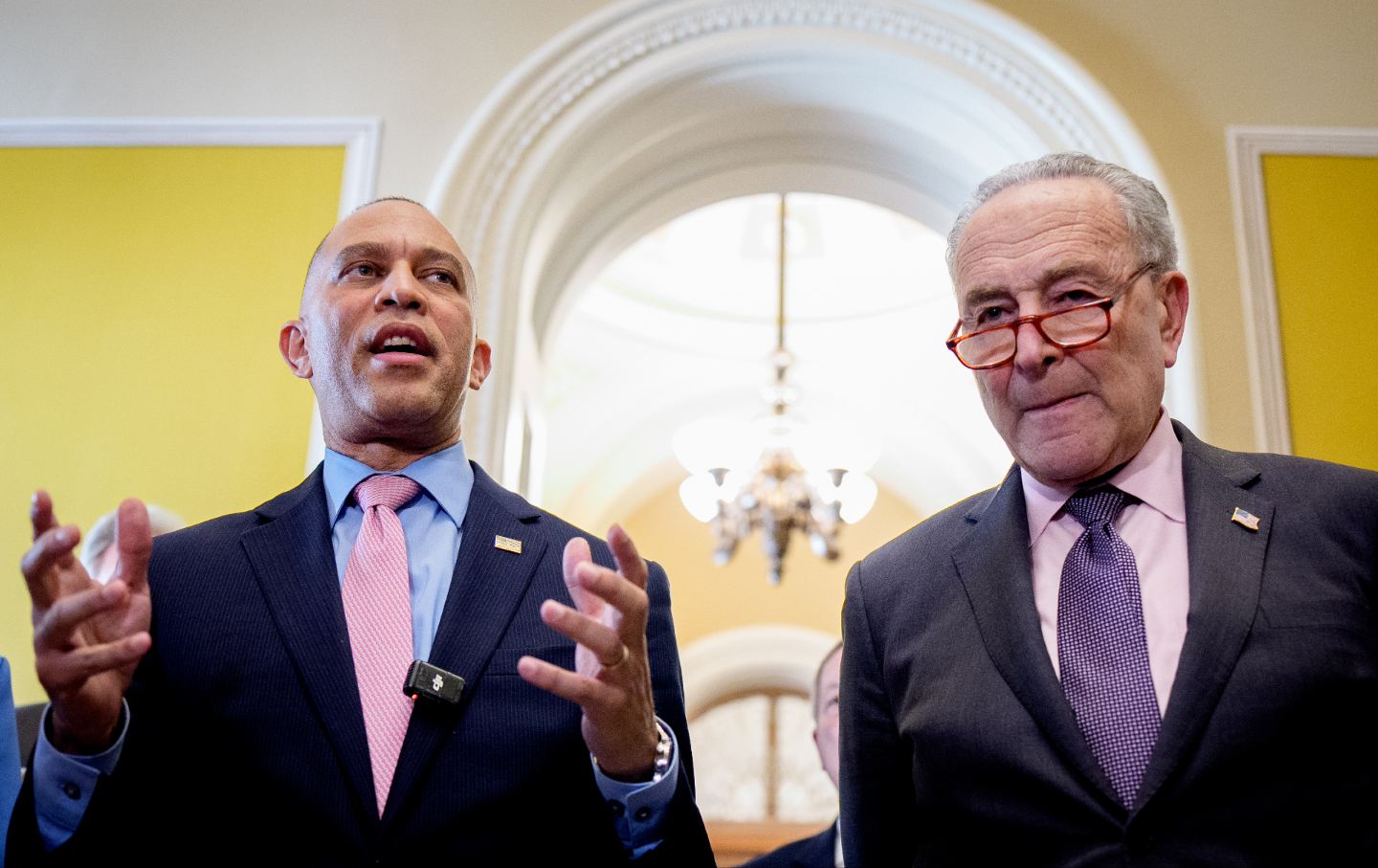
House minority leader Hakeem Jeffries (D-NY), accompanied by Senate minority leader Chuck Schumer (D-NY), speaks following a Democratic leadership meeting at the US Capitol on April 8, 2025, in Washington, DC.
(Andrew Harnik / Getty Images)“What leverage do we have?” If this question had been asked by anyone other than House minority leader Hakeem Jeffries, it would be an earnest expression of the Democratic Party’s dilemma. Instead, it betrayed its impotence. Let the word go forth: Democrats can’t help you.
The strange thing about this stance—one that was then compounded by Senate minority leader Chuck Schumer’s decision to give away the last shred of the party’s leverage over the government funding fight—is that Democrats always claimed to be the ones who saw the danger of Donald Trump coming more than anyone else. Instead of orienting itself around the cost-of-living crisis or the myriad material concerns that provoked real anger in the electorate, the Kamala Harris campaign platformed Liz Cheney to pitch the political establishment as the last defense for American democracy. Now that Trump is doing many of the things that they predicted, why are they so ineffective at standing up to him?
When Jeffries explained the Democrats’ strategy, he compared himself to New York Yankees all-star Aaron Judge: “One of the reasons that [Judge] is a great hitter is that he does not swing at every pitch. He waits for the right one and then he swings. We’re not going to swing at every pitch. We’re going to swing at the ones that matter for the American people.” But Judge is a slugger. He generates extraordinary power through the leverage he extracts from his wide-shouldered frame. To exhaust Jeffries’s not particularly helpful metaphor, it’s unclear how Democrats are going to swing without any leverage.
It’s tempting to explain the Democrats’ fecklessness as a victory of style over substance. But the unfortunate truth is that they have neither style nor substance.
The purpose of a party is to generate political ideas, and to make them meaningful by enacting policy. But performance matters too. A party must find ways to project ideas and to form connections with people. The Democrats’ preferred method is to sell themselves as stable, competent, and reasonable in a world that’s out of control. In a letter to his colleagues, Senate minority leader Chuck Schumer outlined the four prongs of the Democrats’ response: oversight (investigate the bad things that are happening), litigation (sue over the bad things), legislation (float bills to prevent the bad things), and communications (tell the public about the bad things).
These plans are pretty basic. But they’re also an attempt to mask the obvious: that using the courts or Senate committees to hold Trump accountable is, at best, going to yield minimal results. It’s highly likely that Schumer and Jeffries are aware of this, but by pretending, the Democrats can claim to be the adults in the room. They may have been voted out of the room in November, but if we hold a mirror up to Trump, voters will soon come to recognize the error of their decision.
When Schumer declined to fight Trump over government funding, he suggested that by allowing the Republican’s continuing resolution to pass—with cuts to nondefense domestic programs while boosting military spending—he was preventing the administration from having unchecked power. Two weeks later, Trump fired 20,000 Department of Health and Human Services employees. The pretense that projecting stability provides effective opposition long predates Trump, and because competency has always underpinned the Democrats’ rebound, it has blinded the party to political reality.
The Democrats’ institutional, technocratic method was first honed during the period Francis Fukuyama infamously described as “the end of history.” By the 1990s, the structural and political transformations that had dismantled the New Deal had given way to a sense of aspiration amongst the burgeoning middle classes, fueled by the end of the Cold War and a tech-driven economic boom. The rapid commercialization of information drove more and more people to take up jobs in white-collar and service industries. At work and at home, in front of the television, people were exposed to a greater range of economic groups. Their cues were driven by a techno-optimism, infused across the spectrum of consumer products, and marketed in a way that intertwined “progress” with social status. Fukuyama predicted that in the new, post-ideological society politics would be oriented around “the satisfaction of sophisticated consumer demands.”
A new breed of political strategists agreed. Consultants like Mark Penn, who would become a key strategist in Bill Clinton’s White House, built firms that could service both Texaco and Ted Kennedy. Penn found that “as we moved deeper into the business world we were increasingly struck by the similarities between campaigns and corporate marketing.”
For Penn and his ilk, the 1980s had been a decade of ignominy for the Democrats because they didn’t understand that people wanted a competent manager rather than a crusader against Wall Street. The party, he and fellow operative Douglas Schoen wrote in 1986, could only succeed by adopting Republicans’ “basic positions on fiscal issues” while marketing their “personality differences.”
This could be accomplished by rebranding the Democrats as technocrats. During the 1992 election, the New York Times editorial board was surprised that “the differences between the leading candidates this year are pragmatic, not ideological.”
The policy underpinnings of this transformation are well documented, and included NAFTA, “ending welfare as we know it,” and deficit fetishism.
To sell this as technocracy rather than a capitulation to Reaganism, the Clinton administration emphasized personal and technological modernization. There was no room for big ideas, just the “right” ideas. Every policy dilemma had a technically correct answer that a wonkish technocrat was much better placed to identify than an ideologue. The party, discursively at least, remained committed to ridding society of social ills like racially inflected poverty—but the policy solutions developed by these experts were less about direct government involvement and more about building partnerships with the private sector, particularly high-tech industries.
Under the Democrats’ “National Partnership for Reinventing Government,” spearheaded by Vice President Al Gore, government would be streamlined. Technological innovation meant that more than 250,000 federal government jobs could be eliminated. While that sounds awkwardly familiar now, at least we can rest assured that the Democrats did it legally.
The Democrats’ performance of technocracy was pitched against an out-of-touch and increasingly insane GOP. While David Duke, Pat Buchanan, and Rush Limbaugh never gained power over the Republican Party apparatus the way Trump has, their voices were amplified by the rise of talk radio and Fox News. Buchanan and Newt Gingrich were polarizing the country. Clinton contrasted himself as the reasonable alternative to such extremism—the kind of guy who just wanted to get things done. The pitch worked; a 1997 Pew survey showed that nearly two-thirds of Americans associated Clinton with the phrase “able to get things done.” (Two decades later, Hillary Clinton was still turning to this script, describing herself as “a progressive who likes to get things done.”)
Inherent in this approach was a reverence for the best and the brightest. As James Carville, Clinton’s chief strategist, said, it was impossible to find anyone on the campaign or White House staff who did not have some connection to Harvard. All that was needed was to let them loose on the government. They were bringing their experience in finance and in academia to engage in fact-based analysis that would ensure prosperity. The Federal Reserve would manage inflation through targets; recessions would be avoided because the government could precisely monitor GDP and tweak policies to ensure continuous growth.
While Clinton’s staff may have been wonkish and disciplined, his own performance needed to fit more directly into the celebrity-influenced consumer culture. His famous saxophone performance on Arsenio Hall’s show marked a turning point in politicians engaging with popular culture to connect with voters, and he led the way in appearing on talk shows, discussing personal matters publicly, and crafting a more media-friendly persona.
But the economy was not set up to actually enable the middle classes to achieve the American dream. Even in the 1990s, aspirational consumption had been underpinned by personal credit card and mortgage debt. While the narrative behind Apple and Microsoft made it seem like anyone could get rich in the dot-com boom, the real story was that wages lagged far below productivity. At the 2004 presidential election, nearly 40 percent of union households voted for Bush, according to exit polls—an increase of 10 points on 1996. Bush effectively split the group of voters earning between $30,000 and $50,000 with the Democratic nominee, John Kerry. The Democrats did experience Bush’s election as a profound moment of disorientation, but not reflection. The question they asked was how the electorate could vote for someone so stupid—not once, but twice.
The existential angst catalyzed bloggers and organizations like MoveOn, which proved more adept at using the Internet to mobilize anger at the Democrats’ limp response to the Iraq War than providing a deeper sense of purpose for their party. And they were largely ignored, or incorporated, into the party establishment anyway.
By the time the 2006 midterms rolled around, Bush’s bumbling vocabulary, matched by absolute incompetence in his warmongering abroad and in his handling of Hurricane Katrina at home, had made him incredibly unpopular. With Schumer and Rahm Emanuel leading their campaign, the Democrats easily won control of both houses of Congress by running on a six-point platform that included hefty promises like “Honest Leadership and Open Government.”
When the financial crisis hit, the Democrats were lucky to have Obama. He was the best performer of technocratic reasonableness, as his oratory managed to resuscitate optimism and revive the idea of a better world. The will.i.am-produced song “Yes We Can” is a particularly evocative example. A diverse range of celebrities appear in black and white to echo the words of one of Obama’s most famous speeches. The diverse cast—and the video really goes to all lengths to emphasize their diversity—are unified by Obama’s message that hope is the political force that can drive positive change.
Rewatching this video brings up a nostalgia for naïveté. It turned out that hope did not drive change under Obama. Obama’s task was to build on his 2008 campaign and to redefine the Democrats. Instead, he relentlessly pursued bipartisanship and—that old favorite—“pragmatism.” (“Mr. Obama is planning to govern from the center-right of his party, surrounding himself with pragmatists rather than ideologues,” the Times reported weeks after his election.)
Major reforms designed to help ease the financial burden on the poor, like the Home Affordable Modification Program or even Obamacare, were centered on compromises with different wings of the insurance and financial services industry. In the “Yes We Can” speech, Obama speaks of “the hopes of the little girl who goes to the crumbling school in Dillon.” A symbol of his presidency is that the school didn’t receive funding until 2017. Unemployment and wage growth did not return to pre-recession levels until, respectively, 2015 and 2019. The Republican Party did not respond to Obama’s call for unity and bipartisanship; instead, the disciplining effects of the Tea Party and Mitch McConnell underpinned its intransigence. But Obama’s refusal to engage in serious reform to match his soaring rhetoric did not just lead people to stop listening but likely encouraged them to stop believing. It was as if the Democrats expected voters to blame Republican obstructionism for their own lack of ambition.
None of this—not even the election of Donald Trump—appeared to shake the Democratic belief that a vaguely centrist, expert-driven consensus would prevail. “I don’t think [Trump] is ideological. I think ultimately he is pragmatic,” Obama told reporters after Trump’s victory, leaning on his party’s favorite theme. “And that can serve him well, as long as he’s got good people around him.”
In a recent poll, 52 percent of supporters said that the Democrats should focus on stopping Trump, as opposed to get their priorities through Congress. It might help if the party could articulate any priorities. July 2017, a poll asked Americans whether they thought the Democrats stood for something or just stood against Trump, and people chose the latter by a 52-to-37 percent margin. There is no reason that this must be mutually exclusive. It is possible to offer a tangible pathway to a world in which all Americans have a dignified standard of living and to identify Trump as the primary obstacle to that world. However, simply not being Trump has represented the upper bound of the Democrats’ political imagination for the last eight years.
Longtime Nation contributor Adolph Reed Jr. once described liberal politics in the Obama era as “bearing witness, demonstrating solidarity.… Its reflex is to ‘send messages’ to those in power, to make statements, and to stand with or for the oppressed,” as opposed to actually empowering the oppressed. It’s telling that, a decade on, this description remains apt. Party leaders and strategists cling to the assumption that the electorate will reward them for their steadfast reasonableness. There are fledgling signs that they are starting to get it. Tim Walz has acknowledged the timidity of the Harris campaign, and the criticisms of Schumer are coming from all factions. Yet there is little indication that the party is willing to go deeper, and rebuild around a deeper rationale for its own existence.
Popular
“swipe left below to view more authors”Swipe →The Wisconsin Supreme Court race, where the Democrat-backed candidate won by 10 percent, offered temptation for the party to revert to the playbook that Schumer helped orchestrate ahead of the midterms in 2006 and in 2018: play dead, and let Trump’s inevitable unpopularity wash over the electorate. This might allow the party to win a few House seats in 2026, regain control of one institution, and restore Jeffries’s cherished leverage to stall Trump’s agenda. Then, it will be the Republicans’ turn to shoulder the blame for an economy that works for so few people.
It’s not worth trotting out the line that this time it will be different. If a Democrat were to win the 2028 presidential election, they would be gaining influence over a federal apparatus that has been fundamentally reshaped by Trump and Musk. You would hope that would finally be enough to encourage a change to both substance and style, but then you could have said that after the dot-com bubble burst, after the debacle of the Iraq War, after the financial crisis, after the pandemic, and after Trump’s first term. The cult of competency has permeated so deeply into the party’s culture that it has no other lens to make sense of reality.
More from The Nation
The “Piggy” Warmonger The “Piggy” Warmonger
Trump swaps “America First” for Middle East strikes.
Trump’s Imperial Military Budget Trump’s Imperial Military Budget
In his recent military budget, Trump is saying the quiet part out loud: Waging war is more important to his administration than providing for basic needs at home.
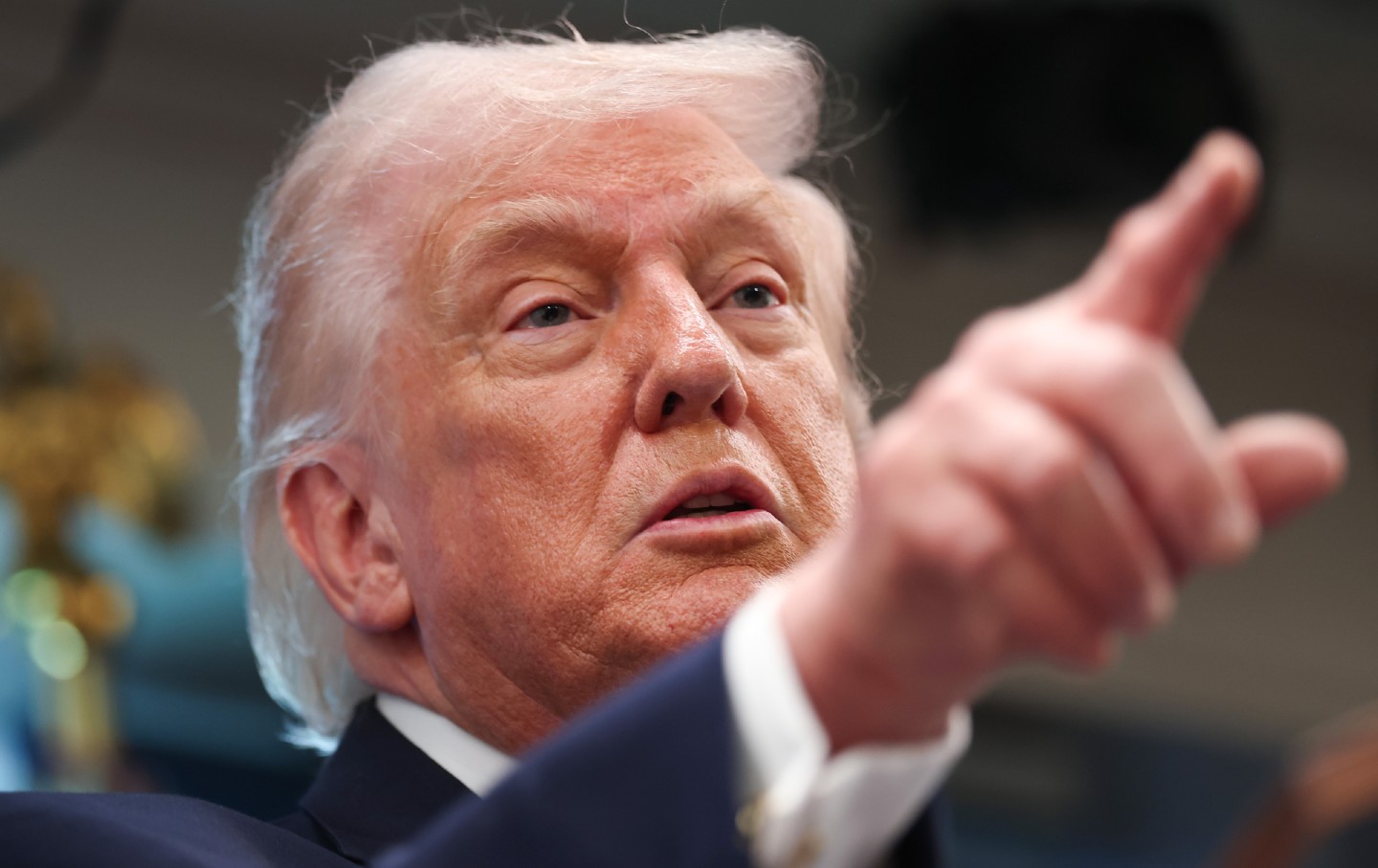
The United States Is Self-Destructing Amid Empire Collapse The United States Is Self-Destructing Amid Empire Collapse
Dangerously wrong priorities will accelerate America’s decline.
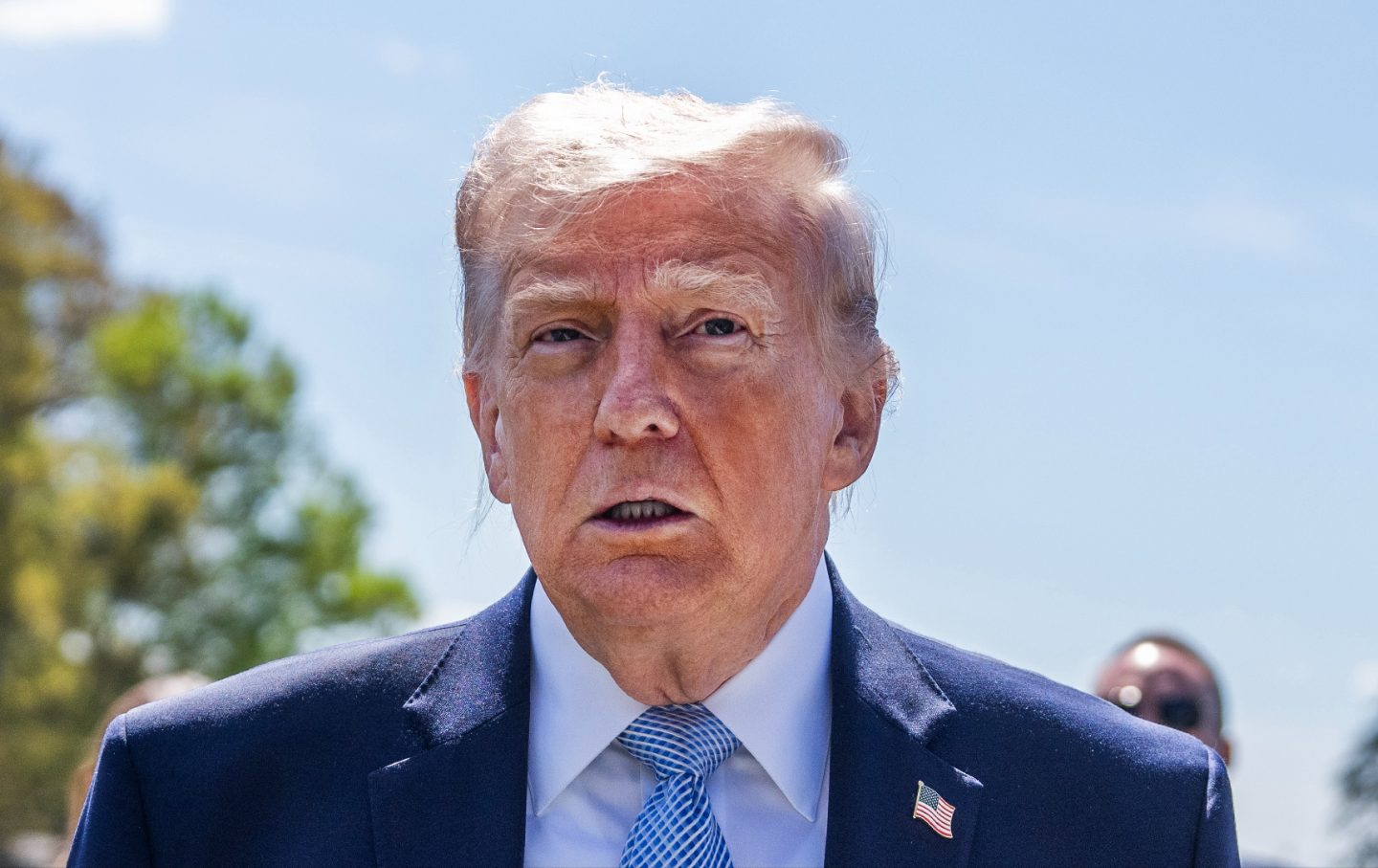
This Madman Is Pulling Us to the Brink of Armageddon This Madman Is Pulling Us to the Brink of Armageddon
Trump’s genocidal threat against Iran is one of the most vile and dangerous things an American president has ever done.
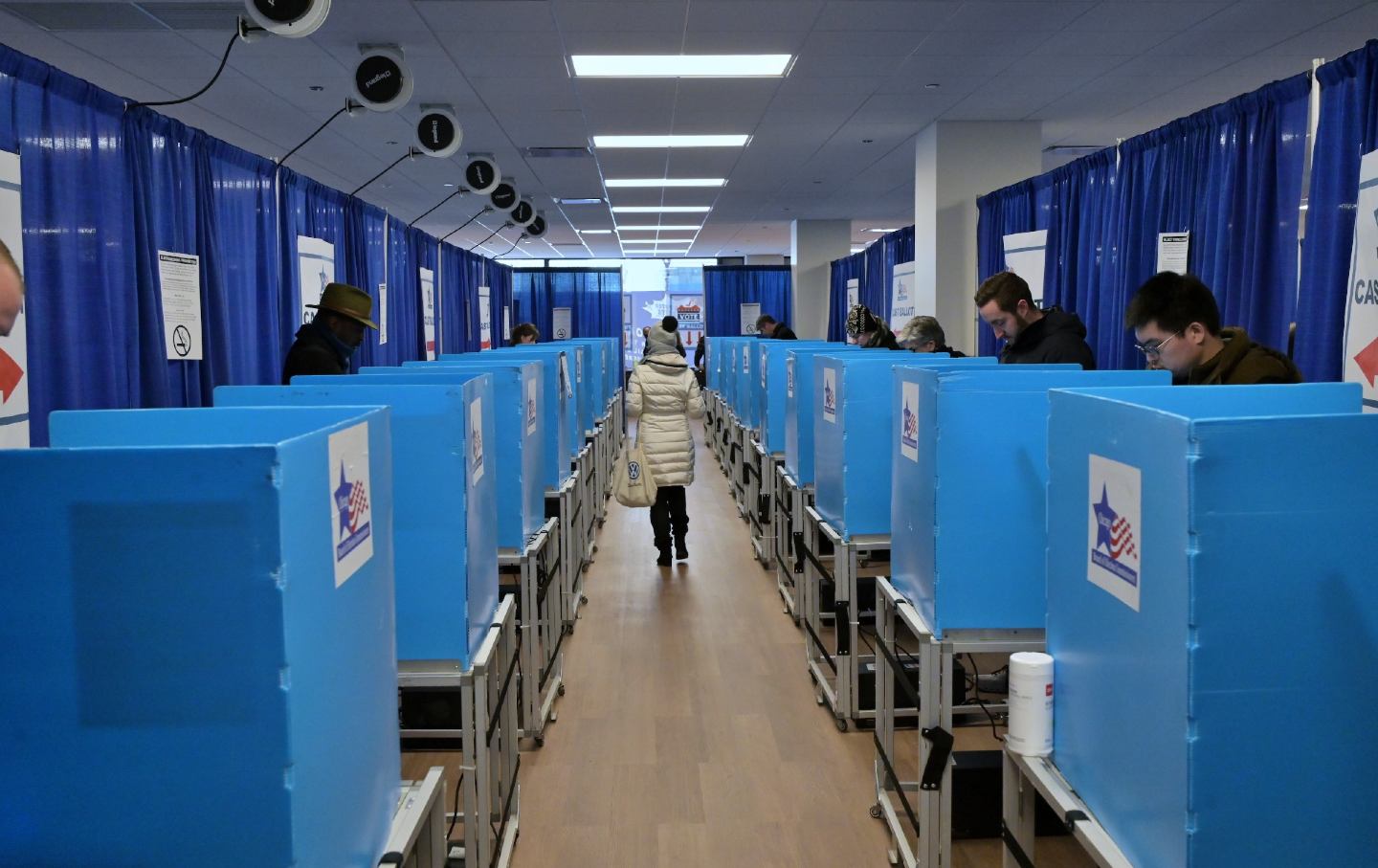
Why I Believe the Senate Must Reject the SAVE America Act Why I Believe the Senate Must Reject the SAVE America Act
The so called SAVE America Act is nothing short of Jim Crow 2026.

