
The Heat Is On
Chester Himes’s Harlem noirs.
Chester Himes’s Harlem Noirs
Himes helped reinvent the idea of the detective novel. He also transformed it into a powerful vehicle for social criticism.
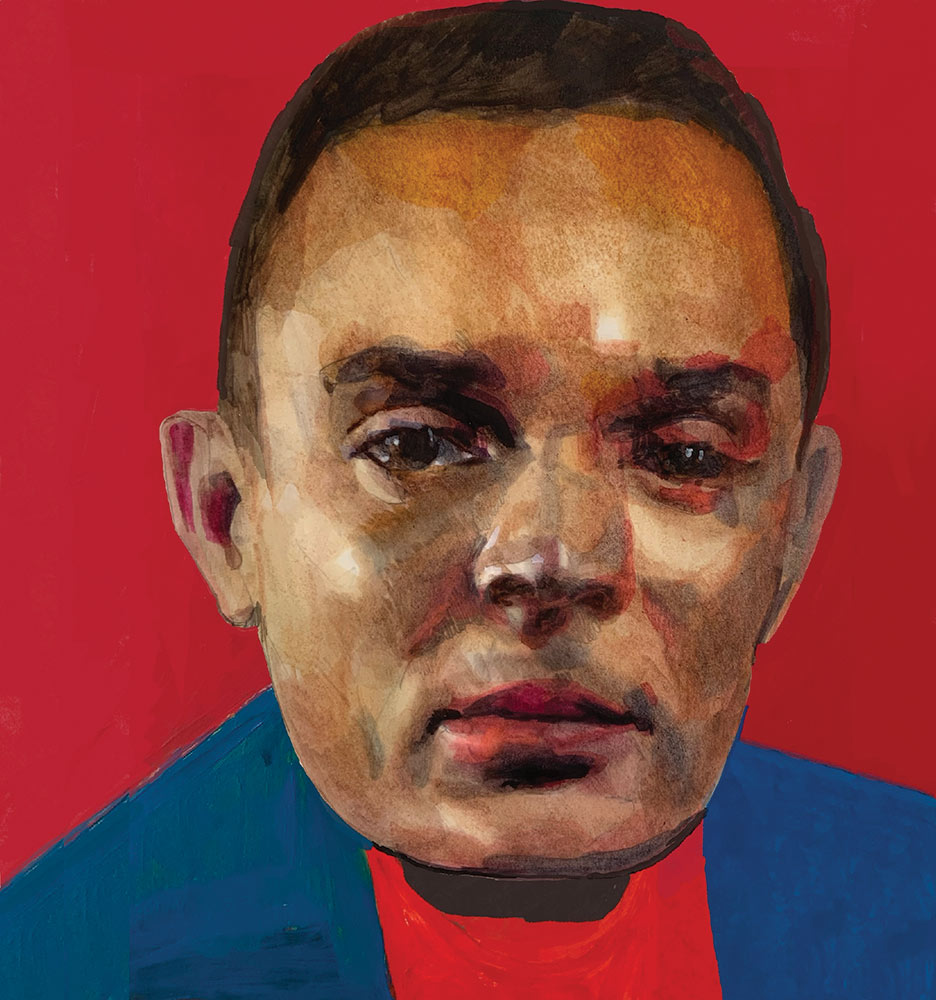
One imagines Chester Himes as a species of cactus lurking along the edges of the literary landscape: arresting, prickly, and resilient, stinging harshly when pressed too hard or approached too indelicately —and yet carrying enough water beneath its tough hide to refresh, even renew the landscape around it.
Books in review
-
The Essential Harlem Detectives: A Rage in Harlem, The Real Cool Killers, The Crazy Kill, Cotton Comes to Harlem
Buy this book -
Dear Chester, Dear John: Letters Between Chester Himes and John A. Williams
Buy this book -
Yesterday Will Make You Cry
Buy this book -
The Third Generation
Buy this book -
The End of a Primitive
Buy this book -
If He Hollers, Let Him Go
Buy this book
In a lifetime beset with neglect, struggle, and scorn, that is exactly what Himes did. He wrote and wrote, channeling his anger, taking risks, and leaving behind a shelf of more than 20 books, the best known of which were his detective stories set in Harlem—a place he didn’t actually spend as much time in as he had in the Midwest, where he’d begun writing while serving prison time during the 1930s, or in Europe, where he’d moved in the 1950s after a series of personal and professional setbacks in his native country confirmed for him his destiny as a literary outlier, marginalized even within the relatively marginalized status of Black American writers near the dawn of the civil-rights era.
“I get the ass-end of everything on the way to someplace else” is a quote that belongs not to Himes but to a fictional character named Max Reddick, the restive, itinerant, and beleaguered Black American writer at the center of John A. Williams’s epochal 1967 novel, The Man Who Cried I Am. But it could also have been said of Himes and his often star-crossed life and literary career. Williams, a friend and confidant to Himes, might in fact have borrowed much of the latter’s embittered humor and worldly demeanor in creating Max. One can’t know for sure. Yet the more one learns about Himes and reads his fiction, the easier it is to imagine him tossing out, even in casual conversation, a lament like Max’s. In many ways, one can imagine it serving as a kind of chorus for the beat-down, rough-edged rhythm-and-blues dirges one finds in what is now known as Himes’s “Harlem Cycle” of novels, four of which, from the late 1950s and early ’60s—A Rage in Harlem, The Real Cool Killers, The Crazy Kill, and Cotton Comes to Harlem—have recently been compiled in an Everyman’s Library collection. They, along with 1960’s The Big Gold Dream and All Shot Up, 1966’s The Heat’s On, 1969’s Blind Man With a Pistol, and the posthumously published Plan B, feature the forbidding, irascible, zero-bullshit Black NYPD detectives Grave Digger Jones and Coffin Ed Johnson, who use even the most unseemly means at their disposal to manage chaos on their combustible turf. The prose is lean and muscular, and the narrative is spiked with mordant wit and baroquely violent imagery.
Chester Himes was in his mid-40s when he began writing detective fiction at the suggestion of his French translator, Marcel Duhamel, who ran a line of crime novels called La Serie Noire for Gallimard. At the time of Duhamel’s suggestion, Himes was likely more than willing to try anything, having arrived at an impasse in his literary career. Born in 1909 in Jefferson City, Missouri, he was the youngest of three sons of teachers working in what was then characterized as the “Negro higher education system” in a racially segregated America. His autobiographical writings, including his 1972 memoir The Quality of Hurt, describe a peripatetic childhood fraught with bitter conflict between his parents and guilt over an accident that blinded an older brother. The family eventually moved to Cleveland, where Himes got caught up in the city’s underworld and was convicted of armed robbery in 1928. In the Ohio State Penitentiary, he found his calling as a writer and eventually published five literary novels.
The novels had only middling financial success—hence Duhamel’s suggestion that he try his hand at something more popular like detective fiction. At the time of Duhamel’s recommendation, Himes was just recovering from the ordeal of The End of a Primitive, his most recently completed novel, which had been rejected by his editor, who told him that if it were published, “it would bring down the roof on all of us.” The chronicle of a destructive interracial romance, it was eventually published in 1955 in expurgated form as The Primitive (though later republished, unexpurgated, with the original title), and while it remained Himes’s favorite among his books, its raw details, interspersed with surrealistic touches like TV newscasts foreshadowing violent acts involving the book’s characters, made the novel a challenging one and opened even its author up to the possibility of finding a more hospitable mode and genre.
The truth is, however, that The End of a Primitive was not Himes’s only difficult book—almost all of them were, in one way or another. Himes’s 1945 debut, If He Hollers, Let Him Go, whose prose still burns the hands of anyone reading it, recounted four anxious days in the life of Bob Jones, a Black shipyard worker psychically and physically assaulted by his white coworkers and the police, falsely accused of rape, and eventually compelled to join the Army. Drawn from Himes’s experiences working in the Los Angeles shipyards during World War II, If He Hollers, Let Him Go is a waking nightmare interspersed with bad dreams only slightly more warped than this deeply sensitive Black man’s daily existence, infected on the home front by the “tight, crazy feeling of race as thick in the streets as gas fumes.”
Even though it was a far cry from his later detective fiction, the novel was a revelation. Himes’s astringent style, evoking the headlong ribaldry of a present-day stand-up comic or rap artist, announced itself as its own all-American paradox: at once hard-boiled and thin-skinned, self-pitying and stoic, grimly resigned and boisterously irreverent. But it was also clearly not going to become a bestseller.
Nor was Himes’s second novel, Lonely Crusade, published in 1947. Following a Black union organizer at a California aviation plant charged with the task of recruiting other Black workers, the novel took chances in its detailed exploration of class as well as racial disparities, Black antisemitism, and the battles and betrayals within the progressive movements of the 1940s. It, too, was a critical and commercial flop. “Everyone hated it,” Himes wrote in his memoir The Quality of Hurt. “The left hated it. The right hated it. Jews hated it. Blacks hated it.” Even some fellow Black authors who were otherwise sympathetic to the risks Himes took did not like it. In a letter to Richard Wright, Ralph Ellison wrote that he found the novel “dishonest in its pseudo-intellectuality,” while James Baldwin, reviewing it for The New Leader, wrote that the book “probably had some of the most uninteresting and awkward prose I have read in years.”
Part of Himes’s problem was not of his making at all. The literary marketplace of the 1940s tended to assess fiction by Black authors as sociopolitical tracts (“protest novel” being the familiar euphemism that Baldwin himself would push back against). There were, of course, plenty of sociopolitical observations in If He Hollers, Let Him Go and Lonely Crusade, but focusing on them meant the aesthetic elements of Himes’s fiction went largely unacknowledged. Back then, his early novels were mostly compared to Wright’s, and the comparison wasn’t entirely misapplied. But another part of the problem was that Himes had not yet quite hit his mark. His books were bracing, fiercely experimental, and often painful to read. But the tough, callous landscape they described, the brooding despair and gritty realism they evoked, would come into its own in his detective novels. Like Dashiell Hammett, Raymond Chandler, and James M. Cain, Himes found that once he turned to this genre of writing, he could become one of its great virtuosos.
Before the detective fiction, however, there were other novels. In the frustrating years after Lonely Crusade, Himes reached further into his autobiography with Cast the First Stone and The Third Generation, which were recently released in new editions. The novels were originally published in 1952 and 1954, respectively, but if you’re using them to follow Himes’s life story chronologically, you should read them in reverse order. The Third Generation’s Taylor family is a thinly veiled rendering of Himes’s own in the early 20th century. As Himes’s father did, William Taylor teaches blacksmithing at various Black colleges in the South. He clashes often with his fair-skinned wife, Lillian, who resorts to what John A. Williams describes, in his introduction to a later edition of the novel, as “stinging, emotional, racial outbursts” at her husband that include denigrating his darker skin. The intense, sometimes violent friction between the Taylors is exacerbated by the Jim Crow segregationist practices of the era, even in the Midwest, where the Taylors eventually migrate with their three sons. Charles, the youngest and most sensitive, is Himes’s alter ego: He falls down an elevator shaft while working as a janitor, sustaining several broken bones and a broken vertebra, injuries from which he would never fully recover (an ordeal that Himes also experienced), then drops out of Ohio State University and becomes acquainted with the Cleveland underworld.
Cast the First Stone picks up on what happened next in Himes’s life. His protagonist, Jimmy, falls from a scaffold, suffering similar injuries, and eventually robs a couple in their Cleveland Heights home and gets caught. Jimmy is sensitive and fiercely attentive to the inequalities all around him. His time in prison is tautly and harrowingly rendered, and as some of the experimentalism of Himes’s prior novels falls away, we begin to see the detective novelist emerge: a careful craftsman with an ear for dialogue and an insider’s knowledge of crime.
Cast the First Stone helped Himes work through his own difficult past, but it also began to point him in another direction. Himes’s time in New York did so as well: Leaving Europe in 1955, “broke, bitter, defeated,” and “utterly chagrined,” he moved to New York City, taking odd jobs that, in the words of one of his biographers, James Sallis, “could not have been other than degrading to a man of his age, accomplishment, and past ambition.” One was as a porter for a Horn & Hardart Automat in midtown Manhattan, an experience that would come in handy a decade later for his novel Run Man Run, a thriller involving a double murder by a corrupt white cop.
But Himes carried out his most valuable research during that year in New York in his leisure-time forays into Harlem, where he got to know pimps, gamblers, prostitutes, and other hustlers similar to those he’d known in his younger days on Cleveland’s mean streets. Thanks to these encounters, he collected the impressions, anecdotes, and story ideas that he would later use in the Harlem Cycle. By then, the Grand Guignol effects that Himes interposed in The End of a Primitive had emboldened him to push these narratives beyond the social-realist guardrails and inject elements of folklore, black humor (in more than one sense), and quasi-surrealism into the customary truculent mode of le genre policier.
Sometimes, as in the case of The Crazy Kill, the plot sprawls, bends, and runs amok to the point where you sometimes wonder how even the implacable Grave Digger and Coffin Ed can remember that the whole thing started with a preacher falling out of a third-story window into a breadbasket containing the body of another man who’d been stabbed to death. Not that it’s pertinent, but the sign on the building’s window beneath the one that the first man falls from is an ad hyping an ointment that promises “a cure for all love troubles” with the legend “STRAIGHTEN UP AND FLY RIGHT.”
In the Harlem novels that followed, the jokes and folks get even wilder. Offering both the bluntness of Hammett’s private-eye sagas and the deadpan absurdist comedy of Luis Buñuel’s films, they also contain the heedless narrative momentum of William Faulkner, one of Himes’s literary touchstones. Despite their sometimes shaggy-dog qualities, they have a centripetal force to them, aligning their scattered elements into something resembling resolution in the manner of a conventional whodunit or a comedic farce, but as most readers conclude the novels, they realize that’s not why they’re reading them. Most are there for the Wild West chaos that Himes has transposed onto urban terrain. The novels are raucous, ribald, absurd, and yet gritty and realistic. They are full of dark humor and yet also willing to take seriously the travails of life along the margins. They are genre novels but also full of literary ambition and sociopolitical insight.
Himes enjoyed a gratifying wave of rediscovery in the late 1960s and early ’70s post-civil-rights era, with the Black Power movement arousing greater attention on African American writers. Three of his books—If He Hollers, Let Him Go; Cotton Comes to Harlem; and The Heat’s On (the last under the title Come Back, Charleston Blue)—were adapted into movies. Himes was lionized by younger Black writers such as Nikki Giovanni and Ishmael Reed, himself a writer of metaphysical detective stories like 1972’s Mumbo Jumbo.
Over the decades, one can also hear Himes’s sardonic voice informing those of vinegary, incendiary assailants on racial presumptions like Charles Wright (The Wig), William Melvin Kelley (A Different Drummer), Cecil Brown (The Lives and Loves of Mr. Jiveass Nigger), Darius James (Negrophobia), and Paul Beatty (The Sellout). Percival Everett cites Himes as an influence on his vast, impudently eclectic body of work, which includes not only James, last year’s best-selling revisionist take on Mark Twain’s Adventures of Huckleberry Finn, but mystery-horror burlesques like 2021’s The Trees and slightly bent contemporary westerns like 2007’s Wounded and 2011’s Assumption.
Popular
“swipe left below to view more authors”Swipe →And two-time Pulitzer Prize winner Colson Whitehead has his own Harlem cycle of crime novels going with 2021’s Harlem Shuffle and 2023’s Crook Manifesto. In his introduction to The Essential Harlem Detectives, the award-winning crime writer S.A. Cosby speaks for generations of such peers as Walter Mosley, Gar Anthony Haywood, Paula Woods, Gary Phillips, Charlotte Carter, and Attica Locke when he attests to the “wild and powerful clarion call” of Himes’s Harlem Cycle in bringing “Black cops and con men, Black madams and Black ministers” into the wonderlands of mystery and adventure.
It now seems ironic that in narrowing his aspirations to achieve fame and fortune, Himes seemed almost haphazardly to find his true literary métier and lasting influence: He became “prestigious” for his “pulp fiction.” But Himes wouldn’t label this development ironic so much as absurd, like so much of his life—a fact that he highlighted in the second volume of his autobiography, 1974’s My Life of Absurdity. Whatever recognition Himes secured during his lifetime didn’t mitigate his pessimism toward humanity in general and race relations in particular. In his last Harlem novel, the unfinished, posthumously published (in 1993) Plan B, Himes even went so far as to predict an all-out race war in America, with Grave Digger and Coffin Ed as two of its casualties. Which seems an egregiously sour ending to a series whose astringent tableau of criminality and avarice was somehow always mitigated by the kind of exuberance and raucous humor rarely found in the novels preceding A Rage in Harlem.
But however aggrieved that real life would make him, Himes remained faithful to the imperative of dreaming his way out. You can’t detect it readily, but I think there’s flickering hope to be found beneath the layers of his mordant pessimism. I’m thinking especially of a flashback scene in Yesterday Will Make You Cry that seems overwhelmed by the story’s brutality, rage, squalor, and peril: Jimmy’s reverie about his home-schooling with his mother and how, “out of all those hazy memories, the times which stood out clearest were the times he slipped away with some book or other, usually some ancient Greek or Roman legend, and read and dreamed.” Through such legends, “he came to feel that the things he did and the things which happened to him…each absolute within himself, were things which did not count, and were only to be forgotten and passed on to an oblivious past: the real things were the things he read and the things he dreamed and the castles he built and the armies of mail-clad soldiers he led through the forests and along the sunken Mississippi roads.”
So as unlikely as it may seem even to his devotees, Chester Himes for much of his life bore the soul of a romantic. A thwarted, combustible, often embittered romantic, to be sure, but the kind of romantic capable even on his worst days of spinning stories about tough, sore men using fair or foul methods to keep—or find—peace.
More from The Nation
The Enduring Lessons of the Jewish Bund The Enduring Lessons of the Jewish Bund
A conversation with Molly Crabapple about “Here Where We Live Is Our Country,” her history of Bundism, and what we can learn from their socialist and anti-Zionist example.

Waging a Culture War by Promoting Comedic Mediocrity Waging a Culture War by Promoting Comedic Mediocrity
The Ellison family, poised to continue dominating the media landscape with its Warner deal, signs on an infomercial-grade comic to replace Stephen Colbert.

The Worlds of Jamaica Kincaid The Worlds of Jamaica Kincaid
Memory pervades a new collection of nonfiction, and so do the ghosts of empire.
Ben Lerner’s Novel of Fathers and Sons Ben Lerner’s Novel of Fathers and Sons
His most experimental and unsettling book, Transcription as us whether art is futile or the most important weapon we have.
Jay McInerney’s Yuppie New York Jay McInerney’s Yuppie New York
The novelist has spent a career mocking and romanticizing the lifestyle of New York's bourgeoisie. Now, in his latest, he examines them as they come to the end of their lives.

