
A Faster Path to Collective Bargaining: Majority Sign-Up
Though approval of unions is at historically high levels, membership remains low. One way to change that is to make it easier for workers to form a union—and to start bargaining.
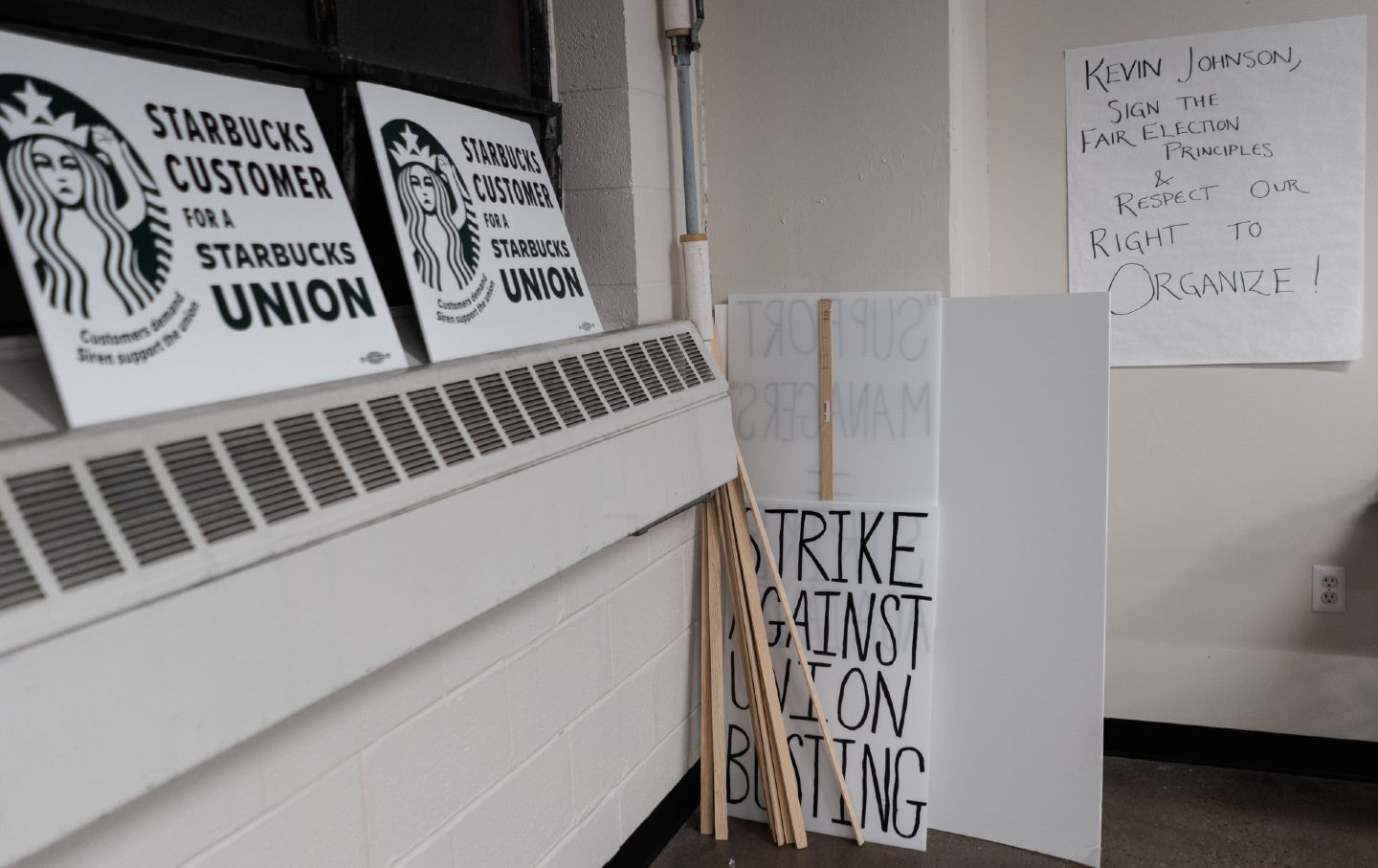
Union membership is currently at a historic low, with just 10 percent of the workforce belonging to a union—and only 6 percent in the private sector. Increasing union density by just a single percentage point would require organizing 1.6 million new workers with no membership losses elsewhere.
In 2023, despite a very encouraging uptick in strikes and organizing, only 97,977 of the roughly 160 million US workers were eligible to vote in the 1,986 representation elections supervised by the National Labor Relations Board.
Even if labor had won every NLRB election (which it did not), this growth rate would have been far less than the increase in the US labor force, which averages around 1.5 million new workers annually.
Given this dismal trajectory, a reversal in membership trends is not in the offing. Major changes will be required if the labor movement is to grow strong enough to build sufficient worker power to win for workers, benefit the entire working class, and address economic inequality.
How best can the labor movement organize on scale? Labor historian Erik Loomis has commented, “There are too many workers in America to rebuild the labor movement in groups of twenty or thirty or even one hundred. You need thousands and thousands of people to be joining the labor movement at the same time.”
And as Ben Fong, of the Center for Work & Democracy at Arizona State University, has noted, “If the labor movement is going to take advantage of the present popular approval for labor unions and interest in labor organizing, it must go after big targets in the private sector, shops where workers can potentially be added to union rolls en masse.” We certainly agree.
Others have pointed out that labor’s resources could be better deployed to support more organizing. Labor researcher Chris Bohner has analyzed labor’s assets and the current leadership’s organizing inertia. “It isn’t a funding issue, as labor has over $35 billion in net assets.” Again, we agree.
Finally, experienced organizers know that building an enduring union where members wield real power on the job must be done from the bottom up, worker-to-worker, as it’s been done during all great worker upsurges. Today, we benefit from the use of new tools and technology that enables a “distributed” model of self-organization allowing workers to directly take on tasks previously done by paid full-timers.
However, absent major legal reforms in the process by which workers gain their collective bargaining rights, none of the above strategies are likely to succeed.
That’s why, with the prospect of a Harris/Walz victory, it’s imperative to win meaningful labor law reform in the next Congress.
As labor lawyer Matt Bruenig recently pointed out, “American labor laws, and the bureaucracy they require, make mass unionization impossible unless rules for certifying unions and negotiating contracts are simplified and streamlined.”
The evidence is compelling: Think of the union struggles at Starbucks, Amazon, and Mercedes-Benz. Private-sector employers can too easily use the NLRB’s bureaucratic process to frustrate workers’ initiatives. And if that doesn’t work, they get another bite at the apple through the courts. All too often, justice delayed is justice denied.
Some organizers have offered a compelling workaround: Strike for recognition.
That strategy is great if workers are unified enough and have the juice to strike. But in our experience, the vast majority of organizing campaigns won’t be able to reach anywhere near that level of militancy. Most workers look to a legally sanctioned, democratic process to build majority support and then obtain bargaining rights through the NLRB.
In the political swirl surrounding the recent Democratic National Convention, politicians often pledged to pass the Protect the Right to Organize (PRO) Act, labor-law reform legislation that was introduced after Biden was elected as president. It died an unseemly death because the votes were not there in the Senate to overcome a Republican filibuster.
While the PRO Act has many good features, it does not address the fundamental need for “majority sign-up” that was a critical part of the effort to pass the Employee Free Choice Act during the Obama years when Democrats had a majority in both the House and Senate. Tragically, that moment of “hope and change” failed when Obama and the Democrats chose other priorities. In March of 2007, it passed in the House by 60 percent, with support from 16 Republicans. But despite having a clear majority in the Senate, it didn’t have the 60 votes necessary to bring it to the floor.
With “majority sign-up,” workers who desire a union simply sign authorization cards indicating their support. Once a majority sign cards, employers are required to recognize their union as the employees’ representative and begin negotiating a collective bargaining agreement. The key advantage over the current process is that this “card check” certification allows workers to move quickly from establishing majority support for their union to meeting with their employer at the bargaining table.
Sadly, conservative elements within the AFL-CIO and its affiliates decided in 2020 that stripping out card check was the best way to build broader support for the PRO Act.
Today, we regularly encounter politicians who advocate for the PRO Act but have no understanding that the key card check provision is missing. In fact, even many of our labor movement comrades also do not know the distinction.
The importance of the many NLRB decisions made during the Biden administration that contributed to an upsurge in organizing should not be underestimated. The board’s decision allowing Starbucks Workers United (an SEIU affiliate) to organize single bargaining units rather than having to organize regional multiple sites enabled a path-breaking victory in Buffalo, New York, that inspired hundreds of other baristas to organize.
The board’s ruling that Amazon employees at the Staten Island fulfillment center had a right to agitate for their union off-shift in company lunchrooms is another example. More recently, the NLRB deemed Amazon a “joint employer” of its Delivery Service Partner contractors, with full legal responsibilities for working conditions and an obligation to bargain.
Popular
“swipe left below to view more authors”Swipe →The board’s 2023 CEMEX decision has provisions that can force an employer who doubts a union’s majority to file a petition for an expedited election. Further, if the employer commits egregious violations of labor law, like threatening to take away benefits or firing union leaders, then the board can issue an order to bargain for a first contract.
In addition to upgrading future labor law reform with majority sign-up, we need reform that limits employers’ ability to overturn NLRB decisions in the courts. Board decisions, sometimes years in the making, must be protected from being enjoined by district court judges.
“The next version of the PRO Act needs to clearly limit the boundaries of the federal judiciary, as the Trump-appointed judges, at every level, have been gutting virtually every decision and rule of the Biden board,” said Larry Cohen, who as past president of the CWA chaired the AFL-CIO organizing committee from 2005 to 2015. “Self-enforcement, included in the current proposed legislation, is similarly critical, or board decisions will be meaningless. The $1,000-an-hour anti-worker law firms can’t wait to cherry pick a Trump judge and then delay and destroy the wonderful work by the NLRB over the last three years.”
There are no shortcuts to a revived labor movement. And the pathway to an era of mass organizing is surely complex. However, reinserting majority sign-up and preventing judges from enjoining board decisions would give workers an easier path to attain their collective bargaining rights. In the next round of labor law reform, let’s work towards making it easier for millions of workers to get started on the path to the power of collective bargaining.
Support independent journalism that does not fall in line
Even before February 28, the reasons for Donald Trump’s imploding approval rating were abundantly clear: untrammeled corruption and personal enrichment to the tune of billions of dollars during an affordability crisis, a foreign policy guided only by his own derelict sense of morality, and the deployment of a murderous campaign of occupation, detention, and deportation on American streets.
Now an undeclared, unauthorized, unpopular, and unconstitutional war of aggression against Iran has spread like wildfire through the region and into Europe. A new “forever war”—with an ever-increasing likelihood of American troops on the ground—may very well be upon us.
As we’ve seen over and over, this administration uses lies, misdirection, and attempts to flood the zone to justify its abuses of power at home and abroad. Just as Trump, Marco Rubio, and Pete Hegseth offer erratic and contradictory rationales for the attacks on Iran, the administration is also spreading the lie that the upcoming midterm elections are under threat from noncitizens on voter rolls. When these lies go unchecked, they become the basis for further authoritarian encroachment and war.
In these dark times, independent journalism is uniquely able to uncover the falsehoods that threaten our republic—and civilians around the world—and shine a bright light on the truth.
The Nation’s experienced team of writers, editors, and fact-checkers understands the scale of what we’re up against and the urgency with which we have to act. That’s why we’re publishing critical reporting and analysis of the war on Iran, ICE violence at home, new forms of voter suppression emerging in the courts, and much more.
But this journalism is possible only with your support.
This March, The Nation needs to raise $50,000 to ensure that we have the resources for reporting and analysis that sets the record straight and empowers people of conscience to organize. Will you donate today?
More from The Nation


What We Must Learn From the Revelations About Cesar Chavez What We Must Learn From the Revelations About Cesar Chavez
The sexual predations of the late labor leader follow a depressingly familiar pattern in left organizing circles.

Dolores Huerta: “My Silence Ends Here” Dolores Huerta: “My Silence Ends Here”
The labor movement icon speaks out after revealing that she was sexually assaulted by Cesar Chavez.

Trump Wants to Criminalize Dissent. This Texas Case Could Help Him Do It. Trump Wants to Criminalize Dissent. This Texas Case Could Help Him Do It.
The Prairieland Defendants are on trial in a case that could set a chilling precedent for the right to protest in the United States.

A Motto for All Health Workers: Resist, Resist, Resist A Motto for All Health Workers: Resist, Resist, Resist
Doing our work and keeping our heads down isn’t a victory. We need to fight this regime every day, in every way.
How Jane Fonda Is Rethinking the Hollywood Resistance How Jane Fonda Is Rethinking the Hollywood Resistance
The actress’s revived Committee for the First Amendment is taking aim at industry mergers as well as threats to the freedom of expression.

