
Will Atlanta’s “Stop Cop City” Referendum Make It Onto the Ballot?
Organizers collected 116,000 signatures in support of a referendum to repeal the ordinance authorizing the police training facility, but it’s unclear if—and when—the initiative will be voted on.
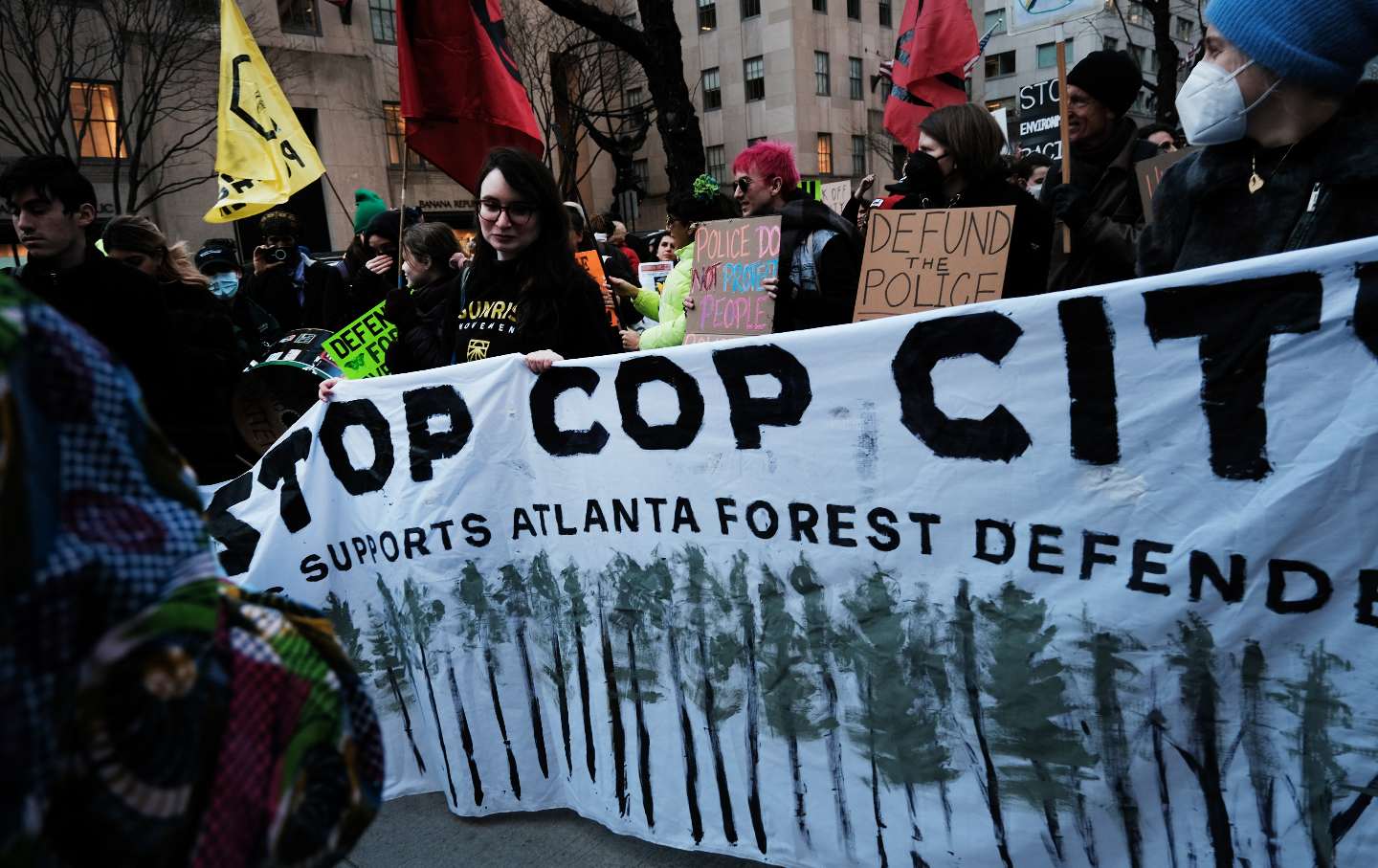
Activists participate in a protest against the proposed Cop City being built in an Atlanta forest in New York City.
(Spencer Platt / Getty)This summer, Stop Cop City organizers pivoted to use the state’s legal processes to advance their goals. What started as a neighborhood environmental campaign two years ago has grown into an international climate and anti-policing outcry and—most recently—a potential voting matter for the city of Atlanta.
In 2021, Atlanta City Council announced plans to build a 85-acre, $90 million police training facility, nicknamed “Cop City” by activists, in the Weelaunee Forest south of the city. The project generated staggering backlash—protest encampments on the proposed construction site in the Weelaunee Forest, a summer of marches, mutual aid, and community-building, and 17 hours of public comment overwhelmingly opposing the facility.
Lisa Baker, a Dekalb County resident and Stop Cop City organizer, recalls that the idea for a ballot referendum, a process of allowing constituents to directly vote on an issue of interest, was tossed around as early as September 2021, but organizers decided against it until the movement grew significantly. Eventually, they revisited it with force, zeroing in on canceling the Atlanta Police Foundation’s contract to lease the land that the training center would be built on.
“If you look historically at other similar land defense projects, they’ve always had two branches. They’ve always had an occupation, kind of direct action, strategy and also a legal strategy,” Baker says. “We have to have legal grounds where we can force them to stop this project.”
Georgia’s ballot referendum laws are notoriously restrictive, but Alex Joseph, a former prosecutor working on the Stop Cop City ballot initiative, says that a movement in Camden County broke the ice for Atlanta’s referendum. In March of 2022, Camden residents voted on a referendum to block the construction of a spaceport in coastal Georgia county. County commissioners who spearheaded the project sued to overturn the result of the election, but in early 2023, the Georgia Supreme Court upheld Camden voters’ decision.
With the knowledge that it was possible to push a successful referendum in Georgia, the Stop Cop City organizers launched their campaign on June 7. Almost immediately, they encountered significant barriers. Putting Stop Cop City on the ballot meant collecting roughly 58,000 signatures, representing 15 percent of the city’s registered voters, in person and witnessed by an Atlanta resident, in 60 days, which placed the deadline around mid-August.
As a resident of Dekalb County, just southeast of Atlanta, Baker lived closer to the proposed training facility than most Atlanta voters. Still, she wasn’t eligible to vote or even collect signatures. In early July, Baker joined three other Dekalb County residents in filing a lawsuit against the City of Atlanta to allow Dekalb residents to collect signatures and restart the 60-day countdown under these new circumstances. In late July, Baker and her co-filers won the lawsuit, and the 60 days restarted, extending the due date to mid-September.
After delivering dozens of boxes of signatures to the city’s elections office, activists were told that they had missed the mid-August deadline to submit signatures. Organizers responded that the deadline had been extended after Baker’s lawsuit, but the elections office argued that the decision was being challenged again—they would have to wait for yet another judgment to be handed down. Most recently, in late September, the city started processing the signatures by uploading them online, needlessly publishing every signer and witness’s name and address, initiating an approval process that could take months.
In total, the organizers say they have collected 116,000 signatures in support of the ballot referendum. Yet the question remains if—and when—the Stop Cop City initiative will be voted on. The referendum could potentially appear on the March 2024 presidential primary ballot.
Unfortunately, the challenge is nothing new. Local police and Georgia government officials repeatedly style the organizers as lawless: Atlanta police and Dekalb County police arrested dozens of peaceful protesters, and a Georgia State Patrol officer brutally shot and killed organizer Manuel Terán (“Tortuguita”) during a raid of a Stop Cop City encampment. Recently, the barrage continues: last month, Georgia Attorney General Chris Carr announced a sweeping indictment of 61 activists involved with Stop Cop City on racketeering charges.
Still, the possibility has Stop Cop City organizers hopeful. “The exciting thing about the referendum was always the fact that we have a chance of forcing the city to do this,” said Baker, “forcing the city to do something other than ignore the will of the people and just shove this down our throats.”
Read the rest of StudentNation’s dispatches on the 2023 election here.
Support independent journalism that does not fall in line
Even before February 28, the reasons for Donald Trump’s imploding approval rating were abundantly clear: untrammeled corruption and personal enrichment to the tune of billions of dollars during an affordability crisis, a foreign policy guided only by his own derelict sense of morality, and the deployment of a murderous campaign of occupation, detention, and deportation on American streets.
Now an undeclared, unauthorized, unpopular, and unconstitutional war of aggression against Iran has spread like wildfire through the region and into Europe. A new “forever war”—with an ever-increasing likelihood of American troops on the ground—may very well be upon us.
As we’ve seen over and over, this administration uses lies, misdirection, and attempts to flood the zone to justify its abuses of power at home and abroad. Just as Trump, Marco Rubio, and Pete Hegseth offer erratic and contradictory rationales for the attacks on Iran, the administration is also spreading the lie that the upcoming midterm elections are under threat from noncitizens on voter rolls. When these lies go unchecked, they become the basis for further authoritarian encroachment and war.
In these dark times, independent journalism is uniquely able to uncover the falsehoods that threaten our republic—and civilians around the world—and shine a bright light on the truth.
The Nation’s experienced team of writers, editors, and fact-checkers understands the scale of what we’re up against and the urgency with which we have to act. That’s why we’re publishing critical reporting and analysis of the war on Iran, ICE violence at home, new forms of voter suppression emerging in the courts, and much more.
But this journalism is possible only with your support.
This March, The Nation needs to raise $50,000 to ensure that we have the resources for reporting and analysis that sets the record straight and empowers people of conscience to organize. Will you donate today?
More from The Nation
Jesse Jackson Still Provides Light in These Dark Times Jesse Jackson Still Provides Light in These Dark Times
We would be wise to follow the path he forged.
Jesse Jackson Gave Peace a Chance Jesse Jackson Gave Peace a Chance
The iconic civil rights leader, who has died at 84, made anti-war and pro-diplomacy politics central to his presidential bids and his lifelong activism.
ICE Melts in the Minneapolis Winter ICE Melts in the Minneapolis Winter
Now it’s time to abolish the agency and impeach Kristi Noem.
How 2 University Freshman Are Tracking ICE Enforcement Actions Across the Country How 2 University Freshman Are Tracking ICE Enforcement Actions Across the Country
With ICE Map, Rice University students Jack Vu and Abby Manuel hope to help communities understand where immigration enforcement activity is happening and how it unfolds in real t...
Meet the Young Organizers Survival Corps Meet the Young Organizers Survival Corps
Young organizers from around the country gathered at Haley Farm to study past social movements and train in the tactics of nonviolent resistance and grassroots organizing.
I Fled the US to Escape the Security State. Instead, It Followed Me. I Fled the US to Escape the Security State. Instead, It Followed Me.
My recent detention at Heathrow shows that the architecture of state repression knows no borders.

