

Posters supporting the Prairieland Defendants outside the courthouse in Fort Worth, Texas.
(Sara Van Horn)Lydia Koza remembers standing at the stove on the evening of July 5, 2025, sauteeing vegetables for her wife, when she heard loud banging. Her roommate yelled something about a raid, and Koza hit the floor, hands in the air, worried she was going to be killed.
Instead, FBI agents ordered all eight inhabitants out of the house, including Koza’s roommate, who held a one-month-old infant. As they stood barefoot outside with guns pointed at them, the FBI arrested Koza’s wife, Autumn Hill. Koza hasn’t seen Hill, outside of jail or court, in the eight months since.
Hill is one of nine people currently standing trial for events stemming from a small protest that took place on July 4, 2025, at the Prairieland Detention Center just outside of Dallas, in which a police officer was non-fatally shot. According to participants, the protest was meant to be a noisy but peaceful show of solidarity with ICE detainees held in the prison. Now, the “Prairieland Defendants” have been charged with participation in what the Trump administration has called a “terrorist attack.”
The Prairieland case marks the first time the federal government has ever filed terrorism charges against “antifa”—a term, short for “antifascist,” that has become a watchword for the Trump administration’s attempted crackdown on left-wing protest. A verdict is expected either this Thursday or Friday.
If convicted, the Prairieland Defendants face decades or even life in prison. Legal experts say their case could set a chilling precedent when it comes to the ability of the government to criminalize protest in the United States.
“We keep saying the process is the punishment,” said Koza. “These charges are ridiculous. They don’t represent anything real. Their objective since the beginning of this case has been to wear people down into compliance. Into accepting their framing of this situation, even though it’s insane.”
Nearly three weeks of testimony have clarified certain facts about what happened at the protest. Around 10:30 pm, some protesters set off fireworks, slashed tires, and spray-painted anti-ICE messages on a guard building and a police car. When police showed up to confront them, one officer sustained a non-fatal gunshot wound. According to the officer’s own testimony, he was shot by one of the protesters after aiming his own gun at the back of another fleeing protester.
In a small, high-ceilinged courtroom in downtown Fort Worth, the government has attempted to frame these events as the result of a far-reaching criminal enterprise, accusing the protesters of belonging to a “North Texas Antifa Cell.” It has labeled their fireworks as “explosives,” their black clothing as “tactical gear,” and their use of Signal, the commonly-used encrypted messaging app, as a “hallmark of antifa.”
In the days following the protest, the government cast a wide dragnet, arresting more and more people based on loose ties to the participants. In total, nineteen people were detained in connection with the case, more than a third of whom were not actually present at the protest. (Ten people either took plea deals or are not facing federal charges, leaving the remaining nine in federal court.)
One defendant, Dario Sanchez, was arrested for removing another defendant from a Signal group and charged with tampering or fabricating evidence and hindering the prosecution of terrorism. He faces up to twenty years in state prison. Another, Daniel Sanchez-Estrada, was charged with conspiracy to conceal documents for moving a box of anarchist zines from one residence to another. Sanchez-Estrada is also facing up to twenty years in prison.
Meagan Morris gave some of the protestors a ride in her van, then drove half a mile away to wait for them, according to her wife Stephanie Shiver. Morris was playing Pokémon on her Nintendo Switch when police arrested her. She has since been charged with providing material support for terrorism.
One person, Benjamin Song, was charged with attempted murder for the alleged shooting of the police officer, although four others were charged with aiding and abetting him. (It is legal to bring firearms to a protest in Texas.) Bail for all the defendants was set at $10 million each.
Popular
“swipe left below to view more authors”Swipe →“We’re really concerned at the way prosecutors are trying to portray activists engaged in very basic, traditional acts of protest—protected under the First Amendment—as domestic terrorists,” said Suzanne Adely, President of the National Lawyers Guild.
Shiver is also worried that the case threatens constitutional rights. “If they get convicted,” said Shiver, “we are now in a new world where your freedom of speech, your freedom of press, and your freedom to own firearms are not guaranteed.”
The Prairieland Defendants have been placed in solitary confinement and shackled to carts while leaving their cells, due to their classification as “aggressive and dangerous” by the Tarrant County Jail, according to their supporters. One defendant was forced to clean the feces of another inmate off their cell walls.
Koza said Hill has been held in solitary confinement for nearly four of the past ten months. In the first three months of her wife’s detention, Koza spent over $2,000 on phone calls to the jail.
Morris has been denied medication, reading materials, and sufficient opportunity to exercise. Hill and Morris, who both identify as trans women, have been deadnamed on indictments and held in men’s jails. According to Shiver, “It’s been an absolute living nightmare for [Morris] every day.”
The Johnson County Jail, where the defendants were originally held, is notorious for its horrific conditions. In September, a pregnant inmate was forced to give birth in her cell after her requests to be taken to a hospital were ignored by guards. She fainted from the loss of blood and required a blood transfusion. Her newborn infant also required hospitalization.
The Prairieland Detention Center itself made additional headlines last month when Palestinian protester Leqaa Kordia, detained in the facility for nearly a year, was hospitalized following a seizure. Kordia is the last participant in the 2024 Columbia University protests who is still being held in detention.
“Antifa” is an umbrella term for any political ideology opposed to fascism. The term, like the label of “environmentalist” or “anti-racist,” describes the political leanings of a constellation of leftwing groups. “Antifa” itself is not an organized group and has no leadership or hierarchy—but that hasn’t prevented the current administration from attempting to fabricate a strawman in order to carry out its repressive agenda. (A central argument of the prosecution is that “antifa” designates more than a political philosophy and, instead, describes an actual group.)
On September 22, President Trump signed an executive order designating “antifa” as a domestic terrorism organization, despite the fact that no legal designation of “domestic terrorism” exists under US law.
In his National Security Presidential Memorandum, also issued in late September, President Trump wrote that “a new law enforcement strategy that investigates all participants in these criminal and terroristic conspiracies — including the organized structures, networks, entities, organizations, funding sources, and predicate actions behind them — is required.”
Following this memorandum, the federal government charged eight of the Prairieland defendants with “providing material support for terrorism.”
The defendants have since been called “terrorists” by Attorney General Pam Bondi and “violent extremists” by FBI Director Kash Patel.
In December, a top FBI official called antifa “no different than Al Qaeda or ISIS.” Yet he was unable to provide specifics about the group’s size and location when pressed by Representative Bennie Thompson during testimony before the House Committee on Homeland Security. “The investigations are active,” he said. “We’re building out the infrastructure right now.”
The prosecution has relied on the testimony of people like Kyle Shideler, who testified on Monday and Tuesday. Shideler works as a researcher for the Center for Security Policy, a think tank known primarily for espousing conspiracy theories and fomenting Islamophobia; the Southern Poverty Law Center has classified Shideler’s employer as a hate group. Shideler helped edit a draft of the government’s indictment against the Prairieland Defendants, including providing the prosecution with the definition of “antifa” that it is using in the trial.
Yet weeks of testimony have revealed widening holes in the government’s case. Several cooperating witnesses—defendants who decided to take a plea deal that involved testifying for the prosecution—admitted that they did not belong to any organization known as antifa, with one saying that antifa has no membership and is language the government drafted.
“The jury and the public are being gaslit,” said Shiver. The government is “making all of these allegations that this was a planned ambush of a police officer. Then all of their star collaborating witnesses are saying that this was a normal protest.”
The government has also gone far afield in its attempts to tar the defendants. On Tuesday, prosecutors produced evidence that included an old Twitter account allegedly run by one or more of the accused, showing pictures of homemade zines and stickers and a video taken at a 2016 protest. Repeatedly highlighting the political views present in various tweets, the prosecution scrolled through the Twitter account for so long that the presiding judge, Trump appointee Mark Pittman, grew visibly bored and forced them to stop.
“We’re seeing in real time the underlying logic of this prosecution,” said Koza. “The prosecution has barely pretended that this case is about anything but ideology.”
But while the methods the prosecution is deploying may inspire mockery, the government’s goal is deadly serious. Xavier de Janon, director of mass defense at the National Lawyers Guild, believes “everything” is at stake with this case. “The federal government has attempted to portray a noise demonstration in solidarity with immigrants in an ICE facility as a terrorist attack.”
He points out the connection between the federal government’s response to this case and its recent crackdown in Minneapolis, known as Operation Metro Surge. “The federal government has used this same language, word-for-word, in Chicago, in Minneapolis, in Portland—anywhere people are opposing the government and opposing ICE.”
The Trump administration applied the label of “domestic terrorist” to Minnesota residents Renee Nicole Good and Alex Pretti, who were shot and killed by ICE in January.
“The government is prosecuting exactly that: standing up against ICE and in solidarity with immigrants,” said de Janon.
Every day of the trial, supporters of the Prairieland Defendants have gathered outside the courthouse with posters of their detained loved ones, artwork, and a large homemade puppet. There, they distribute hot food and political zines. After the trial concludes each day, the supporters rush down the block to shout encouragement at the defendants as they speed away from court in a tinted police van.
Last week, clergy from Fort Worth showed up at the courthouse, organizing their own press conference in support of the defendants. Despite the high stakes, supporters are optimistic. “We’re gonna win,” said one.
Support independent journalism that does not fall in line
Even before February 28, the reasons for Donald Trump’s imploding approval rating were abundantly clear: untrammeled corruption and personal enrichment to the tune of billions of dollars during an affordability crisis, a foreign policy guided only by his own derelict sense of morality, and the deployment of a murderous campaign of occupation, detention, and deportation on American streets.
Now an undeclared, unauthorized, unpopular, and unconstitutional war of aggression against Iran has spread like wildfire through the region and into Europe. A new “forever war”—with an ever-increasing likelihood of American troops on the ground—may very well be upon us.
As we’ve seen over and over, this administration uses lies, misdirection, and attempts to flood the zone to justify its abuses of power at home and abroad. Just as Trump, Marco Rubio, and Pete Hegseth offer erratic and contradictory rationales for the attacks on Iran, the administration is also spreading the lie that the upcoming midterm elections are under threat from noncitizens on voter rolls. When these lies go unchecked, they become the basis for further authoritarian encroachment and war.
In these dark times, independent journalism is uniquely able to uncover the falsehoods that threaten our republic—and civilians around the world—and shine a bright light on the truth.
The Nation’s experienced team of writers, editors, and fact-checkers understands the scale of what we’re up against and the urgency with which we have to act. That’s why we’re publishing critical reporting and analysis of the war on Iran, ICE violence at home, new forms of voter suppression emerging in the courts, and much more.
But this journalism is possible only with your support.
This March, The Nation needs to raise $50,000 to ensure that we have the resources for reporting and analysis that sets the record straight and empowers people of conscience to organize. Will you donate today?
More from The Nation
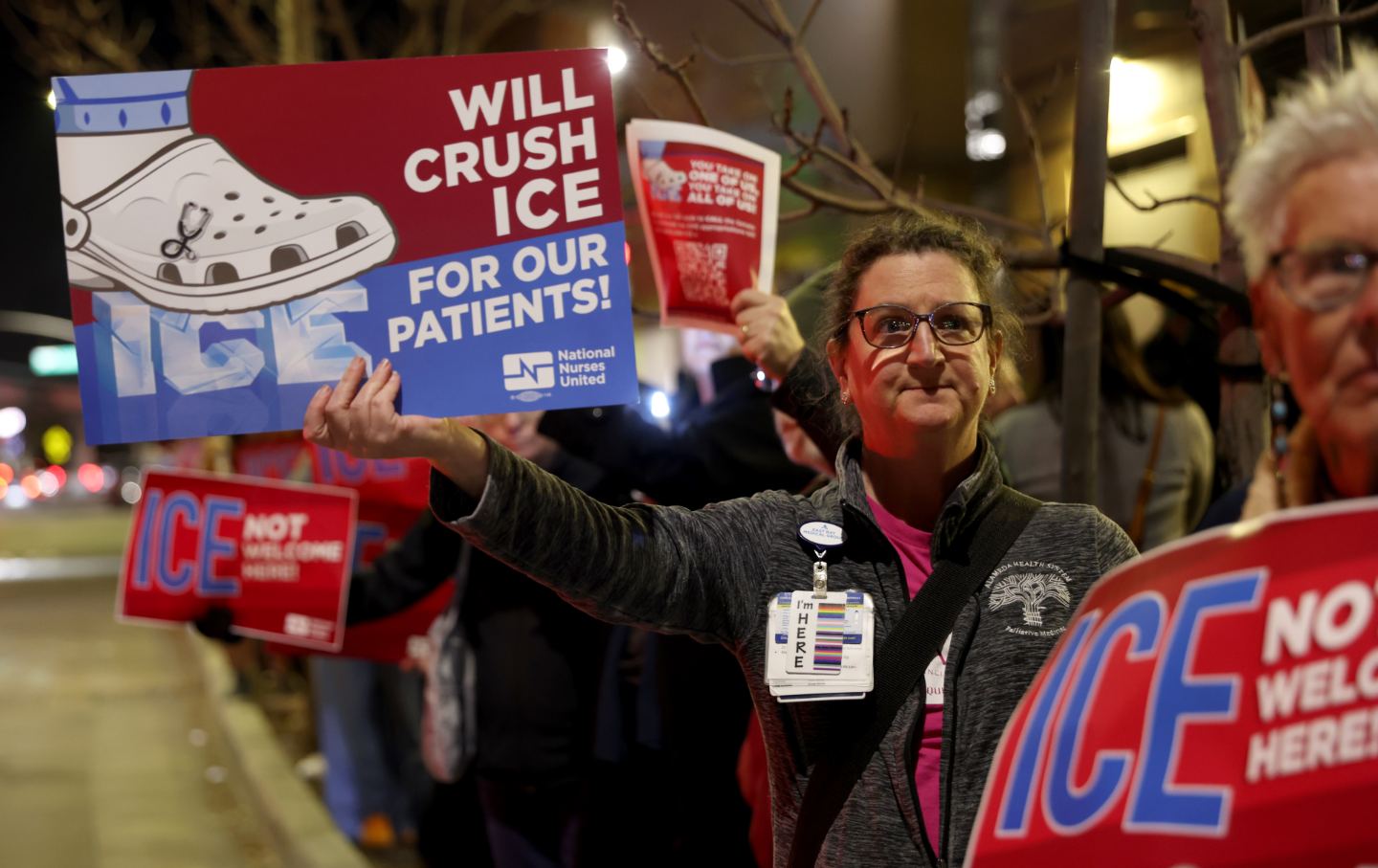
A Motto for All Health Workers: Resist, Resist, Resist A Motto for All Health Workers: Resist, Resist, Resist
Doing our work and keeping our heads down isn’t a victory. We need to fight this regime every day, in every way.
How Jane Fonda Is Rethinking the Hollywood Resistance How Jane Fonda Is Rethinking the Hollywood Resistance
The actress’s revived Committee for the First Amendment is taking aim at industry mergers as well as threats to the freedom of expression.
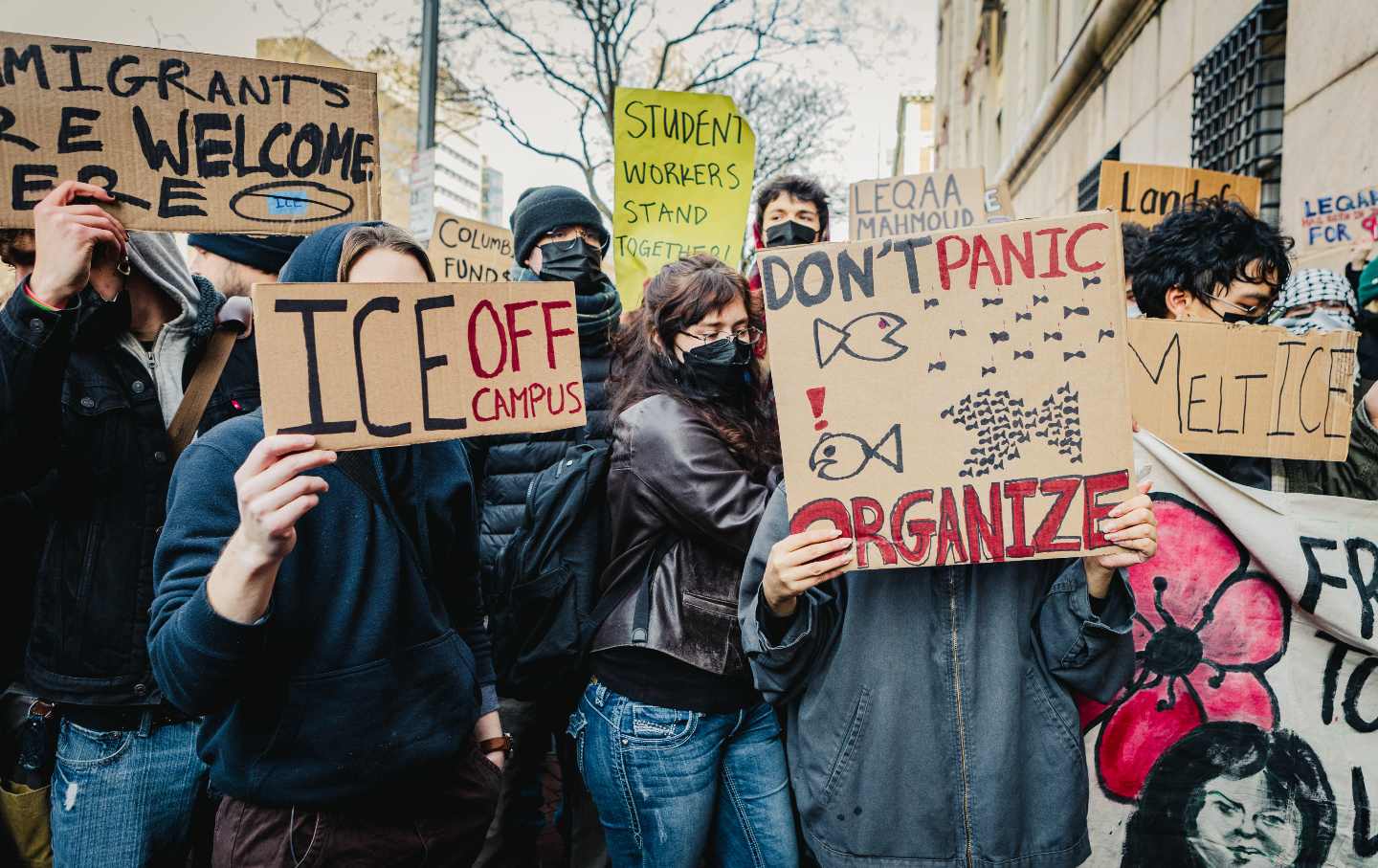
Inside the “ICE Off Campus” Movement Inside the “ICE Off Campus” Movement
Amid repression from the Trump administration, students nationwide are forming alliances with faculty groups, unions, and alumni to protect undocumented and international students...
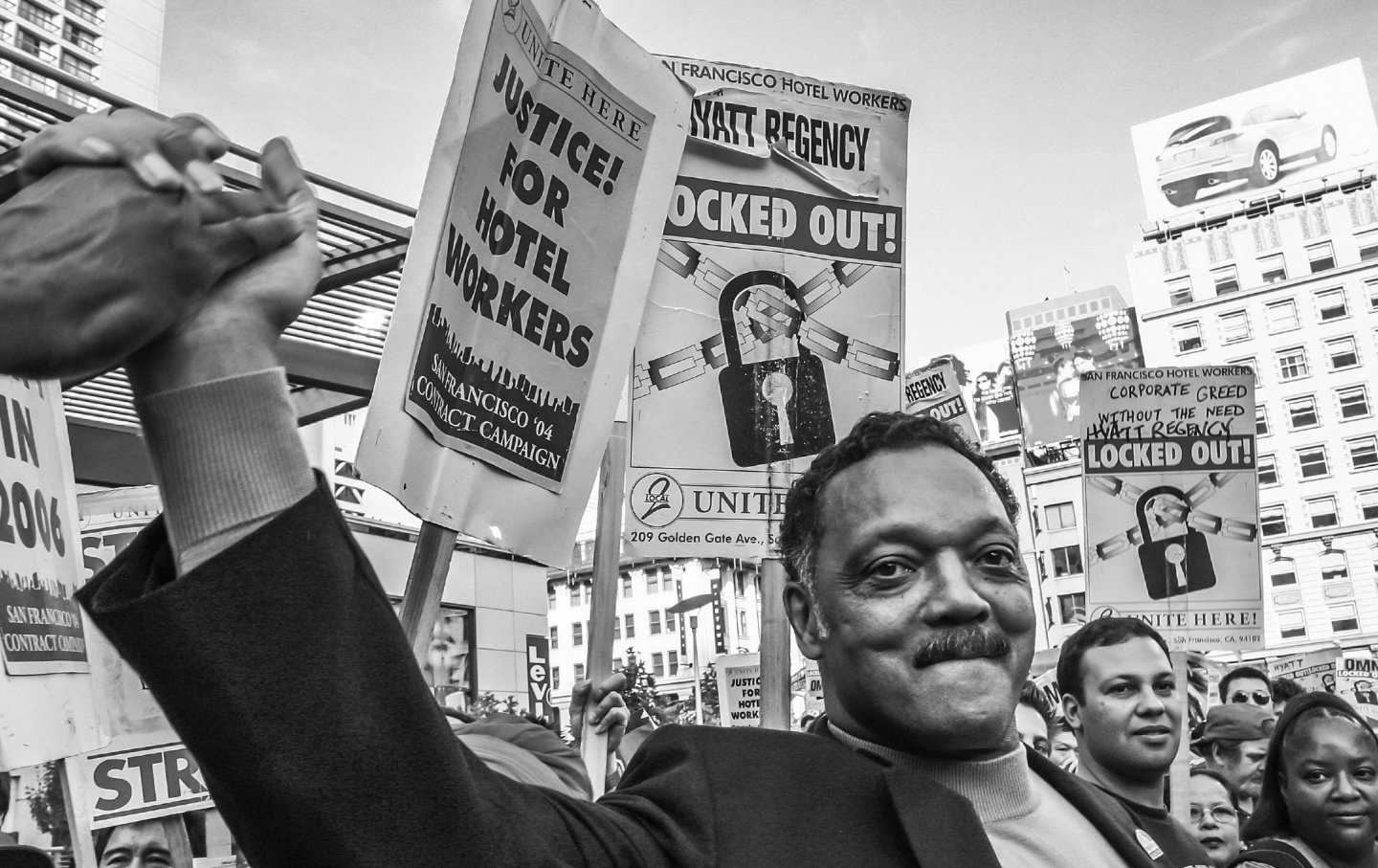
Jesse Jackson Still Provides Light in These Dark Times Jesse Jackson Still Provides Light in These Dark Times
We would be wise to follow the path he forged.
Jesse Jackson Gave Peace a Chance Jesse Jackson Gave Peace a Chance
The iconic civil rights leader, who has died at 84, made anti-war and pro-diplomacy politics central to his presidential bids and his lifelong activism.
ICE Melts in the Minneapolis Winter ICE Melts in the Minneapolis Winter
Now it’s time to abolish the agency and impeach Kristi Noem.

