
The Counteroffensive Against Operation Midway Blitz
How Chicago residents and protesters banded together against the Trump administration’s immigration shock troops.
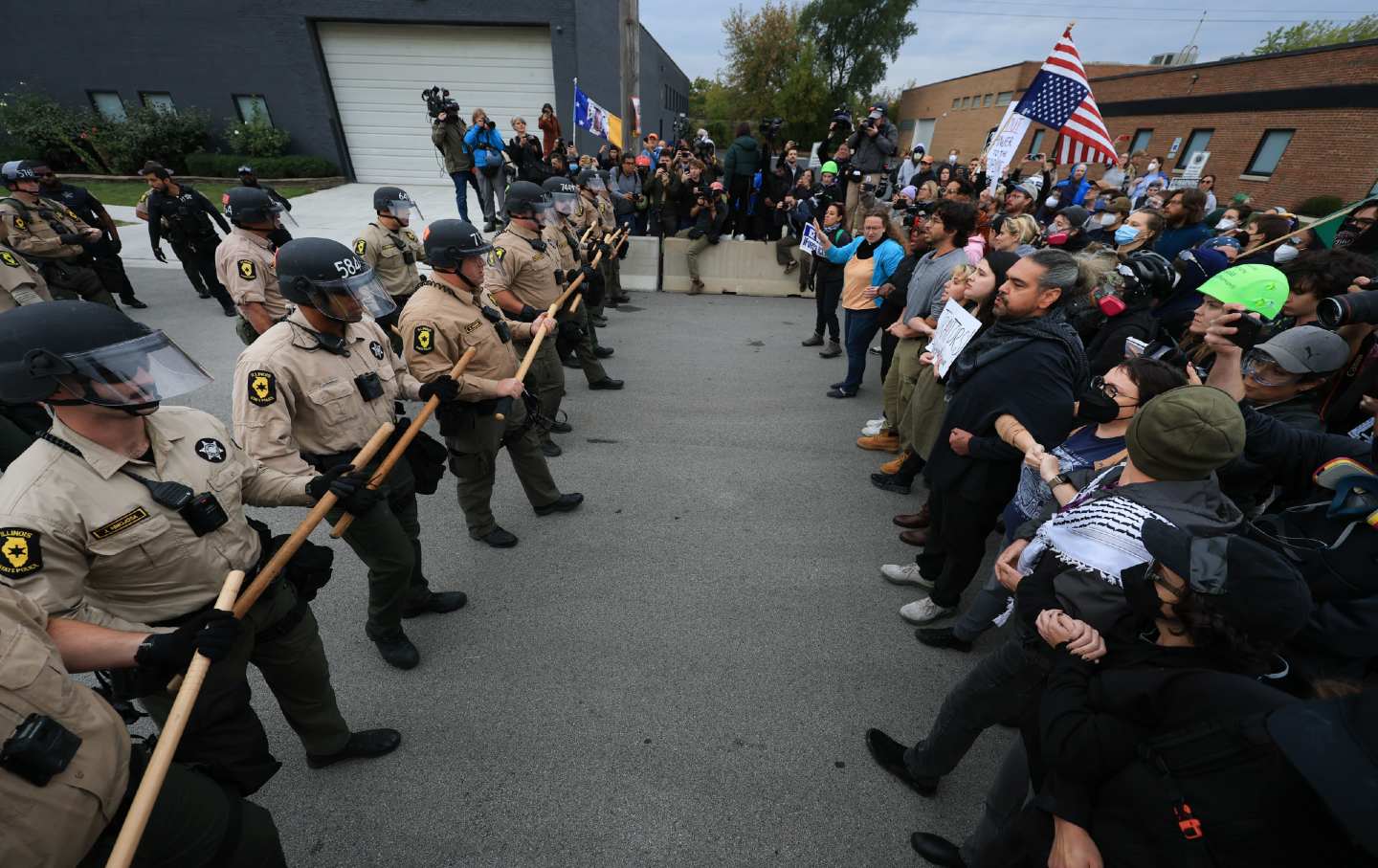
Protesters face off against border agents outside the ICE detention facility in Broadview, Illinois.
(Joe Raedle / Getty Images)Early Friday mornings in September, before most people have had breakfast, protesters outside of the ICE processing facility in Broadview, Illinois, were dodging projectiles from federal agents. By 7 am, Border Patrol agents would be tossing protesters to the ground, and blanketing the area, including homes and businesses, in tear gas. On Saturday afternoons, more protesters would show up—and the feds outside the facility would increase the show of force accordingly.
For the two months US Border Protection chief patrol agent Gregory Bovino led Operation Midway Blitz in and around Chicago, the suburban village of Broadview, a dozen miles west of the city, became a testing ground—not just for how the federal government could terrorize local communities, but for how people would fight back.
Facebook groups sprouted up early in Bovino’s reign of terror to track the movements of agents on the ground. But Laura Loomer, a far-right provocateur and close ally of President Donald Trump, complained about them, and Facebook’s parent company, Meta—one among a growing cohort of media empires now keen to do Trump’s bidding—started shutting some down.
But a host of new on-the-ground life hacks followed. In Chicagoland’s Hispanic neighborhoods, restaurants began locking their doors against potential immigration raids, letting customers in individually. Signal chats and Facebook groups enable the rapid distribution of 3D-printed whistles to alert residents that Bovino’s troops were nearby. This innovation soon spread throughout the Chicago metro area; the sight and sound of mobilized whistle-blowing activists became a routine feature of street life this fall. Local government officials reminded residents to always carry their whistles, and these informal citizens brigades were often the first warning of an immigration raid in many neighborhoods.
Most people refer to all immigration enforcement teams as ICE, but the most horrific actions in the Chicago area were carried out by Border Patrol agents. When guarding the ICE facility, CBP ran the show under Bovino’s direction, in conjunction with a hodgepodge group of officials from other federal agencies, including the Federal Bureau of Prisons and Alcohol, Tobacco, Firearms, and Explosives and ICE’s Homeland Security Investigations and Enforcement Removal Operations teams.
Outside of the facility, residue from gas and pepper balls coated everything. When the gates opened to let cars through, or to unleash the feds to carry out unprovoked attacks on protesters for social media content, the residue would follow in their wake, burning eyes and throats.
On Saturday, September 27, federal agents mustered their greatest show of force during the months-long siege at the facility. Nearly every time DHS agents opened the facility gate, they tackled people and arrested them. Once, as agents retreated, they knocked down Dana Briggs, a 70-year-old Air Force veteran who was not in their way. In a typical Kafkaesque twist, DHS then tried to indict Briggs on felony charges of assault and resisting federal agents; the pending complaint against him has since been downgraded to a misdemeanor.
The conflict came to a head that day when a group of protesters linked arms and prepared to defy Bovino’s order to stop blocking the road outside of the gate. Some wore respirators and goggles; many others wore glasses and N95 masks. Almost all looked terrified.
As soon as the agents opened the gate, they started yelling for people to move back to the end of the block—and began shooting pepper balls at the crowd. A thick layer of tear gas instantly overtook the protesters; the agents also fired canisters well past the end of the block at them as they retreated. The demonstrators weren’t prepared for this full-on assault; the ski goggles and vented work goggles that some had donned for individual confrontations with the agents outside the facility were completely useless. In the wake of the feds’ riot on the 27th, officers with the Cook County Sheriff and Illinois State Police began supplanting DHS agents outside the building.
DHS officers continued to fan out across Chicagoland to execute detention raids during Operation Midway Blitz. They were far and away the most dominant contingent of masked feds tackling and detaining landscapers, and demanding papers from working men unloading trucks in alleyways. A Border Patrol agent also shot a Hispanic woman who was a US citizen in her car after ramming it with his vehicle, and boasted about his marksmanship in a series of text messages with his colleagues. She was also arrested on charges of impeding a federal agent with a deadly weapon—namely, her car.
As CBP agents menaced Chicago area residents, caravans of protesters followed, honking their horns and blowing whistles. Protesters and journalists jumped curbs and cut through parking lots to follow CBP officials, while local police looked the other way. Protesters decked their vehicles out in anti-ICE flags, or scrawled things like “Bovino, you a BITCH” on the back windows of their pickup trucks. Bovino, for his part, seemed to love the theatrics and attention, striding through Chicago in what looked to be knockoff Gestapo gear. While many journalists covering the Broadview protests and the local raids experienced rough treatment at the hands of the CBP, Bovino himself was generally accessible to press inquiries; at one point he even conducted an impromptu interview with a reporter from the Chicago Tribune at a local gas station.
Now that Bovino and most of the CBP agents under his command have left the Chicago area, the protests at Broadview are much smaller and less animated. The Signal chats tracking federal raids are still active, but the chorus of warning whistles has mostly receded, as have the protest caravans. Restaurants are once more leaving their doors unlocked. Court proceedings that have yielded a striking paucity of criminal charges against detained Chicago residents suggest the entire operation was, like other federal raids unleashed in Democratic-led major cities, an exercise in state theatrics, meant to sow fear, shock, and awe in targeted populations. With that work mostly behind them, Bovino’s shock troops have moved on to warmer climes; protesters in Charlotte, North Carolina, are now thronging to their own Signal chats, and disbursing whistles and protective gear against tear-gas and pepper-ball assaults.
Become a Sustaining Donor This September
Between the reemergence of right-wing red-baiting and Donald Trump’s use of the chilling National Security Presidential Memorandum–7 to criminalize left political organizing, we’re seeing McCarthyism reborn before our eyes.
This assault on democracy cannot be ignored or wished away. Resisting it requires bravery in the face of threats and repression, a steadfast commitment to the truth, and the unwavering belief that we can—and will—overcome this darkness.
We must have an independent media that sets the record straight, unearths corruption and abuses of power, and advances a politics of justice and dignity for all if we’re to win this fight.
That’s why I’m writing to you today. This September, The Nation needs to add 100 monthly donors to sustain our progressive journalism. Your contribution makes the next investigative report, the next truth-speaking column, and the next pathbreaking essay all possible.
I hope you’ll support our work with a recurring donation today. If you donate $10 or more a month, we’ll send you a brand new “Hands Off the Free Press!” sticker to recognise your commitment to our cause. Please, donate today.
Onward,
Katrina vanden Heuvel
Editor and Publisher, The Nation
More from The Nation
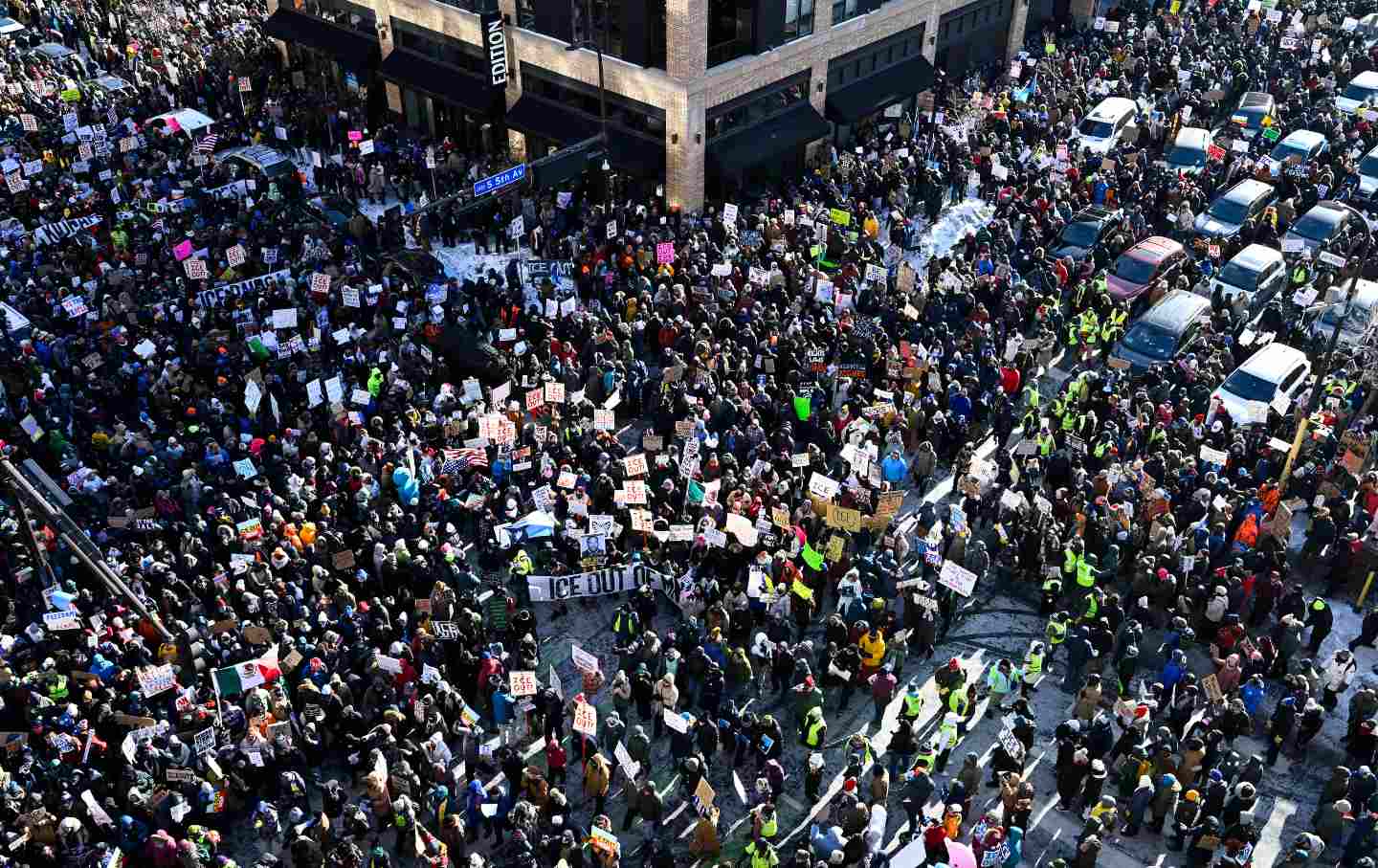
The Impossible Will Take a Little While: The Power of Persistence The Impossible Will Take a Little While: The Power of Persistence
In troubled times, history offers a lesson: Seemingly impossible change can begin with ordinary people who refuse to give up.
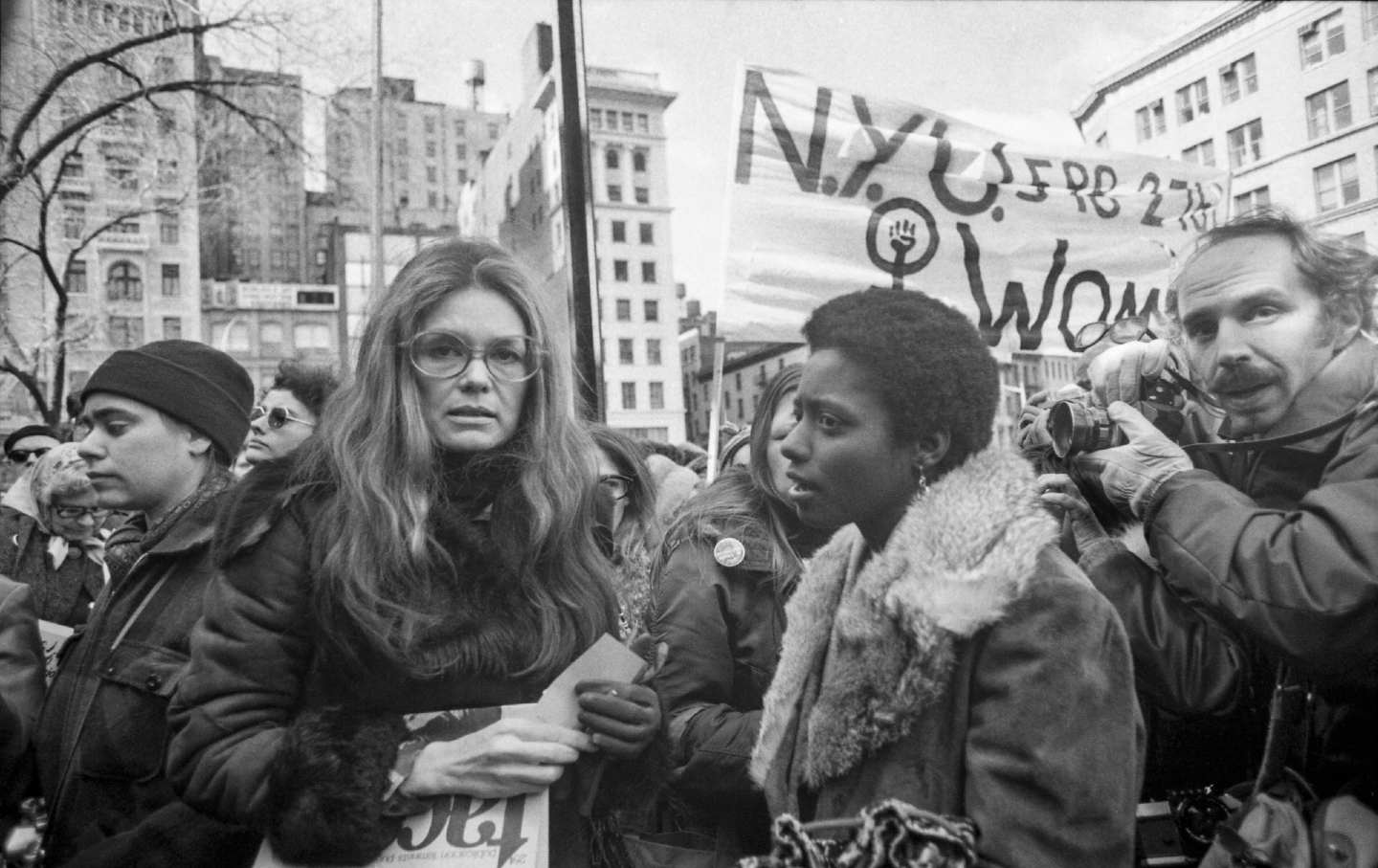
Gloria Steinem’s Many-Splendored Feminist Life Gloria Steinem’s Many-Splendored Feminist Life
The feminist icon lived the struggle for gender equality and always found time to lend support and solidarity to other women leaders, even in her final days.
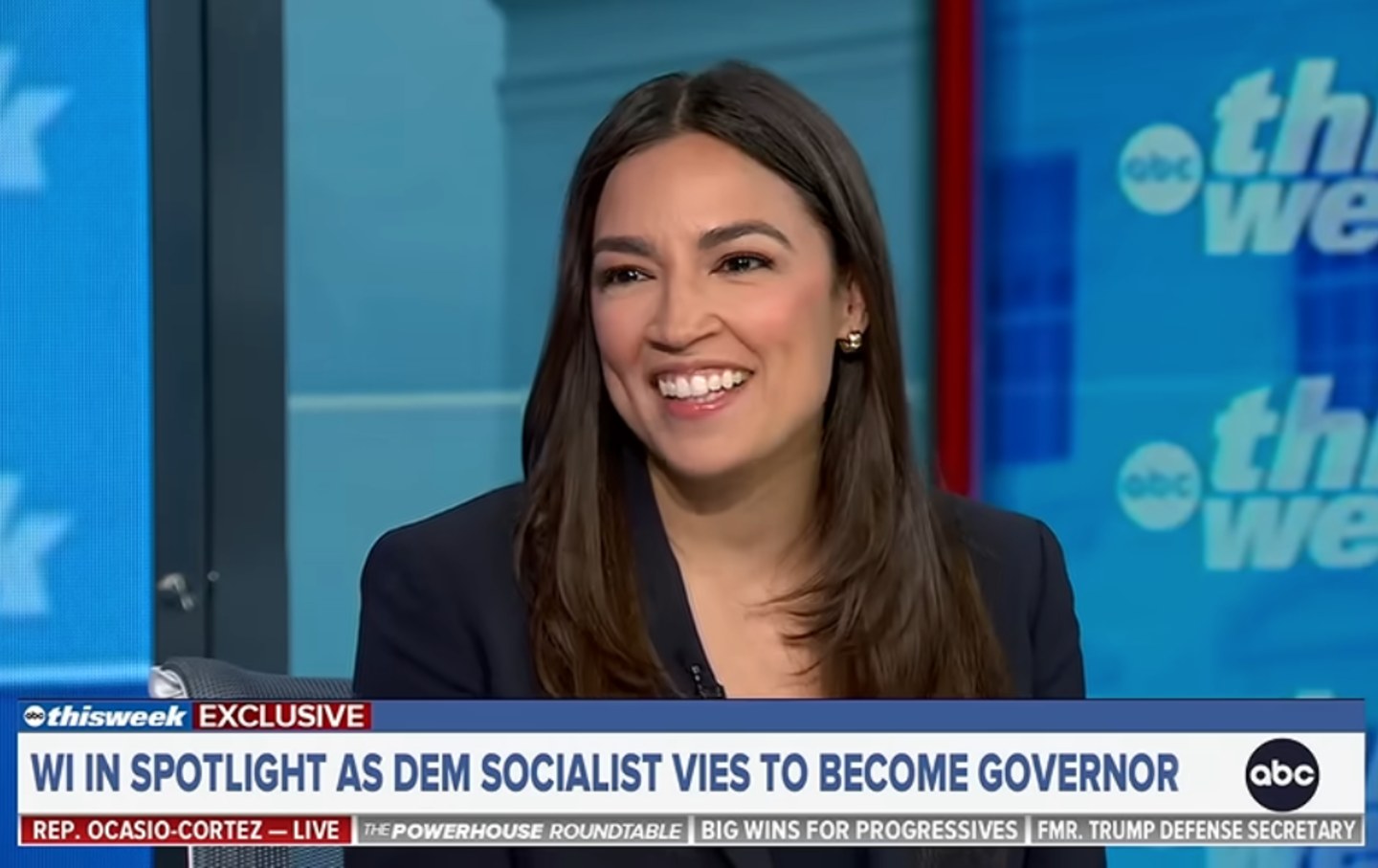
No, Woke 1 Was Not Crazy No, Woke 1 Was Not Crazy
AOC and others are laughing off 2020 as a wild, isolated moment. None of that is true.
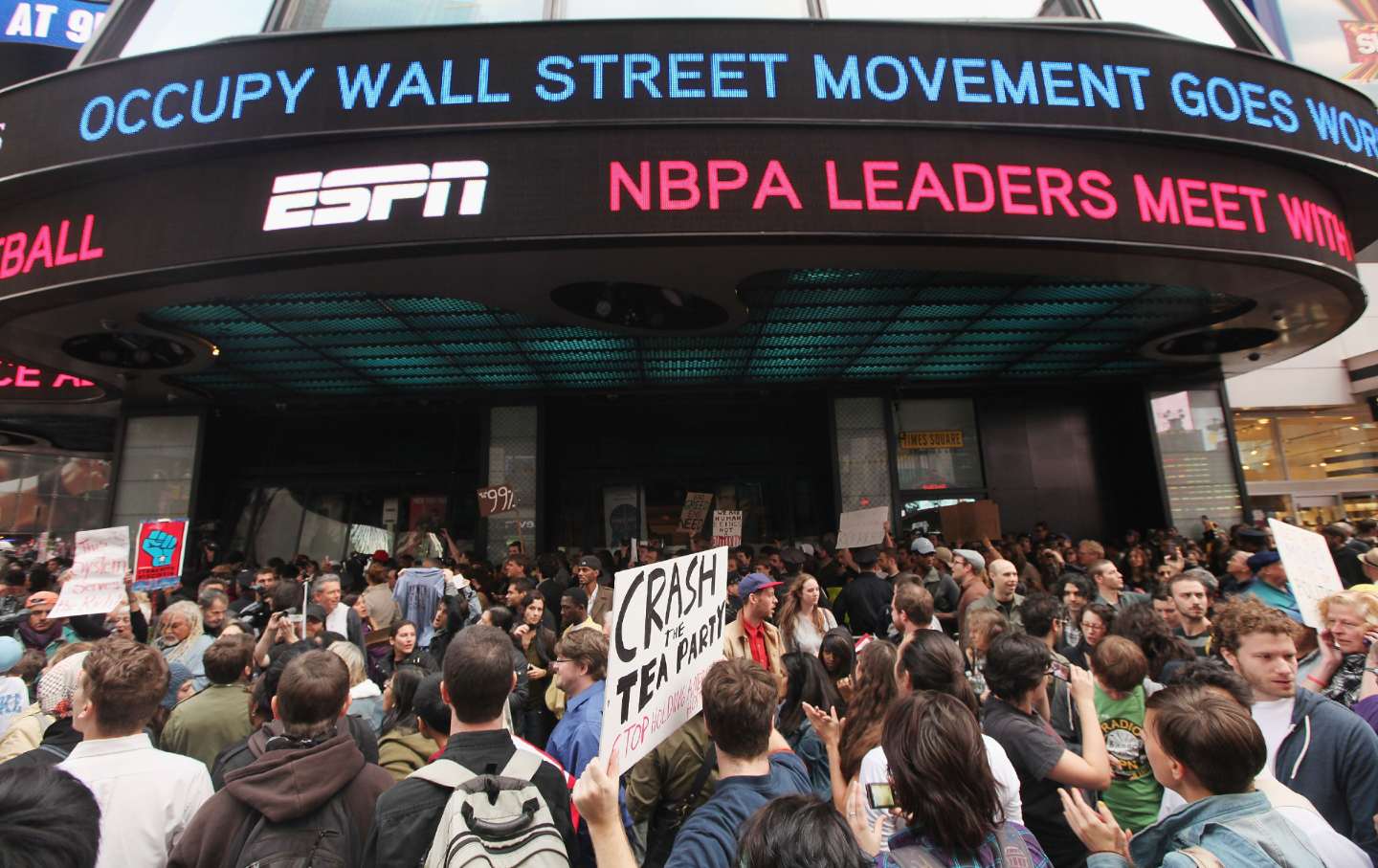
How Occupy Wall Street Still Explains Politics Today How Occupy Wall Street Still Explains Politics Today
It sowed the seeds for a new era of social movements—but its politics of powerlessness should act as a cautionary tale.
Abdul El-Sayed’s Win Is a Landmark. But the Fight Is Far From Over. Abdul El-Sayed’s Win Is a Landmark. But the Fight Is Far From Over.
Even though the Palestine movement is on the march, we can’t afford any complacency.
Mamdani’s Team Redefined Political Video. Now They’re Betting on Short Films. Mamdani’s Team Redefined Political Video. Now They’re Betting on Short Films.
Premiering exclusively in The Nation, a new short film produced by City Hall and narrated by Morgan Spector highlights the efforts of the biggest tenant-led union in New York City...

