
Fighting Book Bans in Kentucky Schools—and Beyond
The Boyle County School District quietly quietly banned more than 100 books, citing anti-trans bill SB 150. But a local campaign by students and their peers successfully pushed back.
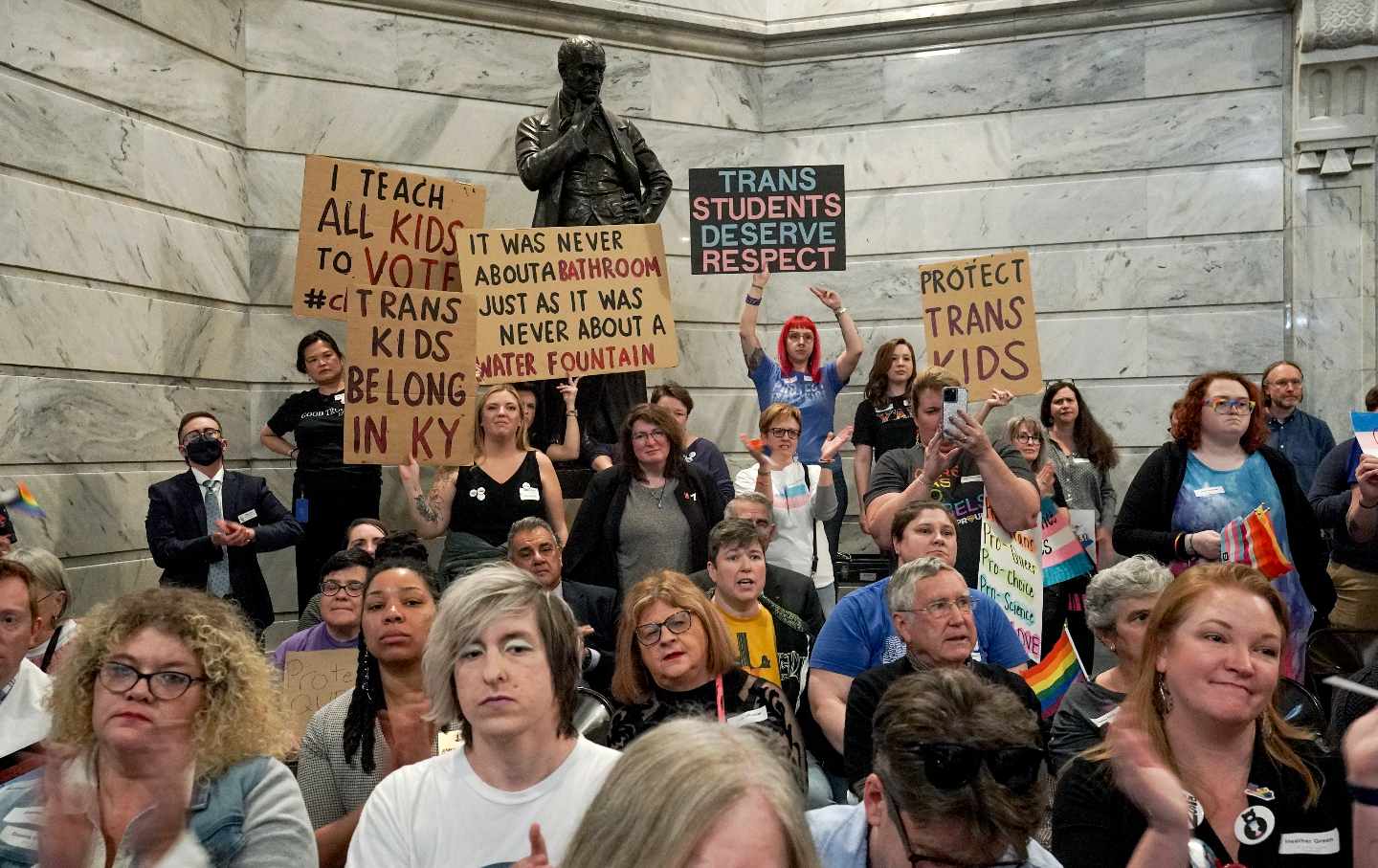
Activists in the Kentucky State Capitol protesting SB 150, which was cited by the Boyle County School District to ban more than 100 books.
(Bonnie Jo Mount / Getty)For this series, five young journalists responded to our calls for articles detailing critical issues that impacted young people this year. The group of high school and young college writers pitched and reported on urgent topics like lack of access to mental health support for homeschooled students, student voices being silenced in schools, book bans, attacks on LGBTQ+ students, and school shootings. Of course, these are just a fraction of the issues that shape the lives, conditions, and experiences of young people—not to mention how these issues intersect with each other. We received more important pitches than we could publish this round. As we close out the year, this package centers the work of young journalists reporting on what affected their schools, communities, and peers in 2023.
—Rainesford Stauffer
When Luisa Sanchez, a sophomore at the Boyle County school district in Kentucky, found out that her high school had quietly banned more than 100 books, she was shocked. Her district cited SB 150, an anti-trans bill signed into law in March 2023, partly designed to limit curriculum around gender and sexuality—the first district in the state to do so. Despite reporting extensively on the importance of banned books, she didn’t find out about the ban until her local paper broke the news. Sanchez, who knew about SB150’s implications, stated that she still “never thought it would be used as a way to weaponize literature.”
Fellow Boyle County High School student Callie Roessler, a junior, was one of the first students to be aware of the ban, having attended school board meetings with her mother. Concerned by the lack of student and community awareness of the book ban in her rural community, Roessler and a peer created the Instagram account @Boyle_Banned, to draw attention to the books being removed—all of which were related to or referenced sexuality, consent, and/or the LGBTQ+ identity. “I think the main thing was that they were hiding it—from the students and a lot of the parents.”
The sweeping Boyle County book ban is just one of the increasing instances of censorship in schools across the United States. Early data from the American Library Association (ALA) reports that the first eight months of 2023 saw a 20 percent uptick in challenged titles compared to the same reporting period in 2022.
Sabrina Baeta, a researcher with a Freedom to Read team at PEN America, says that organizations including her own, the ALA, and others like the National Coalition Against Censorship (NCAC), have come to the same conclusion: “that book bans are increasing, growing in scope, and targeting more areas in the country.”
Cameron Samuels, an executive director of Students Engaged in Advancing Texas (SEAT) and a student who got their start organizing against censorship in their school district of Katy Independent, says that while the issue of censorship often looks different in each community, “this extremism is a concerted effort to uphold an unjust status quo.”
Though book bans are more prevalent in the the South, they are still an issue coast-to-coast, “coordinated on a national level, but implemented on a grassroots, local level,” by a “vocal minority,” said Baeta. Resistance to these bans is also national, and many Southern students—who have experienced the brunt of some of the earliest impacts of the culture war—are at the forefront, sparking discussions around the deeper motives of the bans and the “nuance of censorship.”
Da’Taevyeon Daniels, a 17-year-old student from Fort Worth and 2023’s youth honorary chair for Banned Books Week, serves as partnerships director at SEAT, and has studied censorship with the NCAC. He argues that school book bans should not be decontextualized from a larger attack on public education. He points out that, in Texas, the politicians defending book bans are the same ones pushing forward-voucher bills, which are shown to effectively drain public school funding.
“Here in Texas and nationwide, the connection is so vivid and policy makers with these very radical ideas aren’t even trying to be discreet…it’s just a straight-up attack on public education in totality,” Daniels said. He also noted that individuals pursuing bans often use the guise of “parental rights,” but in reality, “they’re taking the voices of a small group of people and saying these voices matter more than anyone else’s.”
Daniels and Samuels point out that bans are often backed by PACs and national organizations prioritizing single-issue targeted attacks over broad-based community interests, while students are forging grassroots resistance to censorship among community stakeholders.
Anti-education and anti-LGBTQ bills like SB 150 in Kentucky have been effective at giving convenient cover for bans like the one in Boyle County. According to Baeta, amid the increasingly evident unpopularity of the bans, “vague legislation” such as SB 150 “offers no guidelines as to how it should be implemented…[and is] not transparent, but hints at what’s not allowed” and thus “primes a community for censorship.”
Roessler and her peers’ local campaign is a testament to this success: @Boyle_Banned gained hundreds of followers and sparked student and community awareness. The ban caught statewide attention, and according to Louisville Public Media reporting, a spokesperson from the Kentucky Department of Education stated that “the law doesn’t provide for books to be removed from a school library.” And on November 4, Boyle County announced a complete reversal of its ban.
Heightened awareness within the American public of targeted book ban efforts is what Baeta highlights as the most encouraging change she has witnessed over recent years. She continues to advocate for building that awareness from the ground up. “It’s such a national problem that people want to kind of attack the entire big monster,” she said. “There are very simple, very community oriented ways to help, and honestly, those have been the most successful.”
Support independent journalism that does not fall in line
Even before February 28, the reasons for Donald Trump’s imploding approval rating were abundantly clear: untrammeled corruption and personal enrichment to the tune of billions of dollars during an affordability crisis, a foreign policy guided only by his own derelict sense of morality, and the deployment of a murderous campaign of occupation, detention, and deportation on American streets.
Now an undeclared, unauthorized, unpopular, and unconstitutional war of aggression against Iran has spread like wildfire through the region and into Europe. A new “forever war”—with an ever-increasing likelihood of American troops on the ground—may very well be upon us.
As we’ve seen over and over, this administration uses lies, misdirection, and attempts to flood the zone to justify its abuses of power at home and abroad. Just as Trump, Marco Rubio, and Pete Hegseth offer erratic and contradictory rationales for the attacks on Iran, the administration is also spreading the lie that the upcoming midterm elections are under threat from noncitizens on voter rolls. When these lies go unchecked, they become the basis for further authoritarian encroachment and war.
In these dark times, independent journalism is uniquely able to uncover the falsehoods that threaten our republic—and civilians around the world—and shine a bright light on the truth.
The Nation’s experienced team of writers, editors, and fact-checkers understands the scale of what we’re up against and the urgency with which we have to act. That’s why we’re publishing critical reporting and analysis of the war on Iran, ICE violence at home, new forms of voter suppression emerging in the courts, and much more.
But this journalism is possible only with your support.
This March, The Nation needs to raise $50,000 to ensure that we have the resources for reporting and analysis that sets the record straight and empowers people of conscience to organize. Will you donate today?
More from The Nation
Jesse Jackson Still Provides Light in These Dark Times Jesse Jackson Still Provides Light in These Dark Times
We would be wise to follow the path he forged.
Jesse Jackson Gave Peace a Chance Jesse Jackson Gave Peace a Chance
The iconic civil rights leader, who has died at 84, made anti-war and pro-diplomacy politics central to his presidential bids and his lifelong activism.
ICE Melts in the Minneapolis Winter ICE Melts in the Minneapolis Winter
Now it’s time to abolish the agency and impeach Kristi Noem.
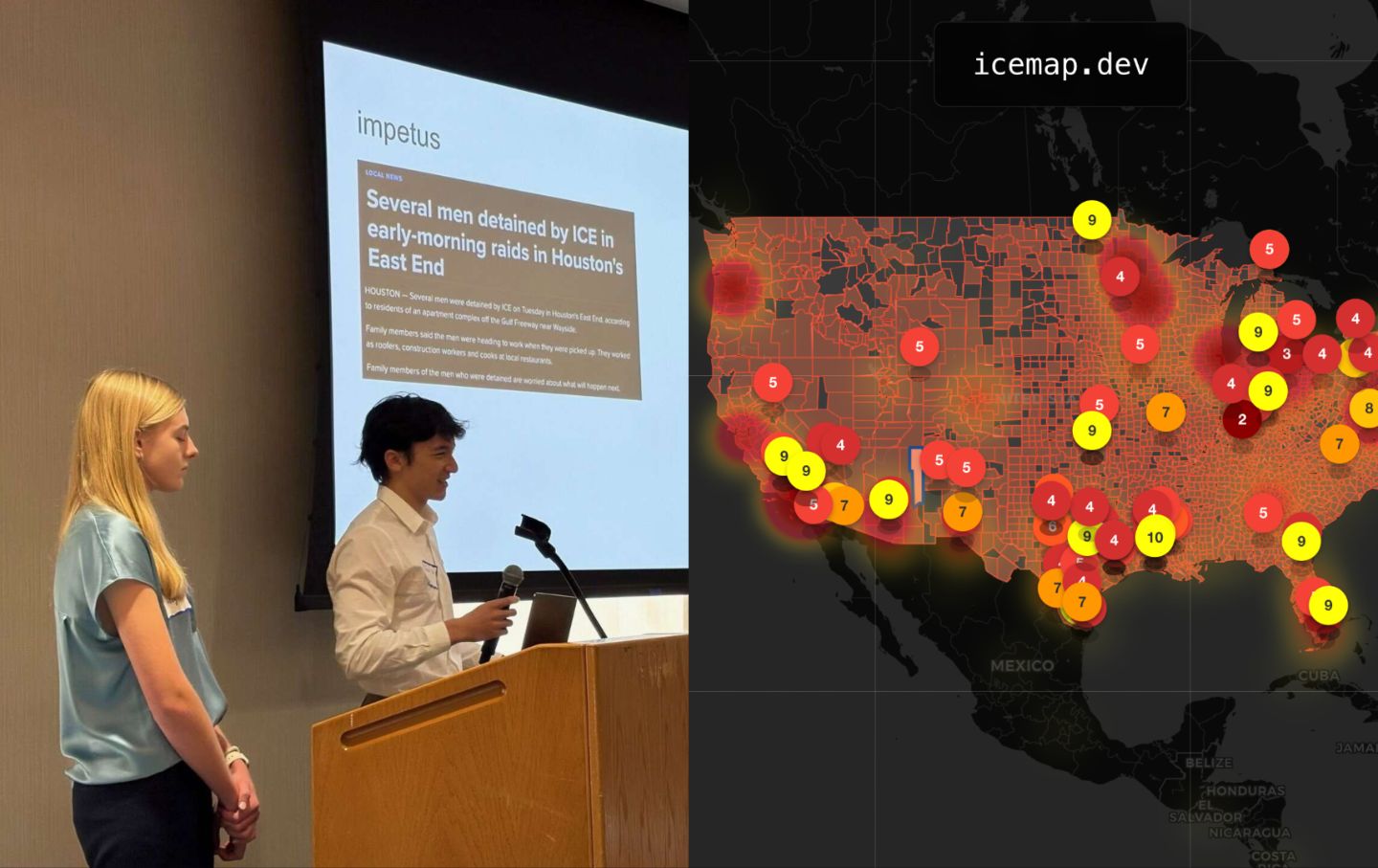
How 2 University Freshman Are Tracking ICE Enforcement Actions Across the Country How 2 University Freshman Are Tracking ICE Enforcement Actions Across the Country
With ICE Map, Rice University students Jack Vu and Abby Manuel hope to help communities understand where immigration enforcement activity is happening and how it unfolds in real t...
Meet the Young Organizers Survival Corps Meet the Young Organizers Survival Corps
Young organizers from around the country gathered at Haley Farm to study past social movements and train in the tactics of nonviolent resistance and grassroots organizing.
I Fled the US to Escape the Security State. Instead, It Followed Me. I Fled the US to Escape the Security State. Instead, It Followed Me.
My recent detention at Heathrow shows that the architecture of state repression knows no borders.

