
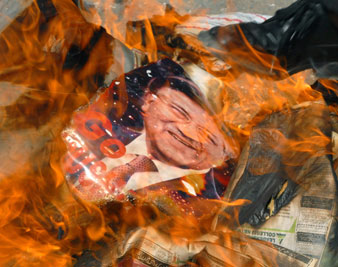
 AP ImagesA poster of Pakistan’s President Pervez Musharraf is burned by lawyers during rally in Multan, Pakistan on Aug. 18, 2008.
With the resignation today of President Pervez Musharraf, a new political era in Pakistan and a forthcoming national election in India would seem to promise hope for reopening in a serious way the question of what to do about Kashmir. In this Himalayan region of romance and myth, the two now nuclear-armed countries have faced off for almost sixty years, sporadically shooting across a “line of control” that serves as a tenuous border.
What kind of crisis is this? An Islamic rebellion? India (and some Pakistani hotheads) would like the world to think so, for different reasons. That explanation has resonance among Islam-shy anti-terror warriors as well as among international jihadists. The Kashmiris, a mix of Muslims, Hindus and some Buddhists, see it differently, none more so than the indigenous Muslims of the Kashmir Valley.
This week, thousands of Kashmiris in the Muslim-majority valley have been marching to demand that the United Nations intervene after Indian troops opened fire on protesters, killing a moderate separatist leader and at least twenty-one others, marking a resurgence in violence not seen since 1989-1991. Tens of thousands of Kashmiris have died since then, many other have disappeared.
Keeping a lid on the unfinished business of Kashmir is the mandate of UN’s second-oldest peacekeeping mission, established in January 1949 and still technically active, though just, with a total staff of 116 people and almost no room to maneuver. Over six decades, the UN has never been able to conduct a referendum among Kashmiris. India flatly denies one is needed and rejects any outside interference. It claims its part of the region as the integrated Indian state of Jammu and Kashmir. Pakistan maintains the fiction that its part, Azad (Free) Kashmir, is an autonomous entity with its own government.
The United States, numerous other countries and the United Nations do not recognize either Indian or Pakistani control, a conveniently forgotten reality. To the world this is still occupied territory. To the Muslims of the Kashmir Valley, it is a former princely state whose people were robbed of their right to choose their future at the breakup of British India in 1947. It remains a restive ethnic and cultural enclave in search of independence or something close to it. Think Kosovo, South Ossetia, Abkhazia, East Timor, Tibet.
Popular
"swipe left below to view more authors"Swipe →
In July, before Musharraf’s resignation became inevitable and violence reignited in the Kashmir Valley, sparked by a dispute between Hindus and Muslims over the ownership of property around a Hindu shrine, the polling organization World Public Opinion, part of the Program on International Policy Attitudes at the University of Maryland, released some thought-provoking if not astonishing findings about opinions on Kashmir among Pakistanis and Indians.
The poll was a small one–907 face-to-face interviews in Pakistan and 1,275 Indians, both in urban areas–and there are always questions about how much polls in developing countries reflect only elite opinion. Nonetheless, some of the findings were unexpected. In India, for example, only half the respondents rejected the idea of independence for Kashmir, while 29 percent thought it tolerable (15 percent), acceptable (8 percent) or even desirable (6 percent). Forty-five percent of Indians polled did say that given a free choice, Kashmiris would probably opt to stay in India, and only 10 percent said Kashmiris would choose independence. But 51 percent said that if the Kashmiris demanded independence, they would accept that.
This relatively relaxed attitude toward Kashmiri aspirations reflects what journalists working in the region have often heard across India beyond the Jammu-Kashmir region; that is, that Kashmiris are “different” from Indian Muslims, and their quarrel with New Delhi is not only not a threat to the Indian nation but should have been handled better politically to head off the bitter and now possibly irreconcilable alienation among Kashmiris.
The Indian government regularly makes the opposite argument: that keeping the only Muslim majority region within India, even with considerable military force, somehow certifies Indian secularism and tolerance. Yet the new poll results (the survey was taken late last year) show that 29 percent of Indians thought that the Indian government was not very effective, or not at all effective, in assuring the safety and security of Muslims. Interestingly, only about half of Pakistanis thought Muslims in India were not adequately protected, and a surprising 36 percent said that India was “very” or “somewhat” effective in assuring safety for Muslims.
Pakistanis, not surprisingly, strongly reject the idea of Kashmir remaining part of India, but fewer than half of those polled approved of trying to wrest Kashmir from Indian control militarily. There has always been some ambivalence on the future of Kashmir in Pakistan, especially among officials. War with India would be suicidal and independence for Kashmiris would take a big chunk out of Pakistan as well as India. Pakistanis often seem to take the attitude that there is something to be said for just fueling the anti-Indian fire among Kashmiri Muslims without actually bringing the issue to a conclusion that could redraw too many maps.
What do all the numbers mean? That if politicians in both India and Pakistan would stop grandstanding over Kashmir while making everyday life intolerable for Kashmiris–India with military repression and well documented human rights abuses, and Pakistan by encouraging and supporting the most violent extremists–there is some encouraging public opinion to work with on both sides. The ground for just solutions is there, only the political leadership is missing.

