
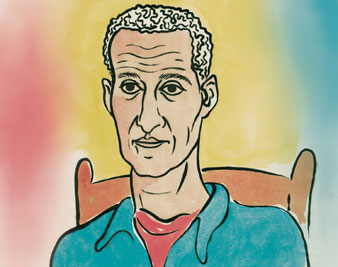
 Adrian Bellesguard
Moviegoers know John Turturro as a character actor who’s as comfortable in bowling shoes or police blues as he is behind a typewriter or under game-show lights. He’s no small fry as a director, either–most recently of the film Romance & Cigarettes, which he also wrote. Until May 18, he’s appearing as Hamm, a blind man who can’t stand up, in the Brooklyn Academy of Music’s production of Samuel Beckett’s Endgame. —Christine Smallwood
How did you get involved with this project?
Last year BAM was thinking about putting together a company, and they talked to me about it. This is one of the plays they were thinking of doing, under Sam Mendes. The whole thing fell apart, but I recommended Andrei Belgrader, who was my teacher at Yale and who I’ve worked with before–I did Waiting for Godot with him and Tony Shalhoub.
I didn’t know Tony Shalhoub did Waiting for Godot.
Tony’s worked with Andrei a lot. And a good friend of mine has always been a big Beckett fan. When my wife and I got married, he was my best man, and I asked him to read something, and he read an excerpt from Malone Dies about these two old people having sex. It’s a wonderful thing about these two old people trying to have sex and they both were never beautiful, and she says it doesn’t really matter, we’re less hideous than we used to be. She has a great line where she says there are pears that ripen only in December, and this is us. Everyone was on the floor dying laughing when he read this. The older you get, the more you realize how realistic his plays are. They just kind of strip down–or everything is taken away–and what’s left is the bare bones. I could easily rehearse this play for three months, and I would not be bored at all.
It’s not draining?
It’s really draining–five pages or ten pages is like a whole play. I’ve been reading it for the last year. You have to descend, as Beckett says, into the core of the eddy. You have to go down, you can’t go out always. He’s amazingly good. He can be so profound and so cheap. It’s just great. Once you’ve been through life and loss and all this and things…. Also, you realize people who are outside of society, whether they’re sick or mentally ill, they understand what it is to be looking in and not have all that stuff in the way. The play really deals with that: when everything’s taken away, what really do you have? You have another person, maybe, to torture or to love, or to both. As Clov says, Why should I stay? Hamm goes, “The dialogue.” It’s quite humbling, actually, to do it the way [Beckett] wanted it done.
What do you know about the original manuscript? Is it very different from the version most of us know?
It’s two acts. He distilled it. They read from the Bible. They read the story of Noah. [Hamm] says, Now I’m in the mood to procreate, and he calls for his girl, and Clov leaves and comes back dressed as the girl. And Hamm says, I really don’t want to have sex because I don’t want to procreate. But obviously their relationship is father, son, husband, wife.
You’ve been drawn to this kind of humor your whole career.
It’s my kind of humor, really. That other kind makes me laugh from my neck up. I like the human comedy. You know, life really is a tragedy, because in the end we all die, but the day-to-day existence is really a comedy. That’s when something’s at its best, when it’s not one thing or the other. It’s like we were saying yesterday, there’s people dying all over the world and somebody sprains their ankle and says, Look how bad my suffering is. And [Beckett’s] very aware of that stuff. I suffer more than you, ’cause it’s mine. It’s horrible. Babies do that and little kids do that and adults do it, too.
You’ve said that today you “don’t see people…struggling with their problems in a movie” like you used to.
When you answer everything, it’s not as interesting. You give a false thing. We all like to have that sometimes, but when everything does that and you see people who are always equipped to handle something, it just does a disservice to your own problems. It’s good to reach for something, because you start to understand that the great thing about a story is that it’s not just a diversion. Take a story like Dr. Jekyll and Mr. Hyde–you see that every day. You see that in the story of Eliot Spitzer. That’s what great things are. People equate popularity with something being great or something being good. It can take a while for people to catch up to it. Beckett is an example of that. A movie like Nights of Cabiria is related to what I’m doing in a play. No matter what, at its worst, life goes on. It’s a tragic comedy with a great kind of Chaplinesque ending. These things are all related. I see people today trying to be great, and you can’t be great without being human.
How is it, sitting so much?
My ass hurts, I’m telling you right now. They’re going to have to give me a softer cushion.

