
We Stomped All Over the Patriarchy on Tuesday Night
Almost everywhere, abortion rights initiatives won, and pro-choice candidates prevailed. Even in Idaho, where they didn’t, women are taking heart.
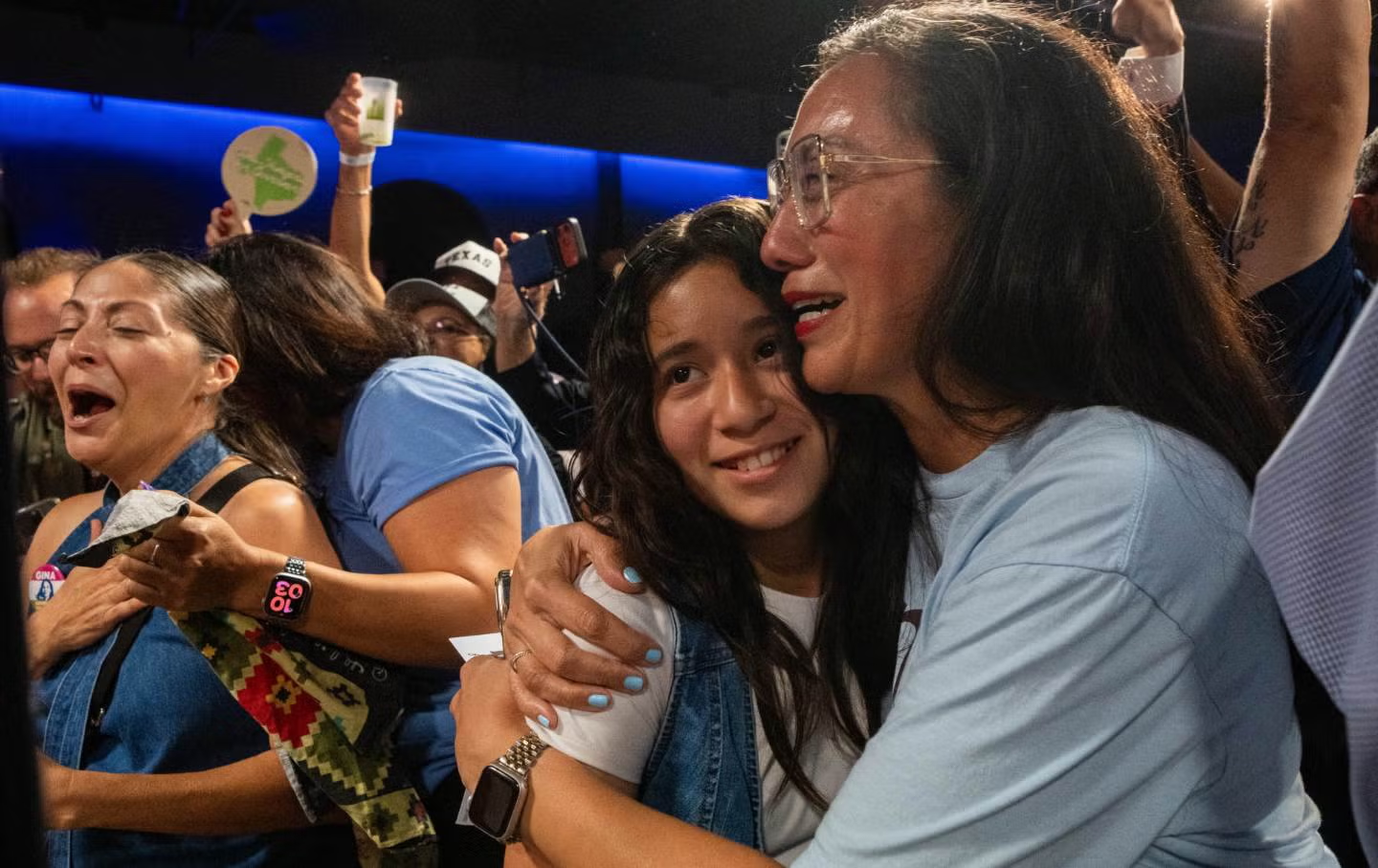
Delia Garza hugs her daughter as Gina Hinojosa is announced as the next governor of Texas at her election watch party in Austin.
(Mikala Compton / The Austin American-Statesman via Getty Images)I’ve always wondered what smashing the patriarchy really feels like, and on Tuesday night, we found out.
Up until then, the patriarchy had been on quite the winning streak, so much so that a newly surfaced rape allegation against the sitting president was hardly a news story. Then, on Tuesday, we got to watch a child sexual abuse survivor defeat the Republican challenger who called her a liar in the Ohio governor’s race. We got to see Max Miller, an Ohio Republican whose ex-wife accused him of holding a gun to her head while she changed their toddler’s diaper, lose his seat in a former Republican stronghold. We got to see Texans elect a Democratic Latina governor from Brownsville, Gina Hinojosa, who ran an ad about her decision to carry a nonviable pregnancy to term—and used that horrific ordeal to defend the right of Texans to choose. A Tennessee woman denied an abortion under the state’s ban won a state House seat; Virginia, Missouri, and Nevada voted to protect or expand abortion rights; and Maine Senator Susan Collin was ousted in large part because of her vote to confirm another accused rapist, Brett Kavanaugh, to the Supreme Court.
But there were exceptions to the trend, including the success of anti-trans ballot initiatives and the defeat of an abortion rights initiative in Idaho, a state that, in the midst of the blue tsunami felt, as Idaho-based reporter Kelcie Moseley-Morris put it to me, like an “island of sadness.”
Related Articles
“It was a great night in this nation for a rebuke” of patriarchy, Melanie Folwell, executive director of the ballot initiative campaign Idahoans United for Women and Families, told me. “But here in Idaho, where we had two of the wealthiest, most powerful patriarchies in the world—the Catholic Church and the Mormon Church—and then the supermajority Idaho GOP, my God, patriarchy won the day.”
Proposition 1 would have enshrined in Idaho statutes a right to abortion up until viability. But 56 percent of voters chose instead to keep the state’s near-total abortion ban. It was a gutting loss in a state where more than a third of the state’s ob-gyns have left or stopped practicing since the ban took effect, and where the campaign shared harrowing stories of women traveling to terminate nonviable pregnancies, getting med-flighted to neighboring states while miscarrying, or bleeding out while doctors whose colleagues have fled the state scrambled to save them. “I feel like the women and families and doctors were so brave telling their stories,” Suzanne Gallus, a Catholic mom of seven who knocked 1,289 doors to support Prop 1, told me. “For people to just ignore all that is especially hard to take.”
Folwell said the campaign faced uniquely strong headwinds, including an influx of new Republican residents that have turned the state into one of the country’s reddest and a convoluted explanation of the meaning of a “yes” or “no” vote that was attached to the ballot by the Republican secretary of state. The Mormon and Catholic churches donated a combined $1.3 million to an anti-abortion PAC that ran a barrage of ads in the final weeks of the campaign claiming that the proposition’s “fine print” would redefine fetal viability to exclude premature newborns who needed oxygen, allow “late-term abortion on demand,” and let minors get abortions without parental consent. The claims were false; the initiative didn’t repeal the state’s existing parental consent laws, and it would have allowed the state to ban abortion after fetal viability except in medical emergencies. But the ads forced canvassers like Suzanne Gallus, a Catholic mom of seven, to have uncomfortably technical conversations about fetal viability at the doors.
“For crying out loud, I’m not a doctor; I’m not a lawyer,” Gallus told me. “I know how to explain that, but then you’re getting into the weeds, and when you get into the weeds like that, I think you do more damage than you do good.”
Folwell said the initiative also suffered crucially from a lack of support from national organizations who balked at the fact that it could be repealed by the Republican legislature. The dozen or so abortion ballot initiatives that have passed since the Supreme Court overturned Roe v. Wade in states ranging from Ohio and Arizona to Virginia and Vermont have all been more enduring constitutional amendments, not statutory provisions, but Idaho does not allow voters to initiate constitutional amendments.
“There was a lot—from national groups— a lot of gnashing of teeth about, ‘Oh, well, it could just be statutorily overturned,’ before it was even won, and a lack of investment and care because of this silly gamesmanship about what’s next, rather than focusing on tangible movement-building and wins to get things done,” Folwell told me. “And I’m [feeling] pretty crappy about it.”
But Folwell felt proud of the 2,500 or so volunteers who powered her campaign.
“The most important story out of all of this is the degree to which there are thousands and thousands of women in this state who feel less alone,” Folwell said, her voice breaking. “And that’s from people who survived something terrible to people who found community in advocacy, and that all has meaning.”
“They may have been let down in myriad ways by people in the state and outside the state, but they showed up for each other.”
Among those who showed up was Whitney Montgomery, the daughter of the architect of Idaho’s abortion ban. Montgomery drew audible gasps during a Prop 1 rally when she revealed that she was the daughter of David Ripley, who has built his anti-abortion lobbyist career on an origin story about his objections to his ex-wife’s abortion. Montgomery’s childhood memories of her dad include his stint in jail for failing to pay child support to her mother—whom he divorced before later marrying the woman who had the abortion.
“I have spent years trying to understand how someone can dedicate his life to ‘saving babies’ while ignoring one of his own,” Montgomery wrote in an op-ed for the Post Register about her decision to support Prop 1. “By his own public admission, he was a cruel and abusive husband to many of his wives. As a child, I remember hiding in a bathroom with a phone nearby, ready to call 911 if things got worse.”
I interviewed Montgomery on election night, after she had just voted at her son’s elementary school; she’d brought her 3- and 6-year-olds to the polls as part of a family tradition, and that night, they were going to make Barack Obama’s chili recipe. Montgomery conceived through IVF, another reason s he objects to the agenda of her father’s political party, which opposes it. When I told her that her decision to stand up to her father—who has admitted being a “jackass” to the wife who had the abortion—felt like a symbol of the stakes for this entire election, she agreed.
“It comes down to punishing women and having that control,” Montgomery said. “He feels like he was wronged by a woman, and now it’s this punishment to women’s health.
“It’s wild.”
(David Ripley didn’t respond to my calls for comment for this article. I did speak to his fourth wife, Wendy, at 10:15 am on Election Day. She told me her husband was still asleep. They’d had a late night; among other things, they were fending off teenagers from the nearby high school who kept stealing their anti–Prop 1 yard signs.)
Popular
“swipe left below to view more authors”Swipe →But outside of Idaho, women won the day, and even from the island of sadness, Montgomery felt like she was part of it.
“It was a sad night for Idaho but I’m so happy for the rest of the country and the progress that is being made,” Montgomery texted me on Wednesday. “I truly believe this fight is not over. It’s just the beginning.”
Indeed, Folwell’s critique about a lack of investment from national groups who saw Idaho as a lost cause echoed what I heard in 2021 from abortion rights advocates in Texas, who felt under-resourced, isolated, and ignored as they fought a Republican legislature that banned abortion at six weeks. To see Texas turn blue on Tuesday after the most highly invested-in Senate race in history, to see a new Democratic attorney general–elect pledge to drop lawsuits against out-of-state abortion providers, while a pro-choice Latina takes the governor’s office is a reminder that all progress is incremental, until it’s not. Before a wave grows big enough to smash the patriarchy, it starts with ripples too small to detect.
Gallus said she would keep making those ripples with the women she’d met through the campaign.
“Cultivating these little seeds here and there is really important when you’re in a place that is very extreme, because this is our home,” Gallus told me in an emotional interview on Wednesday.
“If Texas can do this, then maybe we can, too; it’s just going to take longer.”
More from The Nation

Democrats Would Be Insane Not to Break With Israel Now Democrats Would Be Insane Not to Break With Israel Now
The party has an unequivocal mandate to fundamentally change the US-Israel relationship.

Actually, Democrats Don’t Have to Sacrifice Trans People or Immigrants to Win Actually, Democrats Don’t Have to Sacrifice Trans People or Immigrants to Win
For two years, leading Democratic factions have insisted that the party must abandon key populations to win. Tuesday proved them wrong.

David Sacks’s Sack of Lies David Sacks’s Sack of Lies
Trump’s adviser pushes AI without guardrails.

After the Celebration, Some Key Lessons From Election 2026 After the Celebration, Some Key Lessons From Election 2026
Populist messages and populist candidates won.
How These Midterms Can Guide Us Into a Post-Trump Political Future How These Midterms Can Guide Us Into a Post-Trump Political Future
The historic repudiation of the MAGA right at the ballot box opens up new avenues to democratic revival.

Gen Z Postcards From a Stunning Election Night Gen Z Postcards From a Stunning Election Night
We asked students from battleground and safe states to describe what it felt like to witness the 2026 midterms blue wave.

